Why Do Financial Crises Happen? (S1E11) Transcript
Listen on:
Apple
YouTube
Spotify
Samantha [00:06]: Hi, I’m Samantha Yap, and I help blockchain and cryptocurrency companies tell their stories. I’m really passionate about demystifying emerging technologies and making it easy to understand for everyone.
I’m embarking on this journey to discover the history of money, in order to better understand where money is heading today. In this series we’ll explore why Bitcoin, digital currencies, and decentralised finance may play an important role in our future.
Come join me on The Story of Money, by YAP Cast.
A Pandemic Crisis?
Samantha [00:42]: What is a crisis - financially and economically speaking? How do we know when one is coming, and when we’re in one, and when we’re out of one? In fact, how come no one seems to see them coming until it happens? And who is responsible for the crisis, and for fixing it? Who do we blame, hold to account, put in jail, or make pay for the mess? It turns out, these are hard questions to answer. When we do realise we’re in one, we even give them names. The Asian Financial Crisis, for example. Some of them end up as Broadway shows, like the Lehman Trilogy featuring the 2008 global financial crisis. And back in the 1920s, we all know what people are talking about when they mention the Wall Street Crash and the Great Depression.
But what about the COVID-19 pandemic for example? Is the pandemic a financial, economic, or market crisis? Carmen Reinhardt, author of “This Time Is Different” and chief economist of the World Bank, has called this ‘the quiet financial crisis’, pointing out that some aren’t as dramatic as the media headlines make it out to be. There’s plenty of politics, death and chaos, but the bankers are still wearing their suits (at least the top half) for their Zoom calls. Carmen’s conclusion: “In addition to these trends, a quieter crisis is gaining momentum in the financial sector. Even without a ‘Lehman’ moment, it could jeopardize prospects for economic recovery for years to come.” This doesn’t sound too good. When the World Bank’s chief economist is scared about getting out of bed in the morning, we know something is not right.
Samantha [2:30]: Which begs the question, what is a financial crisis, and why does it happen? What actually causes them? Is it just 'boom and bust’? Does it take a war or a plague? For centuries, economists and monetarists have offered theories for how financial crises develop and how they can be prevented. But yet, they keep happening from time to time. So can we stop them from happening? Carmen’s work, interestingly, suggests that financial fallouts occur in clusters, and the real problem is our short memories, making it all too easy to get into the same rut all over again. So can crypto and DeFi reduce this sequence of crises? Advocates of crypto and DeFi claim this time is different, but are we just replacing one vicious circle for another?
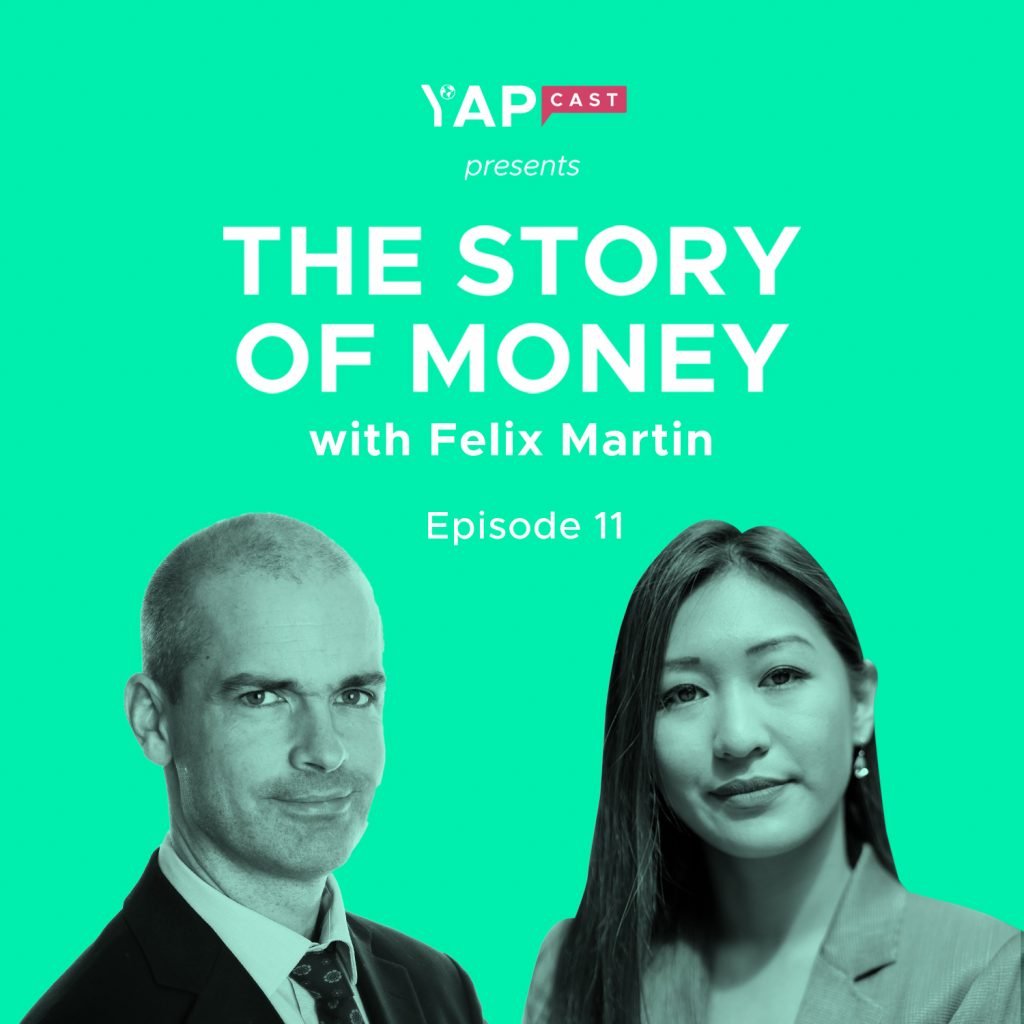
To satisfy my curiosity, I’m very excited to invite Felix Martin, the author of ‘Money: The Unauthorised Biography’. Felix began his career as an economist at the World Bank in Washington DC in 1998, working mostly on sovereign lending programmes and debt restructuring in eastern Europe. He holds degrees in classics, international relations, and economics including a Doctor of Philosophy in Economics from Oxford University.
Samantha [03:52]: I'm really excited to have Felix Martin with us, and I have his book here, 'Money: The Unauthorised Biography'. Hi Felix, Thank you so much for joining us.
Felix [04:01]: Hi, Sam. Very nice to be here.
Excising Money in Economics
Samantha [04:03]: So Felix, could you tell me a little bit about your background? And about the book and the process of you putting this book together?
Felix [04:11]: Yes, sure. Well, I became fascinated whilst I was an undergraduate many years ago now studying classics. And so, I decided later to convert to becoming an economist and I went and did many more degrees culminating in the end in a doctorate in economics. And one of the things that mainly fascinated me about economics and indeed what I thought economics was about when I started studying it, like I think many people, the man or woman in the street, if you ask them, you know, “what is economics or subject about?” One of the first things they'd say would be “Well, I think it's about money. It's about money and business, and people making money and all that kind of thing.”
I was quite surprised when I started to study economics, that there was very little about money, banking, and finance. And in fact, that whole field had been hived off many decades earlier, and was sort of studied in business schools, and the whole banking industry and finance industry and so on. The whole concept of money had, in some sense, been excised from economics. And so this was something which sort of fascinated me, but troubled me about that particular intellectual discipline. And then later, I began to work in the financial markets. That's what I do these days, I’m a fund manager. And I began to see what I thought was a big problem with that - the fact that economics, which is meant to be the discipline in which, for example, central bankers are trained, does not anymore have a focus on money and banking, and people don't learn about it.
Felix [5:38]: When I was doing my doctoral coursework at Oxford, and this was in the early 2000s, I was in the last year of the course that was offered in money and banking to graduate students going on to do their doctorate. And the year after I did that course, it was abolished. But the irony of this was that this, of course, was just before the biggest financial crisis in history, basically. And the fact that you had been producing generation after generation of economists, who were meant to go off and staff central banks, the World Bank, financial institutions, the IMF, and so on. But to not have any more an opportunity even to learn formally about money and banking, this seems, to me, to be pretty odd. So it's what got me interested in going further than just being sort of interested in money. What is it? Where does it come from? What is the history of it? Into wondering also, why is it that we don't learn about it as economists? Why is it in its intellectual blind spot? And then, is there some link between that and what happened in 2008?
Samantha [06:37]: Wow, that's so interesting. Because for someone who's not an economist (my background is in journalism), you would think that economists know about money. I read in your book that in business schools it seems like there’s two different worlds forming. Would you agree?
Felix [06:52]: It's something you see in many disciplines, you see the academic side of it, the sort of thought leading side of it diverging from practice. And that's really what happened in economics and caused problems. What's most interesting is the practice itself. I mean, what's really interesting is, what is money? Where does it come from? How does it work? What are all these people doing in these skyscrapers? For example, in the city of London, and in Manhattan, and in Shanghai and so on. What exactly is going on in these places? I think these are questions which, if they're not of interest to people, they should be because it's clearly so important to the functioning of our economies and society and so on.
What is a Financial Crisis?
Samantha [07:29]: Yeah, you're on the right track there. I run a PR firm, which specialises in helping crypto and decentralised finance projects and protocols, you'd call it, and they're basically saying the same things - “What are all these banks and all these skyscrapers doing? Why can't we just trust a code and a system?” And there's so much to it. So, you touched on something at the end about the reasons for financial crises. And so that's what I really want to unpack in this conversation with you. In your own words, could you explain, what is a financial crisis?
Felix [08:02]: Perhaps put it very simply, one can have an economic crisis, which is not intrinsically connected to something that's happened in the financial sector. And one can have a crisis which is connected and is driven by what happens in the financial sector. So, the former kind of crisis would be in the modern era, let's say, a big war, like the Second World War, for example, or the First World War. These were not financial crises in the sense that they were started by something that happened in the banking sector. Clearly, these were caused by ulterior political and military events. Military events are only one kind of non-financial cause. Another one which was very common, for example, in the 19th century would be fluctuations in the weather, which led to big fluctuations in the agricultural economy. That was a very common cause of economic crises in the 19th century, for example. Of course, that’s much less important today, because so much of the economy is non-agricultural. But there are economic crashes, recessions, and so on, which are caused from within the financial sector. And once all those developed, as the economy began to get more financialized, that process started a long time ago - centuries ago in Europe, but it really began to take off in the 19th century.
And that's when you began to see the first banking crises in particular, which fed back into the real economy. And there is a tempting way to think about finance, which is that it's all just a sort of reflection of what economists call the real economy. And that's a very traditional way of thinking about finance. You think there are people out there, there are entrepreneurs, and there are companies, and there are households, and they're all doing this stuff, making things, demanding things, consuming things, and so on. They're all doing that, quite independently of anything going on in the banking sector. And as a result of what they're doing, they demand a certain amount of finance, they need a certain number of mortgages and a certain number of loans, and so on and so forth. And so the real economy is the dog, and the finance sector is the tail of the dog. So the real economy wags the financial sector.
Felix [10:07]: But what is obvious when you look at history, is that it doesn't always work like that and at certain points for some reasons. It's the financial sector dog which is wagging the tail of the real economy and the things which happen autonomously within the financial sector, within the banking sector, feed back into the real economy. Why does this happen? Again, there are various different kinds of financial crises, there's not only one kind of financial crisis, which can cause problems in the real economy. But a very typical one is a banking crisis. And there is something intrinsic about banking in particular, banking is key to the modern monetary system. That's how our modern monetary system works. We can go into that in a bit if you'd like. But there's a key feature of it, which really drives this, and this is the fact that in a modern banking system, banks undertake what's called liquidity transformation. So the liabilities of modern banks tend to be very short term. What do we mean by that? We mean that your or my deposits at the bank, a lot of our deposits will be on demand, we can take them out, we can withdraw them whenever we like.
Whereas a lot of the assets of those banks, so the loans they make, primarily, are long-term, certainly longer term than the liabilities. And that difference goes to the heart of what banks do, they try to mediate by cleverly mixing up lots of different short-term liabilities, but from lots of different institutions with lots of long-term assets. And in doing so never get caught short. That's the idea. They never get in a situation whereby more people want to withdraw money, than they can liquidate assets to meet those withdrawals. But when that happens, when you get into a situation where people do want to withdraw more money than the bank can realise through liquidating its assets, where that synchronisation breaks down, then all of a sudden, you have a potential for a big problem, because people lose faith in the idea that this is going to be possible. And that's when you get a bank run. And of course, at the very beginning of the last big financial crisis in 2008 if we're thinking about, for example, the United Kingdom, that was the absolutely canonical picture that sparked the whole thing off. It was people queuing up outside a particular bank, Northern Rock, we hadn't seen a bank run of that sort for 150 years in the UK. And what that was, was exactly too many people turning up all at the same time to try to liquidate the bank's liabilities to them. And the bank was unable to liquidate its assets, which were very long-term mortgage lending in order to meet that.
Trusting Banks
Samantha [12:34]: And do you think that that's an issue of trust, when that happens, that people want to just hold cash?
Felix [12:40]: So there are lots of different kinds of trust involved in a modern financial system. And there is one important kind of trust, which is involved in that process, which I was just describing. Because the kind of trust which is involved there is the trust from customers. That the bank will be able to manage its assets and liabilities and in particular, manage the timing of cash flows, which come in from its loans, with the cash flows that they have to pay out to its depositors that this will all hang together, that there won't be some mismatch between these things. And that's a matter of trust, you're trusting the ability of the bank, it’s systems.
In the olden days, it was just people making judgments. These days, you're trusting various kinds of digitised systems and algorithmic solutions, and they've got to try and predict all this, but you're trusting that it all works. That's one level of trust. Now, it's crucial to say that because the problem I was describing is a habitual one. There hasn't just been only one banking crisis in history, there are banking crises all the time in history. Because it has a potential to fall to bits. Almost since the beginning of the modern banking system, there's had to be a backstop. A backstop if it turns out that there are too many people lining up outside this bank wanting to cut out the deposits and you can't liquidate your assets in time.
Felix [13:52]: That backstop is the one that we saw in action in 2008. And that is that if you are a bank, deemed by the authorities to be sensible and well run enough to have a bank charter, in other words, to be a regulated institution, you have access in time of emergencies to the central bank, ‘the banks bank’. And the role of the central bank in that kind of circumstance is for them to step in and say, ‘all right, we understand that you cannot liquidate your long-term mortgage holdings at this point in time to meet your depositors demands. So instead, we will step in, and we will take off your hands, those loans, and we will give you cash in order to pay up to your depositives’, that's called ending being the lender of last resort.
So another aspect of trust would be that people trust that that is going to happen, for example, they trust that the central bank will step in. And then of course, this all cascades backwards, if you trust that the central bank is going to step in, then you don't get so worried that the commercial bank is not going to be able to meet your deposits in the first place. So if you trust the central bank, then of course, you have trust in the commercial bank, then all the problems go away. So it all cascades backwards. Ultimately, you have to trust the top of the system, in order for there to be trust at the bottom of the system.
Shadow Banking in 2008
Samantha [15:04]: That's really interesting because I think that there are a lot of people in the crypto world that don't trust this system, that the central bank is going to end up being the lender of last resort. And people are a bit concerned with the banks just printing money at the moment, even with us talking right now after the pandemic. But just back to what you talked about, in chapter 12 of your book, you do share an account of the queen, asking the British Academy why no one saw the 2008 and 2009 crisis coming? What does this situation tell us about the financial crisis? Is it a problem of collective imagination, about foreseeing events, or is there a problem with the system itself?
Felix [15:43]: There have been many accounts and many analyses written of why the crisis of 2008 came about, the most mainstream perspective on why that crisis happened has to do with the institutions and the regulation of the sector. If I was to summarise the history of money, which I tell in my book, very simply, it would be as follows: what you have is a battle that has lasted for millennia, literally millennia, between two kinds of models for issuing and managing money. And one model is that the sovereign and the sovereign can be of course, in the Middle Ages, that can be a king or a queen, or in the modern era, that can be a democratic government, it doesn't matter. The sovereign is responsible for issuing the money used in a particular jurisdiction. So in other words, deciding basically how much money is issued and to whom it's issued, and so on, so forth. So that's one model, the sovereign should be in control.
But there's another model, which will ring a bell for all of your listeners who are interested in crypto and DeFi and so on, which, again, is it has existed throughout all of monetary history, and this is that if you allow the sovereign to do that, the sovereign will, of course, manage the money supply purely in its own interests. And those interests might converge with those of the money using population or they might not converge with those of the money using population, but there's certainly no guarantee that they will. Certainly not in a non-democratic system. And so for that reason, money users, merchants or just everyday people these days should go and create their own money. How do you do this? Well, you get together with other like-minded people, and you just agree that you're going to issue your own money. And you set up some kind of system for managing the money supply, your own monetary standard, and you operate like that.
Felix [17:27]: It's something I call in my book, ‘The Monetary Maquis’. The Maquis was the slang term for the resistance during the Second World War in France, the anti-state way of doing things. But this tension between these two options for operating money has existed, as I said, absolutely throughout all of monetary history. And very frequently, it's very oppositional because the more successful is the monetary maquis, our private sector people creating their own private monies and operating them under their own kinds of standards, the less successful by definition is the sovereign money. And the less influence, therefore, the sovereign has via money over governing its jurisdiction. But this story arrived at a crucial moment in the late 17th century. And this was really the creation of modern finance, modern money, modern banking systems, it happened for the first time by chance here in the UK, with the creation of the Bank of England, because what happened there was a compromise between the mercantile classes and their demands for how money should be operated. And their demands, for example, to be able to run private banks, which issued their own liabilities, their own money. A compromise between that, and a sovereign institution, the Bank of England, which was there to manage the sovereign money.
And essentially, there was an agreement to create a hybrid system, in which both of these two sides have some say in how money is operated. And that hybrid system, which continues to work today, means that almost all money in circulation in a country like Britain is actually issued by private institutions, banks. 97-98% of the money in circulation in a country like the UK, is liabilities of commercial banks. But at the same time, it's the sovereign via the Bank of England, which sets monetary policy. Now, that compromise is always fragile. It's always fragile, because that compromise itself can come to be seen, as the sovereign used to be in centuries past, as a special interest as alien to a lot of people or a lot of businesses within the country. And once that happens, the monetary Maquis will again rear its head, people will think, “Well, it's no better than it was before. Now, we've just got the Bank of England and a bunch of bankers who are running money for their own interests. And therefore, let's again, try to improvise private monies and private finance outside of the control of those two groups.” And that is essentially in a kind of way, what happened in the lead up to 2008.
Felix [19:56]: But if you recall that time, there was a phenomenon called shadow banking, which became revealed in the course of the crisis. And all shadow banking was, was the creation on a massive scale of new financial credit instruments, primarily, these famous CDOs and CDO-squared and all kinds of acronyms that came along at the time with the creation and proliferation of credit instruments on a massive scale, which effectively functioned like money, but all outside of the regulated financial sector. Effectively what was happening is, in addition to all the money that was licenced, to be created by commercial banks, there was an enormous amount of wholesale pseudo-money being created, outside of that arrangement, outside of the regulation of the official financial sector.
And then what happened was when you got to that point where people are lining up outside the bank where there's a bank run, where people are worried about this liquidity mismatch, the authorities suddenly had a terrible choice. The size of the shadow monetary supply was so large, that to have simply said, “Well, I'm terribly sorry. But this is shadow money, it's not real money within the system, and you've broken your promise, you've created money outside of the regulated sector, and therefore, it's nothing to do with us”, would have had tremendous repercussions in the real-world economy, it couldn't be allowed to happen. And therefore, it had to be brought in, in an emergency inside the regulated sector, effectively, it had to be bailed out. That was the story of 2008, a massive bailout, which went way beyond what had previously been agreed. And that's how it relates to what's happening at the moment with crypto and DeFi.
Bitcoin’s Place After 2008
Samantha [21:31]: So on that point, 2008/2009, that was when Bitcoin was created. And now it's known as digital gold. And it's kind of a move to hard currency, as you call it, and you were talking about the two different worlds in the battle. Where do you think Bitcoin and crypto sit in those two worlds? Where do you think Bitcoin sits moving on from the 2008 and 2009 crisis?
Felix [21:55]: It's a totally fascinating technology, obviously. Of course, people have raised questions. “Well, is it all a flash in the pan?” but you can say that something that's stuck around for a long time now, as you just pointed out since 2008, there's clearly something to it. The question is, what is there to it? Because it has different aspects, not just Bitcoin, but cryptocurrency generally. To refer back to what I just said, in one sense, it's clearly a manifestation of this very old trend of people saying, “I'm not happy with how this absolutely core institution, the core tool that we all use in our daily lives, is managed by our government. And instead of trying to convince my government to run it differently, we're just going to take the exit and create something new”. And it's the technology which allows that to happen easily. I mean, as I said, it has been the case throughout history, that this has been done using all kinds of different technologies, which are developed over time. But what is quite obvious is that modern digital technology, information technology, and the internet, enable this to be done on a scale, which is very different from before.
Once you have a world in which billions of people are connected, and in which, for example, the ledgers on which you store information, which is necessary for financial system, are no longer on paper, they're no longer on a centralised computer in a building somewhere in London, but can in principle be distributed all throughout the world, that's a very, very different situation. Something which previously might have been a very small phenomenon can become a very large phenomena in absolute terms, even if there's still a very tiny proportion of money users who are interested in running their own money. Whereas previously, you have been talking about a tiny proportion of 100,000 people who live in Oxford and want to create an Oxford pound. Now, you're talking about a tiny proportion of several billion people and that's a lot of people.
Felix [23:43]: One fundamental distinction which is really important to have in mind when one’s talking about cryptocurrency, and Bitcoin is an excellent example, is the difference between the underlying technology - blockchain and distributed ledgers generally, and so on - and Bitcoin, the private money itself. These things are separate, they're not separate within the Bitcoin protocol, but they are in principle separate and have developed separately. You can see there's a lot of excitement about blockchain and distributed ledger technology, which isn't to do necessarily, even with particular private monetary units. So one question is, how revolutionary is this new distributed ledger technology and what kind of effects will that have within the monetary sector? And more broadly a separate question is, how revolutionary is Bitcoin, the private monetary unit and the rules governing how many bitcoins get issued? That second part is a very, very traditional monetary question. It's no different from asking, throughout history: “What are the current rules which govern how many dollars get printed?” or “What were the rules in the 19th century, which governed how many pounds sterling got issued?”
Samantha [24:51]: I think it's very interesting how you phrase the question about Bitcoin and the private aspect of it, because the community that I speak to and talk to everyday, they would argue that Bitcoin is not private, it’s actually the most public currency in the world.
Felix [25:05]: When I call Bitcoin a private money, that's not in contradiction with what the advocates of crypto are talking about. The private I'm talking about is to draw a distinction between who makes the rules which govern how much money, or Bitcoin in this case, gets issued. And so it's a distinction between whether that's a sovereign responsibility. It's the monetary policy committee of the Bank of England, yet it's a sovereign institution or whether it is something which has been agreed on by the private users of the money. It's not the sovereign, it's distinctly in opposition.
Most people, of course, don't understand it very well. Most of the users of it aren't able to actually go and scrutinise the code, but they trust the idea that this is hard coded and cannot be changed. Of course, in the abstract, the technologists will tell you that there is no trust involved in that second system, but that's not in practice true. It will never be true that the people that use these things, actually fully understand them or the code, for example, they won't. So there's a huge element of trust involved.
Samantha [25:59]: And again we come back to the question of trust. I like how Felix summarises that what we’ve seen through the ages is a battle between two kinds of models for issuing and managing money. But what I’ve learnt the most from speaking with Felix is what really happens during a financial crisis. In summary - a lot of factors come to play. So can the technological innovation behind decentralised finance actually prevent financial crises?
Stay tuned for the second half of my conversation with Felix Martin on our final episode of season one of The Story of Money on YAP Cast. Felix’s book, which was published in 2013, didn’t actually touch on Bitcoin or cryptocurrencies so I’m quite excited for you to listen to a potential extension of his account of the biography of money.
If you’d like to watch my full-length conversation with Felix Martin, head to the YAP Cast YouTube channel. I’m Samantha Yap, and you’ve been listening to The Story Of Money, by YAP Cast.