Introduction
Welcome to The Story of Money by YAP Cast where we explore the past, present, and future of money. I’m Samantha Yap.
Intro CTA - Spotify
Follow The Story of Money by YAP Cast to learn more about where money is heading.
Intro CTA - YouTube
Subscribe to The Story of Money by YAP Cast to learn more about where money is heading.
Voiceover:
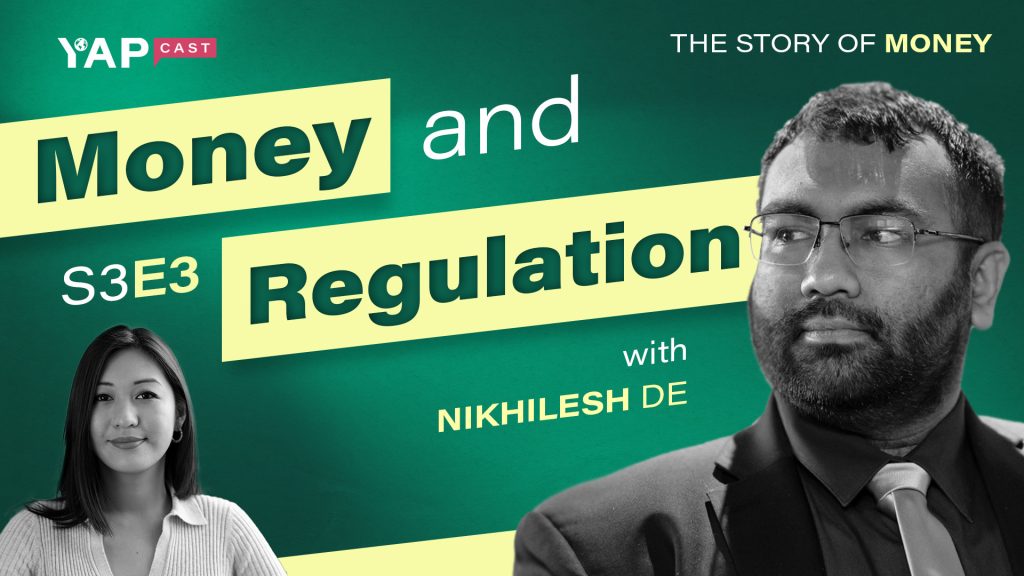
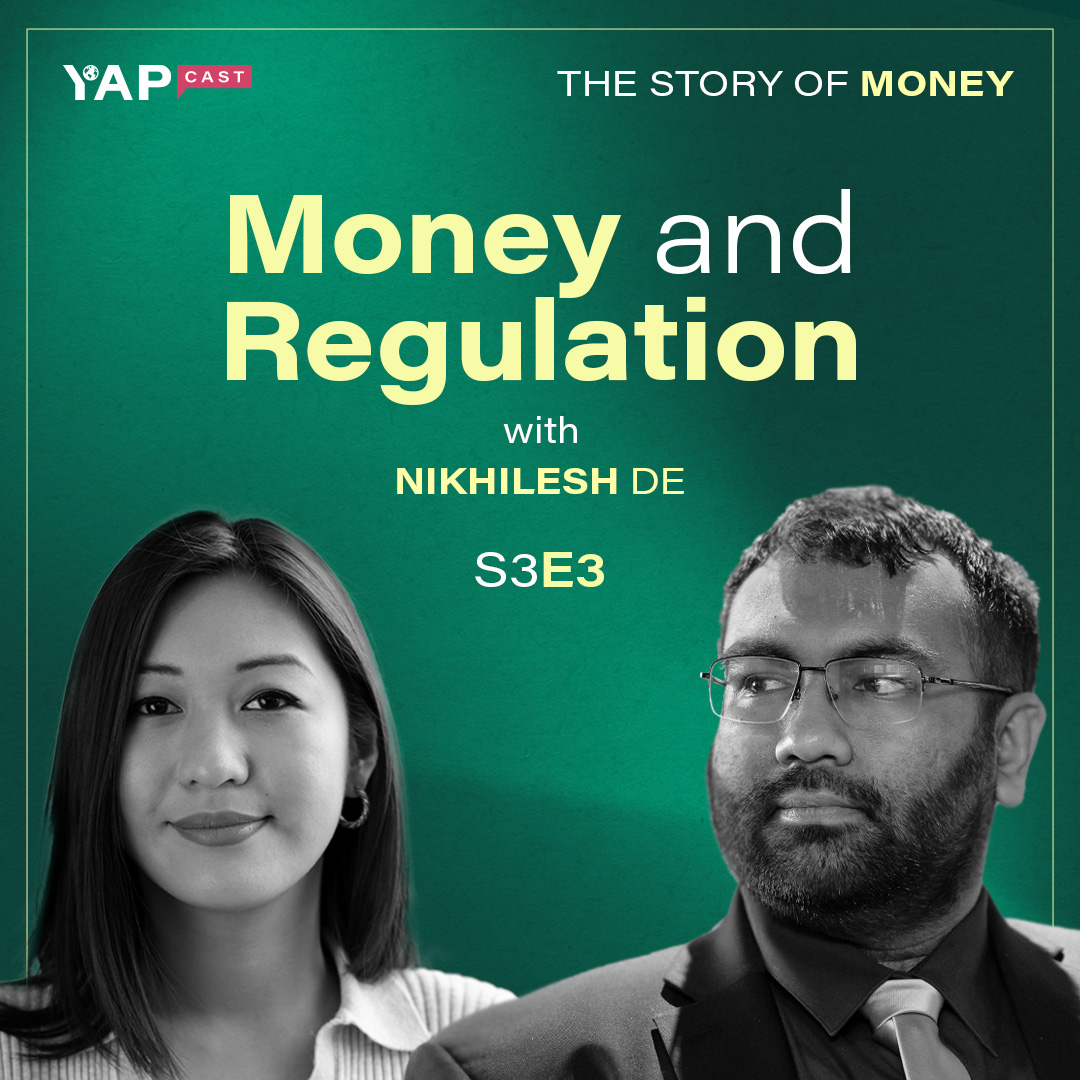
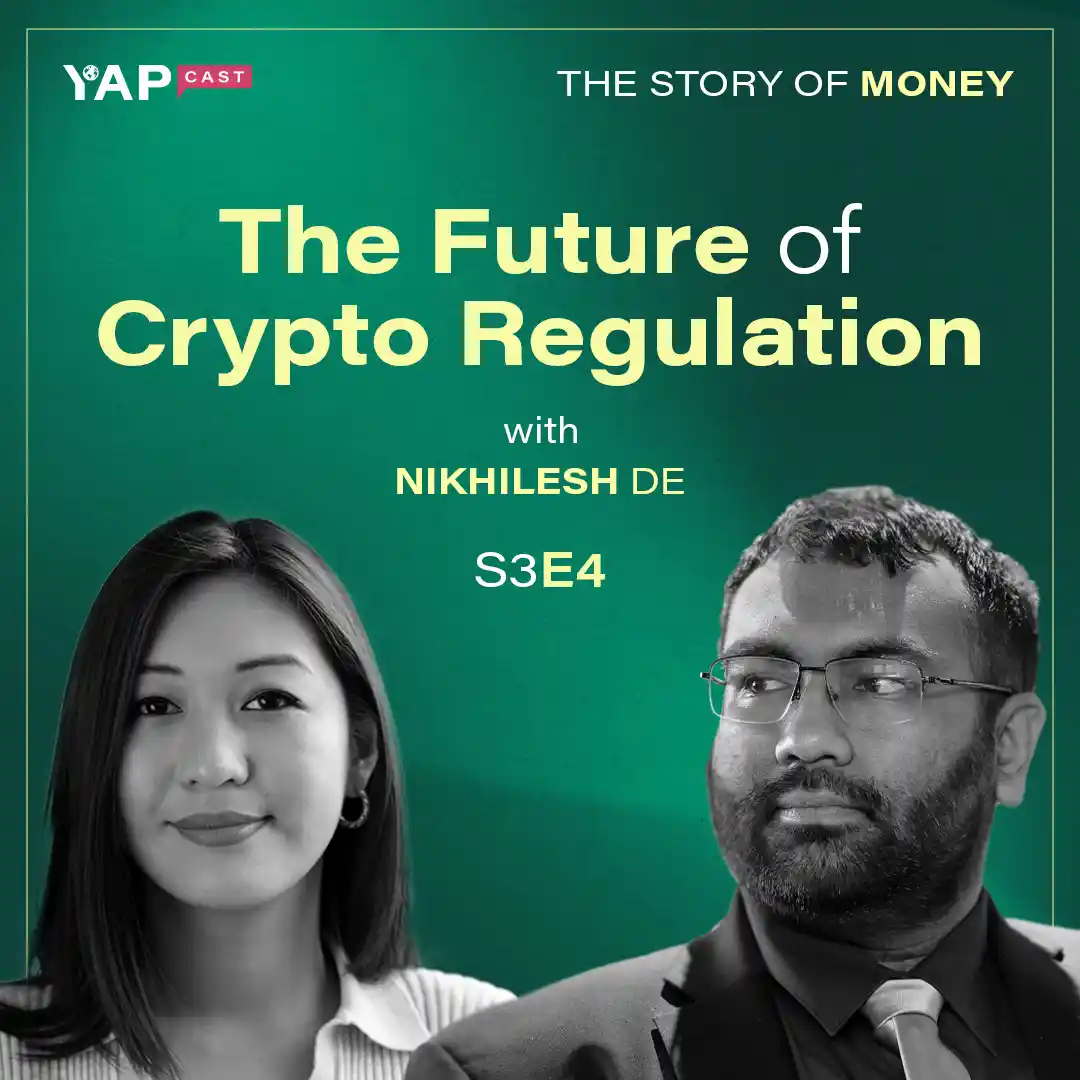
Join me and Nikhilesh De the managing editor for global policy and regulation at CoinDesk - on this episode of the Story of Money by YAP Cast.
I’m sure many of us wonder what life would be like if we had more money. So why can’t governments just print more money? The short answer is that money needs to be regulated in order to maintain financial stability.
The other objectives of financial regulation include: protecting consumers and maintaining confidence in a financial system.
The earliest financial regulation can be traced back to the 17th century when the Dutch government established the Amsterdam Stock Exchange and implemented regulations to ensure fair trading practices.
But as money evolves so does financial regulation.
There’s no better person to speak to us about the development of financial regulation than a journalist and reporter who is covering it on the front lines.
Nikhilesh De, Managing Editor for global policy and regulation at CoinDesk has been covering the world of crypto since 2017, so he’s seen the ups and downs of the industry.
In this episode he’ll shed light on the goals of financial regulation and how they differ when it comes to regulating crypto.
Tune in to this insightful conversation with Nik, a seasoned crypto journalist, to gain some new insights into the world of money and regulation.
Our guest for today - Nikhilesh De
Samantha Yap 00:00
Nik, thank you so much for joining me on YAP Cast.
Nikhilesh De 00:04
Thanks for having me.
Samantha Yap 00:06
Yeah. So, Nik, you are CoinDesk’s managing editor for global policy and regulation. Can you tell me a little bit more about what your day-to-day job is?
Nikhilesh De 00:19
I mean, I think this is true of most journalists. But the fun part is the day to day does not really, you know, it's not the same every day. Right now, as you mentioned, I run a team of reporters who cover policy around the world, specifically as it pertains to crypto. So, we have folks in Washington DC, in the US and New York, we have folks in London, Brussels, New Delhi, trying to get just a lot of what's going on in the world and understand it and trying to figure out how the crypto community is engaging. So, right now, my day to day depends on what the crisis of the week is. This week it was banking, last week it was banking, and I'm sure in a couple of weeks, it'll be something else entirely. It's always fun.
Samantha Yap 01:03
I mean, covering global policy and regulation requires you to keep on top of what regulators and governments are saying about crypto. So how do you keep up like, what are the, yeah, I'm sure there are specific sites and government bodies that you track, like, can you explain how you guys really keep up with it all?
Nikhilesh De 01:33
Yeah, I mean, for me, it helps that I do have a really good team that I work with. So, part of it really is I just read what my colleagues are writing and look at what they're doing and who they're talking to. A huge part of it is talking to people, of course, just trying to figure out what they have on their radar. So, whether that is, you know, a lawyer in, you know, perhaps a state talking about what their local government is doing, whether that's trying to talk to a regulator about what their agency is doing, talking to, you know, even just crypto companies about what they're seeing. I do look at a lot of government documents. So, most governments, I think, publish all sorts of things, whether that is request for information, things like proposals and proposed rulemaking, just summary explanations of what they're doing, court rulings. Those are all, for the most part very freely available and very useful in getting a sense of what's going on.
Looking at ongoing court proceedings is another way to get a sense of just how officials in these places are thinking about crypto and thinking about what's going on with the world and what they need to either update or address even if they feel a need to address crypto at all. Sometimes it's the case where they look at crypto and they say, okay, well, this is interesting and all but it's so far out of our remit that we just don't want to care about this, we can't care about this. So, we're just gonna ignore it for now.
Samantha Yap 03:00
Yeah, so how much is your week focus on reading government documents and court proceedings, because that sounds like a lot of reading.
Nikhilesh De 03:11
It is. There's definitely a lot of it. I don't necessarily read every single word. A lot of times, I'll skim things at first and see, okay, you know, is this relevant to us? Is this relevant to our audience? And then sometimes I'll say, okay, well, this is kind of interesting. But it's not news. But it could be useful for a deeper analysis later on, in which case, I'll stick it into, you know, I have a ongoing Google Doc, where I keep certain things like links and stuff. And I'll say like, okay, look at this link later. Or we use Slack at CoinDesk. So, sometimes I'll just put a link into a Slack chat that I'm the only one in and I'll get back to it later. So that helps. If it is interesting, or newsy or whatever then, of course, I'll read the entire thing. But not reading the whole thing at first, just skimming it really helps with keeping up with the sheer volume.
From Intern to Managing Editor: Nik's Crypto Journey
Samantha Yap 04:07
Yeah. So, could you share how you got into crypto in the first place? Because I have worked with you for many years now. But can you just share a little bit about your story of how you got into covering crypto?
Nikhilesh De 04:24
Honestly, just coming to CoinDesk, you know, I was an intern at CoinDesk, and I started working at Coindesk. That was the entirety of how I got into crypto. I wasn't really in crypto prior to CoinDesk. I was just trying to figure out, what this all is as it happened. So, I got lucky, I think. I came in at a very interesting time. I started covering crypto in the fall of 2017. And that, of course, was, you know, there was a ban, there was a bull market, there was a crash. All of that happened within I think the first six months of my covering crypto. So, it was a very educational time really helped to just get right into it and have to cover it, have to understand it as it was unfolding in real time. And now here we are a couple years later and yeah, it's been a very weird wild ride.
Samantha Yap 05:13
Now you're the managing editor for covering global policy of crypto.
Nikhilesh De 05:18
I could not tell you how that happened.
Samantha Yap 05:20
How did your work in covering crypto lead you to, like, evolve into you covering regulation? Because regulation is you're touching on law? You're touching on policy, and how that's being made, not just in DC, but in various governments around the world. So how did your work evolve into that?
Nikhilesh De 05:49
Honestly, almost by accident. A couple of years ago in the US, there was this huge push to try and get a Bitcoin exchange traded fund, basically a product that would allow your average everyday retail user to invest in a Bitcoin product without having to directly buy crypto. And this would be the kind of product that could be available through normal brokerages. So, like your TD Ameritrade, your Vanguard, your Fidelity's. So, I was covering these ETF applications, and the subsequent rejections of all of these applications. And somehow, that led to me covering the SEC, the Securities and Exchange Commission more broadly, which then led to me coming to DC and visiting and talking to lawyers and lawmakers. And ultimately, that just kind of kept expanding.
So, I ended up covering this Commodity Futures Trading Commission, which oversees Bitcoin futures products, the Office of the Comptroller Currency of Federal Banking regulator. And now, that just kind of kept snowballing and I got lucky, CoinDesk was very encouraging of that. You know, it was a environment that allowed me to really focus and specialize on this. I call it a niche within a niche when I was first kind of, developing my beat. But I would say now, it's probably a lot more, it's less of a niche now. More people are interested in it. And of course, CoinDesk, at some point, decided, okay, well, we're gonna build an entire team around this beat, which, of course, was really helpful. I mean, it was terrifying. But the sheer amount of news that is happening, I think, really warrants it. And it's really cool to see how that's developing now.
Samantha Yap 07:24
It is a really important beat. And it is the most important beat because I think it is, kind of, dictating a bit about- I mean, regulation is dictating how people are navigating crypto.
Regulating Money: Concerns and Considerations in Crypto
So considering that this podcast is about the story of money, let's take like 10 steps back from this niche within a niche, but can you tell me what is money to you today?
Nikhilesh De 07:58
Do you want philosophical, do you want practical?
Samantha Yap 08:02
Either-or. Both.
Nikhilesh De 08:04
Philosophically I guess it's the ability to transact for me. I don't really think of like, I get that, like, my savings are in forms of money, and things like that. But on very real level when I think of money, I just thinking, okay, well, you know, I can spend five bucks on a sandwich or whatever. I guess to me, that's how I look at it. I don't really think too much about it, to be honest, either professionally, or personally, it's just kind of, I guess it's one of those things where, it's been with me for as long as I've lived. So, it's not explicitly taking a role in my mindset.
Samantha Yap 08:47
Yeah. And going to the basics of what you're covering - regulation. Why do you think regulating money is important?
Nikhilesh De 09:01
I mean, from what I've covered, you know, a lot of regulators will tell you that they have concerns about the possible, I'm not gonna say illicit, the possible harmful uses of money. And that leads to things being illicit, but a lot of it is genuine concern about things like, weapons proliferation about harming others. I think we're even seeing that in crypto, especially where North Korea has been developing a nuclear weapons and ballistic missile program that seems to be funded in large part by devs of crypto.
So, from kind of like the regulatory perspective, the question seems to be it's with certain restrictions or certain rules around the use and transaction of money, make it safer for other people. And obviously, you can call this a slippery slope kind of situation. There always going to be slippery slope kind of situations, but trying to figure out where those lines are to be done is probably one of the more important questions. I don't know that regulators have necessarily found that right balance yet. And certainly, there's gonna be differing viewpoints depending on who you ask, especially in the crypto community. But it is something that I think a lot of people are genuinely trying to put a lot of thought and consideration into. The results? TBD.
The Complex and Nuanced Goals of Financial Regulation in the Crypto Industry
Samantha Yap 10:25
What do you know of the goals of financial regulation? I've looked up some of them, you know, I think some sort of regulators think about ensuring stability of the financial system. And yeah, ensuring that consumers are protected. From the past few years of you covering financial regulation with respect to crypto, what have you seen are the goals or intentions of regulators?
Nikhilesh De 11:04
This is a really tough one, because every regulator is different. Every regulator is going to have a completely different and sometimes contradictory answer, depending on who you ask. I mean, this is part of what makes this fascinating to me, because despite all those differences of opinion, they all have to kind of find some kind of consensus agreement before they can really do anything. And I think right now, we haven't really seen a real consensus, which is part of why, not the entire reason, not even like a big reason, but part of why we haven't seen a lot of clear crypto regulation and clarity in the US at least. But yeah, I think, stability is definitely a major one, protecting consumers from either theft or scams, that's another big one. Protecting markets from being easily manipulated to the benefit of the few is a stated goal.
Again, I think if you ask people in the crypto community, they're gonna say, well, that's not really a thing. But I think a lot of regulators generally are considering that and trying to create a fair and equitable system for most of the people who are in it. But again, this is a kind of, you know, your mileage may vary. Not every regulator is successful. And right now, we're just in such a weird kind of zeitgeist where things are happening far faster than regulators can necessarily keep up, it is a little bit difficult, I would say, for them to be able to marry the stated goals and the views that they say they have with what they're actually doing.
Samantha Yap 12:39
I think people are, you know, from kind of the crypto discourse that I pay attention to daily, because of our work. People are questioning, who really is this regulation benefiting? Because if the intention is to protect consumers, others perceive that the regulations are being put in place is to maybe protect financial institutions or protect the government. So, who does regulation really benefit? What have you seen, because you talk to regulators, and you say, yeah, it's different, everyone that you speak to, but yeah, in your opinion?
Nikhilesh De 13:33
I'm just going to use the whole banking, you know, bailout example from the last week, regulators first off not going to call it a bailout. They're gonna say it's not a bailout. But, functionally what happened is looking at Silicon Valley Bank, regulators came in said, okay, well, legally, we're required to do XYZ, the FDIC is only required to insure up to $250,000 per account of funds held at Silicon Valley Bank, but so many companies held money there in excess, you know, cash there in excess of that limit, that if the regulators had not stepped in, and they hadn't been able to find any private bailout, or private capital to support the bank, it's very possible that a lot of companies would be in danger of not being able to pay their employees or continue operations and even though what the federal government did in assuring depositors that their money is fine, protects these companies, you're also seeing a lot of companies and venture capital funds and "elite" be protected as well, because they were also depositors.
So, who did the regulation protect? Did it protect everyday people who just happened to be employees of companies that banked that Silicon Valley Bank? Yes.
Did it protect the ultra-wealthy folks who held money there as well? Yep.
Did it protect these major companies that could probably have, they could have withstood the losses from Silicon Valley Bank’s collapse? Yeah.
So, all of those folks were protected, all those companies and institutions. And depending on who you ask, you know, that's either a good thing, bad thing, terrible thing. Great thing for the economy, horrible thing for the economy, great for Bitcoin, bad for Bitcoin. I think there's a lot of valid viewpoints to that. It is one of those areas where I think it's also very complex and nuanced. And we should probably be a bit more willing to accept that nuance. But I think that is a good example of how regulations are kind of, not just perceived, but also executed in the real world. And a lot of places, yes, they will protect people of all stripes. But that means that some people you will disagree with are gonna get protected. And sometimes the rules are going to be, you know, they're not gonna make sense to you, but they might still work out for someone else.
The Need for Genuine Engagement Between the Crypto Community and Regulators.
Samantha Yap 15:58
Yeah. You rightly pointed out that it did protect those startups as well as the elites that had money in the bank. What's your perception of, perhaps maybe the crypto discourse around regulators? Yeah, I think we're speaking at a time in early 2023 right now, where it's a bit in flux. People are concerned, I think you recently wrote a story about Ether might be classified as a security. So, people in the crypto community are nervous. What’s your perception of how the community is taking it? Because I know you basically talk to both sides?
Nikhilesh De 16:50
Yeah, I mean, this is, like, here's my thing; I think that there's a lot of good faith engagement between crypto people and regulators. And there's a lot of genuine efforts to understand where regulators are coming from, as well as address and educate those concerns.
And there's also a lot of bad faith, you know, engagement, there's a lot of people who just want to dunk on regulators for the sake of dunking on regulators. And I understand that as well.
On the regulatory front, I think there are regulators who genuinely want to understand what it is this industry is doing, and want to encourage it while still, to use the regulatory line or the line, we've heard all sorts of regulators use, you know, ‘encourage growth while promoting innovation and still protecting consumers’. Right?
I think there are a lot of people who genuinely want to live up to that particular standard. But there's also a lot of regulators who think that this is an annoyance that they want to, you know, if not get rid of it, they at least want to wrestle it back into a box, such that it's not going to be a major headache for them. And I think one of the problems is, you know, you have these four corners, and they sometimes meet in the middle. But far too often, there's just a lot of talking past each other. Even folks who have good intentions, you're going to try and talk about why you can't put you know, classify Ether as a security. And they're making these points, but they're not necessarily making them to the regulators who need to listen. And the regulators might say, okay, well, you know, we think this is cool, and we want to allow you to do whatever it is you're doing. But again, they're also not necessarily going to find the right audience. And I don't know what the exactly the answer to that is.
Part of what I like to do, or what I like to think I'm doing is at least trying to put all of those different viewpoints into a common ground so that maybe it can help it proper engagement. And again, I personally am completely neutral agnostic towards crypto. I think it's asking some of the right questions. I don't think it has all the right answers. But I'm curious to see where it goes. So, I'm not here necessarily to encourage any particular crypto project or anything like that, but I really do want to see more genuine engagement between the different sides of these debates.
Samantha Yap 19:16
Spoken like a true journalist that you're neutral. You know, I think what you do is very important because, like you said, so you're saying that yeah, they’re kind of speaking, you know, the crypto community, crypto founders, maybe they’re, I think Twitter and the media actually is the forum where all these discussions are being made because yeah, what did they look to? Your CoinDesk article or yeah, maybe an article that Political’s put out or a Reuters piece updating people on what's going on. So, I do think that the media discourse on social media like Twitter is where all these discussions are happening. But they're mainly talking across themselves.
Nikhilesh De 20:05
And also, that's the thing like, Twitter isn't real life. I feel like there's not enough acknowledgment of that from. And this isn't even like a crypto specific issue. Looking over the weekend, you had all these VCs tweeting about the importance of Silicon Valley Bank. A lot of regulators do not care what happens on Twitter, like genuinely, they're gonna look at Twitter as, it's like you yelling into a megaphone at a brick wall. It might make you feel better but there's no one listening. So, part of that is where do you engage with the regulators? Where do you actually do that? Is that going to be a good faith engagement? And I will say, like, some regulators will say, okay, yeah, we're listening, just come on in and talk to us. And they’re either not going to do anything with that, or they're going to look at whoever is coming in with suspicion. But finding a place where you can have that kind of conversation is important. And Twitter, I think, really, it could be in some instances, that forum, but a lot of times you have people who are just angrily tweeting whatever. And the noise drowns out the signal way too often, I think.
Engagement between Crypto Leaders and Regulators
Samantha Yap 21:22
Do you know, if there are discussions being made between crypto leaders and regulators frequently? Or are they maybe happening on an ad hoc or case by case basis?
Nikhilesh De 21:40
No, there's definitely, I think, a lot of engagement. I think I've been giving a lot of US centric examples, mainly because my primary beat is US. But, you know, even my colleagues elsewhere, you'll see a lot of crypto CEOs say, oh, you know, we're going to be meeting with congressional leaders in DC or European Parliament folks in Brussels. There is, I think, genuine amount of engagement here. You do have a lot of in person meetings. The Commodity Futures Trading Commission just announced that its Technology Advisory Committee is going to contain a number of folks who are deep into crypto, you have CEOs of crypto startups, you have academics who have been studying crypto, you have people involved in protocols, just as an example. I think there is a lot of genuine back and forth. There's a lot of conversations happening.
Of course, the next question then is; will these conversations lead to any kind of actual clarity and guidance? And the answer to that is; not really yet. Not yet, at least but not really.
Samantha Yap 22:45
So crypto was introduced in 2008. And it has evolved and emerged and been adopted now widely due to the cycle of the market. And so, it's been around for a while, but still new to regulate, like, so basically, trying to regulate it like a currency that is run by technology is new for regulators.
Regulating Crypto: Is it Money?
In your experience, talking to regulators and covering this beat, how different do you see regulating money like fiat currencies? How different do you think that is to regulating crypto?
Nikhilesh De 23:31
Well, for one thing, a lot of places a lot of regulators don't see crypto as money. And, you know, crypto, like the industry is either going to have to if they want to be seen, as you know, money, they're gonna have to accept that that's gonna lead to certain rules and regulations, or otherwise convince regulators why it makes sense. And, you know, a lot of rules for money are starting to get imposed on crypto, we're seeing proposals to close tax loopholes, we're seeing, you know, for a while we've had crypto transactions in excess of, I forget what the limit is, but showing up on currency transaction reports, which is something that the US government has for large transactions or suspicious transactions. So crypto’s been part of that for a while.
So, to make a rambling answer slightly more clear, in some places, the government does see crypto as money and others it does not. And different cryptos are going to be classified differently, depending on what they're doing and how they're being used, and, you know, even who issued them in some cases. But yeah, it's not necessarily going to be seen as a currency the same way that the US dollar might be. US government doesn't recognize Bitcoin, for example, as the same way it recognizes the dollar. And you can see that just in the way they're taxed, you don't get taxed on a $2 transaction to buy coffee. You're gonna get taxed on that Bitcoin transaction if you spend $2 worth of Bitcoin to buy coffee.
Samantha Yap 25:04
I think we hit the heart of the issue here is yeah, some people, some regulators don't see crypto as money. But crypto proponents and leaders see it as money. And I think the tension here is trying to apply the definition of what money should be on crypto. Whereas, crypto, let's say Bitcoin and Ethereum, they have their own rules and their own mechanisms as well. So, it's even understanding, you know, how, for example, with Ethereum, let's take that Ether example, that people are saying that these tokens, they're more used for utility, rather than an exchange of value. So, yeah, there's a lot of applying of definitions to crypto. Have you been seeing a bit of that? And how do you think people are grappling with that?
Nikhilesh De 26:07
To be honest, I've mostly seen it from like, the kind of is this a security lens conversation? So, you mentioned this earlier, but we're now having this whole thing where regulators are saying, perhaps Ether is a security and really, we're seeing this, I wouldn't say too widely yet, The New York Attorney General's Office did file a lawsuit alleging that Ether as a security. The lawsuit was not against the Ethereum foundation, it was against a crypto exchange called KuCoin. And it was kind of odd. It was a very, like, kind of sideways attempt to say, Ether as a security, right? Normally, if you have, you know, SEC, for example, a lot of times, most of the times when they say, so and so crypto is a security, they're gonna sue the issuer.
So, you know, they alleged that, for example, the TON, Telegram Open Network token was going to be a security so they sued, TON, sorry they sued Telegram, excuse me. But more recently, they've started saying, okay, well, we think XYZ Cryptos are securities, we're just gonna slide that into, a not unrelated, but like, it's kind of tangentially related lawsuit.
So earlier this year, they went after a former Coinbase director on allegations of insider trading. And in that suit, they said, oh, by the way, I think these 9 cryptocurrencies are securities. And, again, they didn't sure the issuer, they didn't even sue Coinbase for listing those tokens. They just said, okay, well, this guy is accused of insider trading. And these are some of the tokens we think he insider traded, and we're asserting jurisdiction, because we think those are securities, the NYAG seems to have done something similar with Eher in the lawsuit from a couple weeks ago. And it'll be interesting to see if that goes anywhere, or if that leaves any kind of precedent. If it does, then I'd imagine crypto companies will have a right to be concerned, but at least for now, it doesn't seem to be a huge issue. And trying to bring this back to your actual question. I think that's the lens that regulators are going to come at it from. Now they're gonna say, okay, well, we're thinking, whether or not those money. We're not really asking that question. We're gonna think, okay, is this a security, is this commodity? Does this fit into one of our existing buckets for financial asset that isn't money in and of itself?
Outro
So there you have it, the tension between regulators and crypto proponents is ongoing as they try to define what money is and how it should be regulated. But as we've heard from Nik, the conversation around crypto and regulation is complex and multi-faceted.
Nik does seem to be of the opinion that regulation will benefit everyone in the long run, but we still have a long way to go.
Tune in to our next episode to hear about the ongoing battle between regulation and innovation.
We’ll run through where crypto regulation is heading and cover topics from DeFi to the emergence of stablecoins, CBDCs, and taxation.
Outro Spotify
Thanks for listening to this episode of YAP Cast. I’m Samantha Yap. Rate and follow this podcast to join us for another thought-provoking episode of The Story of Money by YAP Cast.
Outro YouTube
Thanks for listening to this episode of YAP Cast. I’m Samantha Yap. Share this episode and subscribe to this channel to join us for another thought-provoking episode of The Story of Money by YAP Cast.