n our societies, money has a tendency to define us, but why?
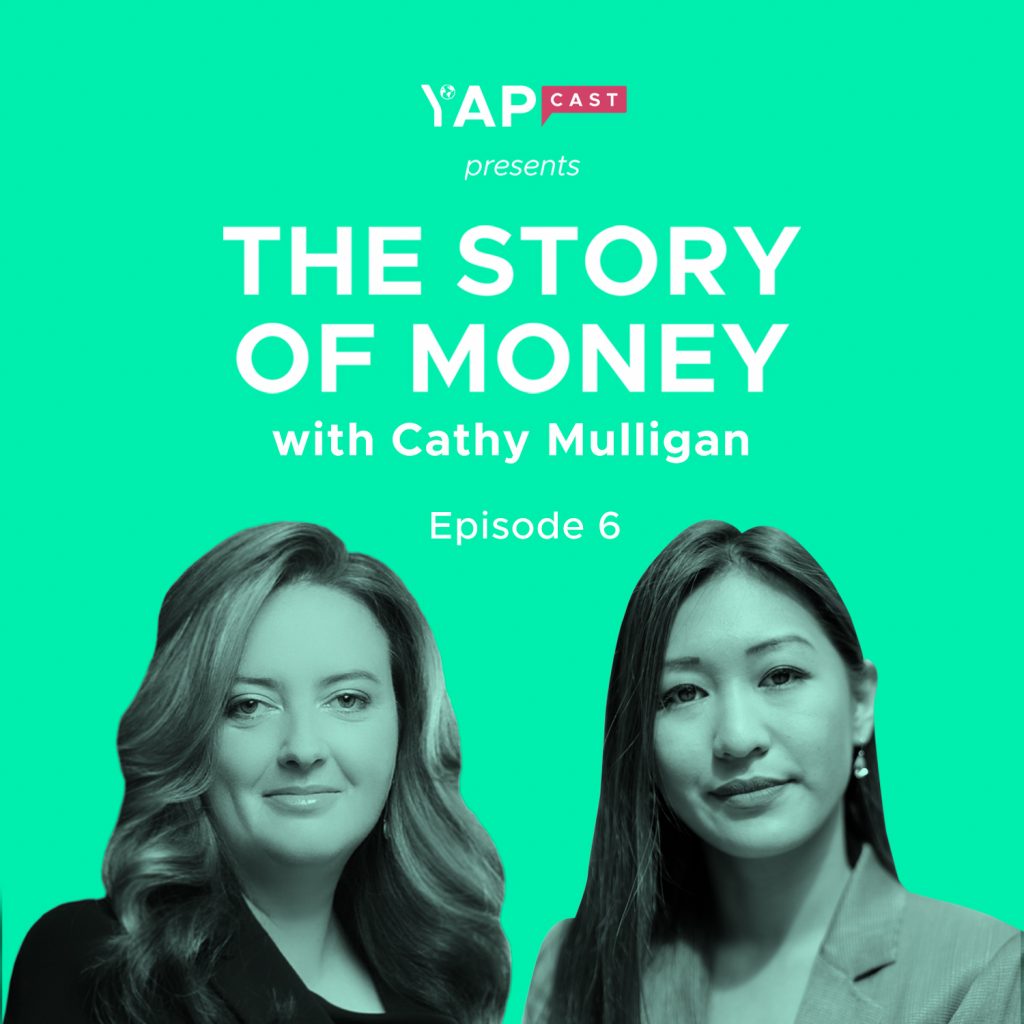
In this episode, Samantha and Professor Cathy Mulligan, the Director of DCentral Lab from the University of Lisbon, talk about how money has come to play a huge role in shaping society as we know it, and has in turn been shaped by an ever-evolving social landscape. They discuss the ways digital currencies may hold the keys to completely rethinking the way we’ve set up our current economic system.
Join Samantha Yap on a quest to discover the history of money, to better understand why Bitcoin, cryptocurrencies and decentralised finance may play an important role in our future. She’ll take you on a 5-minute audio journey that touches on the history behind today’s topic, followed by the best parts of her conversation with a returning guest, Professor Cathy Mulligan.
Cathy Mulligan is Professor of Computer Science and Director of the DCentral Lab that investigates blockchain, cryptocurrencies and associated digital technologies for social good and sustainability at Instituto Superior Técnico, University of Lisbon. Cathy is a cross-disciplinary researcher who has worked at the boundaries of economics, sustainable development and digital since 2006. She has led multiple research projects across the UK, EU, Australia, India and Malaysia. She is a member of the World Economic Forum’s Data Policy Council and has consulted at senior levels for the UN, OECD and various governments across the world. She is a Visiting Lecturer at Imperial College and Honorary Senior Research Associate in the computer science department at UCL. Cathy has over 25 years experience in senior corporate and research roles and has written 7 books on digital technologies.
Episode Transcript
Money as a Social Construct (S1E6) Transcript
Listen on:
Spotify
YouTube
Samantha [00:06]: Hi I’m Samantha Yap, and I help blockchain and cryptocurrency companies tell their stories. I’m really passionate about demystifying emerging technologies and making it easy to understand for everyone.
I’m embarking on this journey to discover the history of money, in order to better understand where money is heading today. In this series we’ll explore why Bitcoin, digital currencies and decentralised finance may play an important role in our future.
Come join me on The Story of Money, by YAP Cast.
Samantha [00:43]: Perhaps the key to thinking about money is that it's an extraordinarily powerful idea. An ideal even, that everything is exchangable. In the words of Jorge Borges, a key figure in Spanish language and international literature, money symbolizes man's free will because it can be transformed into anything, even if that means throwing it all away to find happiness. But as the famous saying goes, “Money can't buy happiness, but it can make you awfully comfortable while you're being miserable”, says Clare Boothe Luce, an American author and politician. The Philosophy of Money is a book on economic sociology by German sociologist and philosopher Georg Simmel, written in 1907. He was fascinated by the notion that money is a perfect means of exchange, able to convert qualitative differences between things into quantitative differences that enable them to be exchanged. If money didn't exist, we'd have to invent it. But he also believed that our social relations are increasingly mediated by money, and they become more abstract and featureless as a result, while our inner lives are rendered more devoid of meaning and value. Does money enrich our lives as well as our bank accounts, or are the two mutually exclusive? Maybe the answer lies in what meaning we ascribe to money, whether we value it highly or see it as a means to an end. The Bible says in Matthew 6:24, “You cannot serve both God and Money”. “Money”, as Nigel Dodd writes in The Social Life of Money, "can be anything or everything, and derives its power from that fact". When the euro was first introduced, there was hope both among policymakers and critics, that somehow, this unified currency might also play a social role, which was to unify member states by building social cohesion among its citizens. That’s not how it panned out, of course. And in fact, the European central bank is far removed from both EU society and governments, basing its decision-making entirely on technical questions like price stability. Its one-size-fits-all is in keeping what Dodd calls, a “sanitized view of money as a cultural-neutral landscape”. So, is money an abstract thing or something functional we prefer not to talk about, like our salary or how much rent we pay? And how does that square with the sense that in societies, money defines us: how much we have, what we spend on, or don't spend on, or what we do with it? To help me unravel what money as a social construct actually means, I welcome back Professor Cathy Mulligan, Co-Director of the Imperial College Centre for Cryptocurrency Research and Director of DCentral Lab from the University of Lisbon.
Samantha [03:41]: Welcome back to the YAP Cast, Cathy.
Cathy M [03:43]: Thanks for having me, Samantha.
Samantha [03:45]: So when the euro was first introduced, it was seen among policymakers as a way to unify the other countries and play a social role. Could you give us an idea of money as a social construct?
Cathy M [03:57]: So, money for me is nothing more than a social construct, but I like your analogy to the euro, because the idea was to create this common “European feeling”. You would feel European in whatever country you went into, trying to create a social identity for Europe. Which I think is probably an important thing for Europe to try and do. However, what we've seen as well is, because of the way the euro got set up, we've also seen that it nearly has torn Europe apart. Before we had Brexit, we almost had Grexit because of the financial situation of Greece. And we saw very passionate discussions from the Finance Minister of Greece at the time, basically saying we need to exit the European Union so we can actually retain control over our own economy and run it the way we want. So that's why in particular for CBDCs, we need to really deeply think through how we're setting them up. The euro started with a great vision, but it’s also almost torn the European Union apart because of design that was not necessarily well thought through, if you will. And the monetary policy of the euro is very, very complicated.
Samantha [05:07]: How well does the system of where money comes from work today?
Cathy M [05:10]: That really depends on who you ask. Sorry to give you such a blithe answer but that phrase, “It takes money to make money” is not an incorrect one, really. So in order to get a $100 or a 100 pound loan, you actually have to have enough wealth for the bank to say "Yes, I will loan you that money" in the first place. So, the circulation of money really works extremely well for those who already have wealth. So I would say, if you went to ask some really rich people or people in the middle class and above, “Does the money system work today?”, they would say it probably functions quite well or relatively well. The issue, however, is that it doesn't really function particularly well for those who don't have pre-existing wealth, or those who can't put up lots of collateral to get those loans to create money. So for example, you might have small businesses that are unable to access credit markets because they don't have enough collateral to put up to secure that loan. Whereas other companies, which shall remain nameless, have so much money that they can just get more and more money in order to continue the domination of the global economy. For me, the current financial system is extremely exclusionary, and in the same way we have a social contract about what money is, we also seem to have a social contract about who can actually have it. There are lots of people impacted by (and lots has been written about this) the level of financial exclusion currently experienced in today's world. So I would say it's not particularly just. I would say, yes, it's functioning but it's not just, shall we say. And a large part of the research that myself and the guys at the [DCentral] lab are doing together with me, is looking at what is the social good that we can create out of these technologies - is there a way to be more inclusive financially or be more inclusive for smaller companies in order to help them access these credit markets.
Samantha [07:05]: You make a good point. Even getting on the property ladder, as people say, people need that 10% or 5% deposit. But not everyone has that cash lying around so they're not able to borrow, and therefore not able to own a home. And I'm sure there's more that people are shut out from.
Cathy M [07:21]: Exactly, and that compounds: the more you rent, the harder it is to save that deposit. But meanwhile, the people who are able to afford to buy the property to rent to you are able to make more and more money, and then go out and buy more property to rent. It's not a dissimilar situation with money.
Samantha [07:38]: So going into the meaning of money, it seems to take a variety of meanings to people. What does money mean to you?
Cathy M [07:46]: That's a very philosophical question. For me, honestly, money means freedom, and that's why I think social justice around access to money and finance is so important to me. Money is freedom in the sense that, if I don't like a job I'm working, I've got enough money to walk out the door and be able to, for example, still have my home. So for me personally, money is freedom. The whole point is that it has a very different meaning for most other people. Well, actually other people say money is freedom as well, but I think everyone has a different interpretation of what it means. But for me it's freedom to have the agency to do what I think is important and useful for the world.
Samantha [08:28]: That's interesting because for me, I see it as a very practical thing- it provides security, like we talk about financial security, you just need to have enough to pay for rent, to pay for food, to live, to get by - so it enables me to do things. I never really saw it as a social thing, but am I missing something here?
Cathy M [08:48]: I think money is massively social, if you think about just some of the ways that money is implicitly used in your day to day life. So, the way that people display logos or talk about what restaurant they went to, inherently, what some people are saying is that “This is what I can afford.” I think it's a very subtle thing, and I think you're right, it's such a practical everyday thing that potentially we don't think about it from a social construct perspective, but it definitely is, right? And if you think about some of the ways parts of our world and our society are set up, the amount of money you have is the calling card to allow you into certain places.
Samantha [09:30]: Yeah, that actually brings me to my next question: how much does money play a role in impacting our social lives today?
Cathy M [09:37]: I think it probably is one of the defining factors in many countries, actually. We might like to think that it's not something that drives our life so much, but I would say try living without money. I will leave you with a challenge Samantha: try not to spend any money for five days.
Samantha [09:55]: That's a really tough challenge. That is a really interesting point because money is like you say, freedom. People say money is power, and yes, money does matter. And you talk about social good, and even for me, I used to be a very naive journalist, I would say. I would want to write about social causes, but really, charities need money to do the work. So, yeah, money is power.
Cathy M [10:22]: I actually would like a world where we don't need charities. Now we're getting into a really exciting topic. So, I think that the need for charities and the need for philanthropy in the world today is an exact and very clear example of how badly our financial system actually functions. And I'd love to understand how we could make financial systems work such that we didn't need charity because everybody was able to have enough financial resources to do the things they wanted to do and also take those loans that we're talking about, to access money and engage the financial system in a way that is really empowering, rather than having to wait for a charity. Can we create an agency for people? I'd love to see a world where we don't need charity.
Samantha [11:10]: Well that is a very powerful point: a world where we don't need charities. How does cryptocurrency change the game with this?
Cathy M [11:18]: So this is where I think it gets interesting, when we talk about things like private money. Imagine you and I run companies. Let's say I'm really good at baking and you grow some of the best tomatoes in the area, and they're always super fresh and tasty. We would be unable to go and access finance to create a joint venture between us that allows us to go and sell fantastic sandwiches to the world because of the way that the current financial system is set up. But what if we could create our own ‘Cathy and Samantha coin’ and say to the world, “Hey guys, you've seen how good these tomatoes are, and you've seen how good her bread is. Why don't you invest in us? And we will give you a promissory note, basically a cryptocurrency coin, and you will earn money off that when we are successful.” So there could be lots of different ways to cut this, but I think we're at the start of cryptocurrencies, Bitcoin is really a thought experiment, to me. I know a lot of people have massive investments in it, but I think it's the start of a thought process that is going to take us for the next 20 to 30 years. But if you think about what you're actually saying, you're saying that what cryptocurrencies, for me, do in particular is give access to small companies and individuals who might be financially excluded. You can give them new ways to engage in the financial system that are truly empowering. Rather than, I don't know if you've ever been to a bank and tried to get a loan and they've turned you down.
Samantha [12:50]: I have. It took me like, two months to get a bank account when I moved here.
Cathy M [12:55]: Exactly, so, it allows us to completely rethink the way we've set up our economic system. A new type of economic system is emerging that is completely based on digital technologies. So I think new types of money are going to emerge, that we won't necessarily understand in the same way as we understand what money is today, but will enable new types of transactions around value using those kinds of digital currencies. For me really, let's put it this way: the price in U.S. dollars of Bitcoin or Ethereum in US dollars is probably the least interesting thing, and I can't understand why everybody's going on about it all the time. You've basically invented a new monetary system, and all you're trying to do now is compare it to the old monetary system. It doesn't make sense to me. And that's what I really think is fantastic and extraordinarily useful around cryptocurrencies. I think it's where we're going to start to see a lot of changes because it demands us to rethink things that we've taken for granted for generations. We’re now asking each other, “What is money?” Actually, it’s what you and I decide it is. Sorry I'm very excited. I'm going to shut up.
Samantha [14:05]: No Cathy, I think we've done some really philosophical and really impactful topics today. Thank you so much for joining me on YAP Cast.
Cathy M [14:15]: Absolute pleasure. Thanks so much, Samantha.
Samantha [14:18]: That was Professor Cathy Mulligan, the Director of DCentral Labs from the University of Lisbon. It was really interesting to hear how she sees money, and how it means different things to different people. For her, as with many, I suppose it's freedom: freedom to quit a job, to take a holiday, or to buy a house. But with that comes a glimpse at just how badly broken our system is, and that the amount of money you have is the calling card that allows you into certain places, and bars you from others. She also talked about how charity is the thing that has come to fill the gap for those who don’t have money, and how she'd love to see changes that would make the system work where we wouldn't need charity. So might cryptocurrency fill that gap? I loved the way she described Bitcoin as a thought experiment. I guess those deep believers wouldn’t agree with that, but she believes this could still take us another 20 to 30 years, and so perhaps it still is that. But it also shows just how radical the change may be - it's helped to frame a discussion where even the mainstream world, even finance ministers and central banks are ready to completely rethink the way we've set up our economic system. Which makes it some thought experiment.
If you’d like to watch my full length conversation with Cathy Mulligan, head to the YAP Cast Youtube channel. I’m Samantha Yap, and you’ve been listening to The Story Of Money, by YAP Cast.