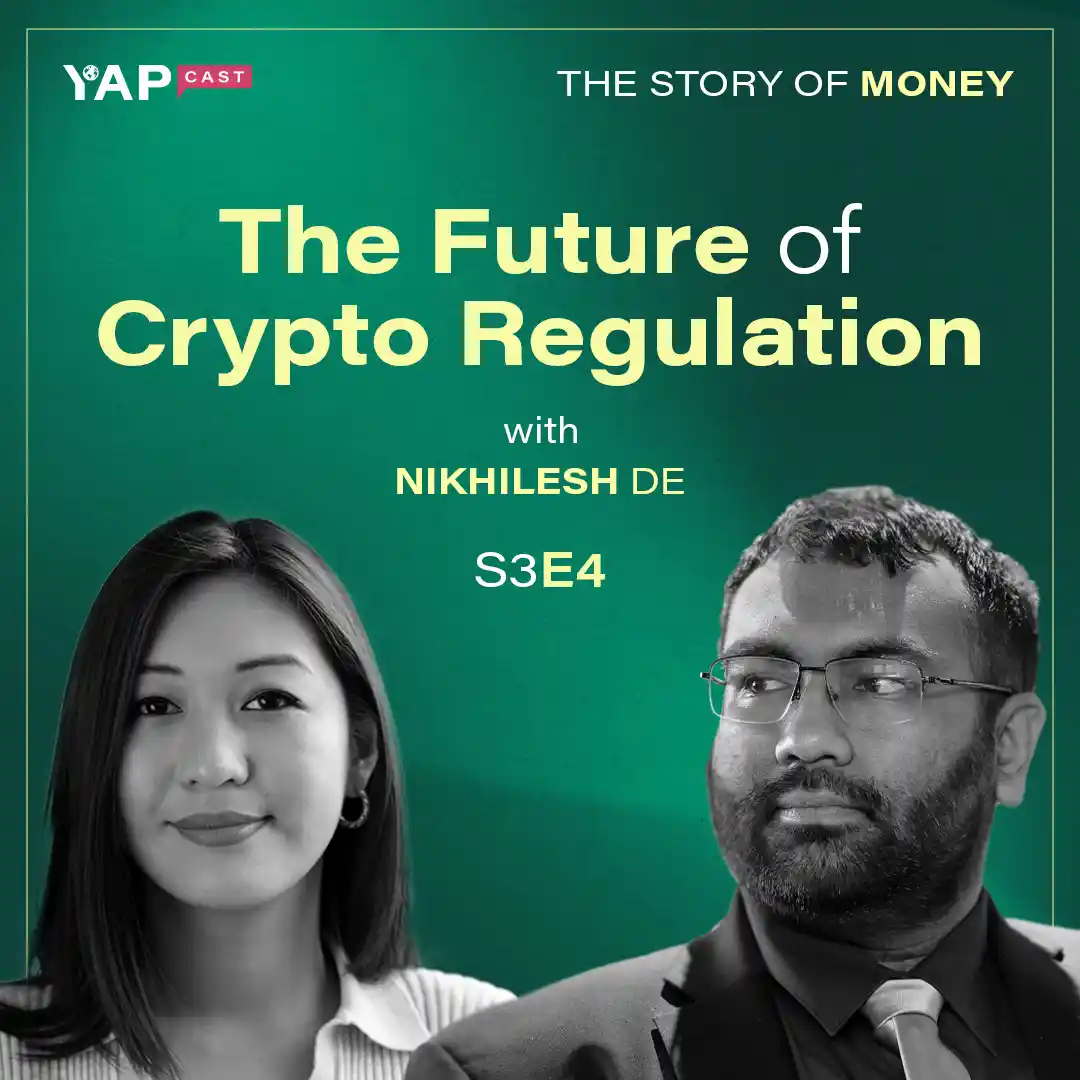
In the first episode of YAP Cast season 2, Samantha Yap is joined by Hart Lambur, Co-founder of UMA: an optimistic oracle built to query and verify data for decentralised finance.
They touch on the concept of contracts, the international localisation issue for financial products-&-services, centralized finance complications, and the role of digital currencies and DeFi in the future global economy.
Join Samantha Yap on a quest to discover how money’s practical relationship with law can evolve to be globally seamless.
Episode Transcript
Episode 1: Law & Money Episode Transcript
Samantha Yap [00:03]: Hi! I’m Samantha Yap. Welcome to of The Story of Money by YAP Cast where we talk about where money is heading. Join me and Hart Lambur on this episode of The Story of Money by YAP Cast.
Let’s start by talking about law and money. How do the two work together? And can we remove parts of the role law plays and replace it with something else?
We’ve had contracts in England since the 12th century, and breaches of an agreement, or covenant, could be settled in court, with damages granted to the victor.
Modern contract law has its origins in the 19th century, but its roots lay much further back. So, could it be replaced with something better and could we replace contracts and lawyers with code?
Helping me understand this is Hart Lambur, Co-founder of UMA, an Optimistic oracale built to query and verify data for decentralised finance. To understand Hart, and to understand the relationship between finance and law, we need to explore Hart's own past. Hart started out in banking, although it wasn't what he wanted to do, and like a lot of his peers, he had to pick things up as he went, he had ringside view of a key moment in financial history: the collapse of Lehman Brothers
Hart’s background, and the realisation from Lehman Brothers that the system was obscure, that no one really knew their exposure.
Samantha Yap [01:37]: I started by asking Hart what he learned during his time at Goldman Sachs.
Hart Lambur [01:43]: So, I was a guy that studied Computer Science in university, and I graduated and randomly, even though I didn't expect to, ended up working on a trading desk at Goldman Sachs. So, I was an interest rate trader focusing on government bonds for eight years, following my university courses. Yeah. My time there was through the financial credit. It was wild and I'll agree with you that going in all of the analysts that get their job at Goldman, I would argue that none of them actually know what they're doing or what their desk does or what their job is. It sort of actually speaks to how big and complicated finance has become, like how many different nuances or niches there are in it. It's wild but like one example that I think is relevant to some of the stuff that has happened in crypto recently was around the collapse of Lehman Brothers. People have talked a little bit like the Three Arrows and Celsius sort of crypto blow-ups which have happened recently. It was sort of like the Lehman Brothers moment for crypto, and I will tell you I was on the trading desk when Lehman Brothers was blowing up, and it was remarkable to have our swaps desk actually have no idea what their risk was, they had no idea what their exposure was, they had no idea what contracts were good, whether people were going to make margin calls. They just had…they were literally like they didn't know their risk to the nearest billion dollars, and it was a function of just the opacity and lack of transparency in the market; and I think it's really interesting because decentralized finance does actually solve this, and yet in some of the crypto issues we've had recently, it hasn't been the decentralized finance bit that's broken, it’s actually the centralized finance sort of opaque and obscure agreements that actually caused issues.
What is a contract?
Samantha [03:45]: What is a contract? We'll come back to that later. But for now let’s stay with the old traditional financial way of doing things, and which Hart worked on before.
Swap trades are a form of derivative, which are financial instruments whose value is derived from the value of an underlying asset.
A swap is just one of several types of derivatives, like forwards, futures and options. So, driving all these trades were contracts.
What are financial contracts?
Hart Lambur [04:20]: Yeah, financial contract is an agreement between two or more counterparties to make a payment under some set of conditions. That's it.
Why do we need them?
Samantha Yap [04:31]: And why do we need them?
Hart Lambur [04:34]: Well, that's where I think it's probably best to look at examples. So, insurance. Insurance is a financial contract between the insurer and the, I guess, it's the insuree policyholder that's going to entitle them to some payout under a set of conditions, and it's super useful. So, we know we need to insure ourselves against different risks, and it's actually a very simple form of financial contract where the policyholder just gets the payout if conditions are met and that's it.
How is it enforced? (Enforcement technology is law, as pursued in a court)
Samantha Yap [05:05]: So that sounds simple enough. A contract spells out what happens when conditions are met. And so, who decides that, and who enforces that?
Hart Lambur [05:15]: What actually is the enforcement mechanism? Like what's the technology that powers that contract? And my argument is, well not argument, it’s true - the technology powering that is legal recourse like it's the legal system. So, we write a financial contract and if I'm in Canada and I write an insurance contract, my enforcement technology are the courts of the Canadian government. For you in the UK, it's the UK courts. Different systems, same concepts, right? And we are fundamentally writing a legal agreement, and that financial contract is really nothing more than a legal agreement. So, one sort of interesting observation here is that most financial products and services that we all use in our daily lives, most traditional financial products and services, really are just legal contracts when you kind of boil them down and distill them. They are legal contracts and the enforcement, the technology that powers them, is the legal system.
The problem: geographic barriers (no common ground)
Samantha Yap [06:13]: That's interesting calling the legal system a technology. Okay, so that's a really great example how, you know, if I engage in, yeah, maybe a financial contract here in the UK, it can be enforced under UK law, you know. But cross borders, I can imagine it gets a little complicated if there's a contract with someone in Canada. And it's like, who determines that? So yeah.
Hart Lambur [06:43]: It basically doesn't happen. Like that's a great point, right? So, if I'm a UK insurer, if you're a UK insurer, I can't buy a policy from you because I'm in Canada, and like I don't have access. Again, we call it a technology. I don't actually have access to the UK court system technology, I’m not part of the UK legal jurisdiction, and vice-versa. So, in Canada, I can't sell you an insurance policy. Of course, everything can kind of get solved if you're big enough, right? If I'm big multinational corporation, I can figure that out so; but at the individual level, that doesn't happen because they're really just different legal jurisdictions, which brings you to kind of like one of the downsides of the financial system, the traditional financial system, today is it's localized. The financial products and services offered in the US are not offered in Canada or in the UK or in Australia, and those are all like countries that are otherwise fairly similar, you know. The internet services that are offered there are all the same. You get - it's the same Twitter; it's the same Facebook. It’s the same all that stuff but the financial products aren't the same, and the reason for that is that the technology powering all those financial products is actually different in each of those jurisdictions. So, this is one of the real like downsides I would argue for the current traditional financial system.
Hart ponders a solution
Samantha Yap [08:13]: So, if we think in terms of technologies, contracts are a legal agreement, and that is the technology. The enforcement mechanism - the courts - are a technology.
So, Hart, what made you switch from high finance to crypto? What made you think this technology could be different?
Hart Lambur [08:33]: I worked at Goldman through the financial crisis for eight years which was far longer than I expected. I never expected working finance in the first place, but it was super interesting and learned a lot and then I left to start a fintech business that was called Openfolio. I should have probably started a crypto business then that was in 2013 before Ethereum existed, but I didn't so. This fintech business was really interesting, taught me a lot about that space, and that got acquired by an asset manager in 2017. And then I'm sitting there and I'm looking at smart contract platforms like Ethereum and based off of my background and my finance experience and my CS experience and my own academic interests, I'm thinking this is like a very interesting intersection of things I'm interested in, and it seems obvious to me that we should figure out a way to write financial contracts on a blockchain or on a smart contract system. Maybe a little bit naive at the very beginning because this is actually quite hard to do, but that was you know before DeFi as a term existed or was invented. And I think there were a segment of people that also had a similar thought. It's like look these smart contract systems would be a really cool way to recreate finance and recreate it in a way that is global by default and is permissionless and has like lower barriers to entry. And I think that is the kind of the origin of where DeFi started.
Samantha Yap [10:10]: So Ethereum, we know. Let’s talk about Ethereum. Ethereum was built by Vitalik Buterin to develop the idea that a cryptocurrency could be more than just a currency. It should be possible to use the underlying blockchain technology for anything, like decentralised applications, or Dapps, connected to the blockchain by slices of code called smart contracts.
Solution: the smart contract
Samantha Yap [10:34]: Right. So, let's get into smart contracts, and how it changes the game. What, in your own words, are smart contracts?
Hart Lambur [10:42]: So a smart contract is a bit of code written on a blockchain that will execute some logic. Let's put it that way. And I think now, maybe to make the analogy a bit crisper, let's talk about like a financial smart contract. So, my earlier definition of a financial contract: some agreement between two or more counterparties to make a payout under some set of conditions. A smart financial contract here would be implementing that logic, that same thing on a blockchain. And to keep just rolling with this for a second, if you do this in the pure sense, which I think is what we should talk about, and what's most interesting. The enforcement technology now is no longer the legal system. I'm not using a legal system to enforce this technology. I'm actually using blockchains and economic incentives. So, I'm solely using blockchains and economic incentives to compel these counterparties, to follow the terms of contract, and that is very different.
Implication: inventing a new contracting system
Samantha Yap [11:54]: Yeah, right. So, you're basically saying the technology you're referring to was is the legal system like the courts, the laws of a country. Now you're saying that a piece of code can replace that or is already replacing that. Is that right?
Hart Lambur [12:10]: Yeah. I'd take it a step further and say that it's almost like inventing a new legal system. And it's not a legal system but it is a method of contracting. If you think like abstractly think like contract theory. So, the contract theory right now is: we write contracts that are or traditionally are legal contracts, and now we're writing contracts that aren't legal contracts. They're enforced in a completely different technology. So, we have, in essence, invented a new system of contracting, and this new system of contracting just has trade-offs straight up its like different, and has a different set of trade-offs towards the way traditional financial contracts work, and it's also like super cool and super interesting if you kind of think about smart contracts and blockchains in this light. We aren't just inventing like a new database or something like that; we've actually invented an entirely new way for counterparties to enter into contracts, and I think that's like you don't invent that very often it like hasn't. They haven't invented a new form of contract in the last 200 years, so I think that's kind of exciting.
Samantha Yap [13:23]: So, there we have it for this episode. Hart’s journey has taken him from the financial apocalypse of 2008 to reimagining how one party seals an agreement with another, and how that agreement, that contract is executed. Next time we’ll explore how this works, or doesn’t, and what this all means.
Thanks for tuning in to another episode of YAP Cast. I’m Samantha Yap. For new episodes, follow The Story of Money by YAP Cast.