How do we assign value to something that is mutually accessible, and in an understandable format?
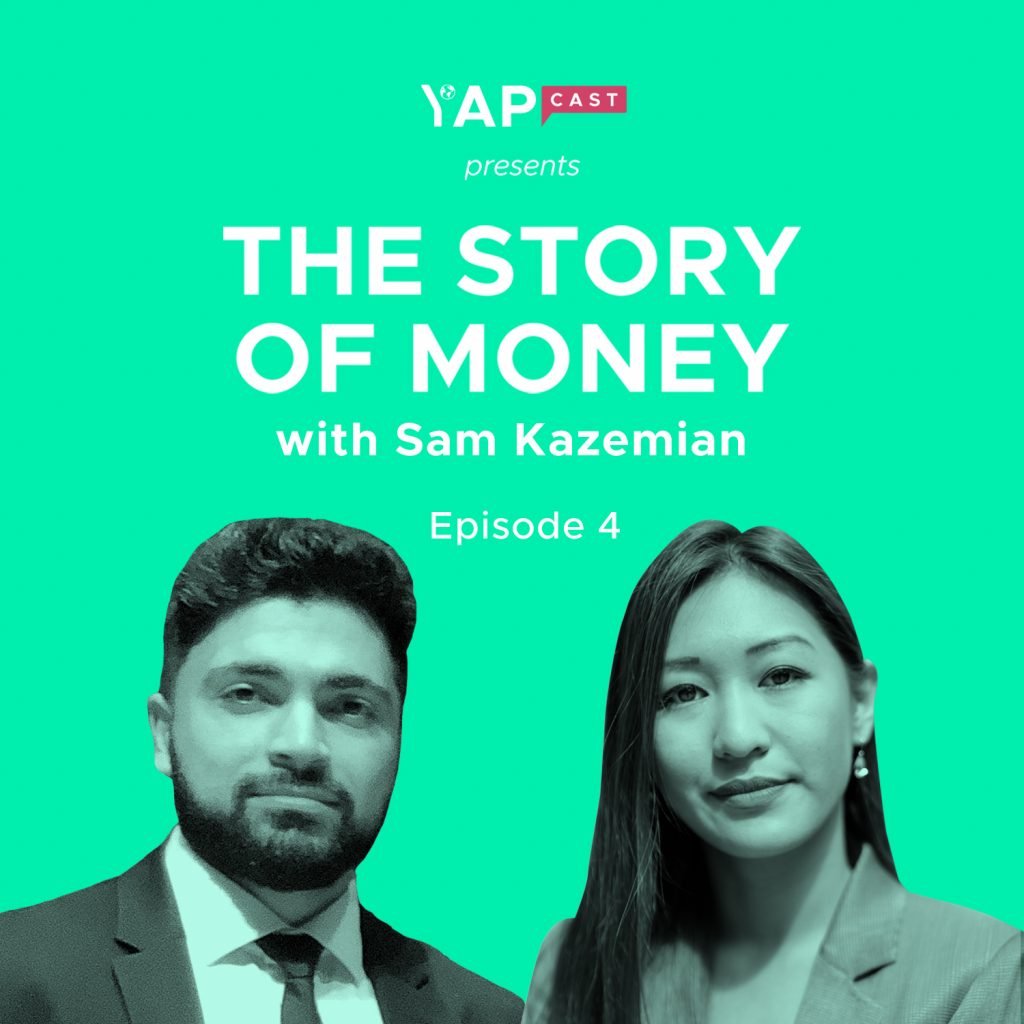
In this episode, Samantha discusses the denomination of money with Sam Kazemian, the Founder of Frax Finance. They touch on why we need a standard unit of measurement to coherently communicate value to each other and why stablecoins may present a more viable alternative to Bitcoin in being the currency of the future.
Join Samantha Yap on a quest to discover the history of money, to better understand why Bitcoin, cryptocurrencies and decentralised finance may play an important role in our future. She’ll take you on a 5-minute audio journey that touches on the history behind today’s topic, followed by the best parts of her conversation with our guest of the week, Sam Kazemian.
Sam is a software engineer, entrepreneur, and cryptocurrency enthusiast. He is the Founder of Frax Finance, a decentralised stablecoin protocol. Frax is the world’s first hybrid, fractional algorithmic stablecoin protocol that is partially backed by collateral and stabilized algorithmically. Frax is open-source and permissionless, bringing a truly trustless, scalable and stable asset to the future of decentralized finance. Sam is also the co-founder of the blockchain based knowledge base, Everipedia.
Episode Transcript
Ep 4 How Do We Measure Money? Transcript
Listen on:
Spotify
YouTube
Samantha [00:06]: Hi, I’m Samantha Yap, and I help blockchain and cryptocurrency companies tell their stories. I’m really passionate about demystifying emerging technologies and making it easy to understand for everyone.
I’m embarking on this journey to discover the history of money, in order to better understand where money is heading today. In this series we’ll explore why Bitcoin, digital currencies and decentralised finance may play an important role in our future.
Come join me on The Story of Money, by YAP Cast.
Samantha [00:43]: We’ve touched on credibility and trust in money, now let’s look into the denomination of money. In other words, how we measure money. Denomination is the monetary unit in which something is priced or measured. I see a shoe I like, and I ask the price. I will be told the price in some kind of unit: the national currency, or national unit of account, or the US dollar, most commonly. But it could be anything. It is what the seller feels is the most valuable and liquid currency, or equivalent. In short, it enables the seller to assign a value to the shoes in a mutually accessible and understandable format. Denomination is important then, for someone wanting to acquire something, and for someone wanting to sell something, or for agreeing on who owes who what. Now if we didn’t have that agreed denomination, we’d be bartering. One cow for 10 chickens, say; or half a horse for one husband? So, who agrees what that common currency is? Well, anyone, really. We’re actually already used to value being denominated in different ways. Nowadays, most online games or apps we use, it seems, have some form of coin that we earn and trade for things, possibly, even real money. It’s the same with credit card points or frequent flyer miles.
Samantha [02:09]: The calculation for us is whether what our money is being converted into is worth it. Is it worth trading my credit card points to buy a new TV or discounted flight tickets for a holiday to Italy? So what do we learn from this? First off, you care what the currency is denominated in. Second, even if it’s something you recognise and like, you still need to trust the person who is controlling it, be it the gaming app or credit card company. Which is why in most cases it’s a government that denominates a currency. After all, we trust them right? Sort of. Governments really want to be in charge of denominating the measure of value. Indeed, an independent currency is one where all the payment instruments (a fancy way of including not just money in circulation, but the other bits of money we don’t see) are denominated in the same currency. This means overnight deposits of commercial banks at the central bank, the central bank’s reserves and all that, need to be denominated in the same currency for that currency to be considered independent.
Samantha [03:16]: Currently, the USD is the de facto global currency, accepted more or less everywhere. From street touts to central banks, the USD is welcome. Governments, however much they think their own currency rocks, will keep a tidy sum of USD stashed in a vault somewhere. According to the International Monetary Fund, the U.S. dollar makes up over 60% of all known central bank foreign exchange reserves. The history of that is something we’ll explore in my conversation with today’s guest. It’s fine for a currency not to be independent, like those countries which have adopted the Euro, for example. But the point about being independent is that whoever runs that currency is free to dictate the convertibility of it. In other words, make it easier or difficult for people to swap it for another currency, and this is where things get tricky. For example, when Argentina's economy was in recession around 2001, its USD-pegged Peso eventually collapsed once the peg was removed. After the government had limited the amount of cash that could be withdrawn from banks, Argentinians had a problem. What could they use to buy stuff? Ever inventive, they replaced the Peso in daily transactions with IOUs, initially Peso-pegged, but eventually using their own denomination. What happened here is that the government effectively had to choose between preventing the flight of local currency into a foreign one (as everyone preferred dollars) by rationing the supply of cash, or risk the danger of losing control of the monetary system.
So, governments use denomination to maintain control of their monetary system. It is an act of sovereignty. If you can control how your citizens denominate what they produce, and sell et cetera, then you can, in theory, control the country if you control the currency of denomination. But this might change with the cryptocurrency revolution. Bitcoin and Ethereum as decentralised cryptocurrencies pose a threat to national currencies and to governments. But stablecoins present an in-between solution before Bitcoin or Ethereum get widely adopted. Stablecoins are in the name - a stable form of currency that offers price stability, that is backed by an asset. The most widely adopted stablecoins are backed by, and pegged to fiat currencies like the USD. To talk more about the promise of stablecoins, I’m excited to have Sam Kazemian, the founder of Frax Finance, a decentralised stablecoin. In more detail, Frax is the world’s first hybrid fractional algorithmic stablecoin protocol. We’ll get into that later in the conversation.
Samantha [06:08]: Sam, welcome to the show.
Sam K [06:10]: Hey, good to be here, Samantha. Thanks for inviting me.
Samantha [06:12]: No worries. So tell us a little bit about yourself Sam, what's your background?
Sam K [6:16]: So basically, I got into cryptocurrency a long time ago now, around 2013. I heard about it while I was in college at UCLA. It's funny now, as one of the first cryptocurrencies I started mining was DogeCoin in early 2014. It's pretty crazy how far DogeCoin has come since then. After college I started my first company called Everipedia, which is like a decentralised Wikipedia. My interests in crypto really are about the aspect of cryptocurrency as money and what money actually means, and where the evolution of crypto as money is going to go. So in 2019 I started Frax, which is an algorithmic stablecoin. It's the first fractional stablecoin, that’s basically what we call it. I'm currently working on that full time, and it's been really fun.
Samantha [07:07]: Awesome. Do you still have a lot of Dogecoin?
Sam K [07:10]: I have more than enough, thankfully. But realistically, at this point I accidentally sold a lot of it in the first bull market, just trading and doing other stuff. So I am like the Bitcoin pizza guy, the guy that everyone makes fun of every year. I’m like the Doge pizza guy. I didn't buy any pizzas, but I would have probably done better if I just never touched it. So now, a lot of the cryptocurrencies that I have I just don't bother touching, because I don't want to pull a Doge on this one.
Samantha [07:42]: Yeah, just for our listeners, the first Bitcoin transaction was a guy buying pizzas with Bitcoin. How much Bitcoin was it back then?
Sam K [07:50]: It was 10,000 Bitcoins.
Samantha [07:54]: So every year there's a Bitcoin Pizza Day, and people calculate what the price of Bitcoin is that day, and then remind this guy who bought the pizzas.
Sam K [08:04]: It's a really good way to start this just as an aside, but think about how weird that is. It always gets me thinking, you call these things cryptocurrencies, there's the word ‘currencies’ in it, and everyone always says everything is gonna be denominated in Bitcoin, yet, we have a Bitcoin national holiday, so to speak, every year where we're like, “Wow that was the most expensive pizza in the world”. I just find it funny because his name is Laszlo, and you’re thinking, “Laszlo will never forgive himself”, it's just weird, right.
Samantha [08:42]: A lot of the world's transactions and trade today is denominated in US dollars, even when you travel. I was born in Malaysia, I’ve lived and travelled a bit throughout Southeast Asia and every time you measure how well the currency, for example, the Indonesian Rupiah or the Malaysian Ringgit is doing, it is denominated in US dollars. That's how it is reported on and measured. I wonder how the world has decided that the US dollar is how things are measured?
Sam K [09:15]: Not getting into the history of it or anything because a lot of people have opinions like "Oh, well the US military forces the entire world to use it", or something like that. The thing I think is important from an economic perspective is that whatever the world currency or the predominant currency that's being used in trade happens to be - it's currently the dollar, it didn't always used to be the dollar, it used to be gold at some other point - but the point is that it's like the SI unit of value. So if you think of SI units, meters are for distance and joules are for energy, and so son, obviously there's no SI unit for money. But if you think about it, we all need one. Most people need one to be able to coherently communicate value between each other. Imagine if I quoted you every price in toasters, and I said, “My laptop is worth about 42 toasters”, and then you said “Well, my laptop is worth two dryers”, that would be impossible for people to actually understand each other. You wouldn't be speaking the same economic language. Thing about currency or the predominant world currency is that everything is denominated in it, because it's a coordination mechanism for us to talk about value, the same way that metres are a coordination mechanism for people to talk about distance. And the question becomes what's a good unit? Is it something that's going to significantly change your standard of living across time? Or is it actually something that is completely neutral to the average person's standard of living? That idea is a very powerful idea, and I think most people just gloss over that. Most people just think that a dollar is just worth whatever it is. No, there's actually some thought put into the exact purchasing power of this unit that we all use as a SI unit of account.
Samantha [11:12]: So the US dollar is definitely a unit of account that we all still need today. I’ve been in the crypto community for three years now and I feel like people make comments about the US dollar, but it is a system that still underpins a lot of the way the global economy works today. In a previous episode, we touched on Bitcoin and how that might be a future form of money. People call it ‘digital gold’ or ‘the gold standard’. I'm not so sure about this, but where do you stand on Bitcoin?
Sam K [11:47]: First of all, I have Bitcoin. I think it's a good investment, I think it's very revolutionary. But one of the first things that I said, which we've talked about here, is that I think ‘good investment’ and ‘good currency’ are mutually exclusive. I think they're in conflict with each other in terms of what I think a currency is supposed to be, and what currency currently is in the world in terms of the dollar. So, the important thing to get at here is that most proponents or most people who are saying that Bitcoin is not only a revolutionary new technology but everything will be denominated in it, it'll be the currency of everything. In fact, the other day, admittedly, El Salvador passed a full law, and that basically made Bitcoin the national currency, like the US dollar, which is also accepted in El Salvador. So that's interesting, that's a counter argument to something that I think, which is that Bitcoin is not a good currency, it's a good investment. So my personal view is that Bitcoin as a stable unit of account is not possible. One of the main things that people say is that as the market cap gets bigger, it's going to be less unstable, it's going to be more and more stable and predictable. I think that the data actually shows that this is not correct. Last month in May, Bitcoin had its most volatile month in its entire history. It went down by about 50% from its highs of around 60 thousand into the 30 thousands, and it's currently in the high 30 thousands range. And that was Bitcoin at over a trillion dollars of market cap. So I've been in this space since Bitcoin had a couple billion, and it's basically 500X to 1,000X since I got into this space, and it's just had its negative 50% month.
Samantha [13:39]: And we're speaking in May 2021.
Sam K [13:43]: Yes, and that doesn't mean it's bad or it's a scam or anything. I not only hold Bitcoin, but I also think it's something that will go up in value over the long term compared to the dollar. But the fact that we compare it to the dollar, again, is evidence that it's not a good currency. So there’s evidence for and against, and it's difficult to say what's objectively right or wrong: that Bitcoin is a good investment, but bad currency; or that stablecoins are good currencies, but bad investments. But it'll be interesting, and I'm very bullish on Bitcoin as something to make a lot of money on. But I'm not bullish about the fact that poor Laszlo is ever going to not get made fun of for spending 10,000 Bitcoins on two Domino’s pizzas. Just imagine people making fun of you for spending dollars on pizza - that doesn't even make coherent sense.
Samantha [14:37]: So, we've talked about Bitcoin and how there are people who are of the view that we should head into a world where items are denominated in Bitcoin, and then we've talked about how currency is meant to be stable. And so, one of the solutions to this is stablecoins as an in-between. You're the founder of Frax, a stablecoin. Before we get into that, could you explain in an easy to understand way, what is a stablecoin?
Sam K [15:06]: Yeah, so the cool thing is that it's in the name: A stablecoin is an on-chain cryptocurrency token that's meant to be price stable. So it's meant to either follow some peg, and recently they don't follow outside pegs, but we can get into that. So for example, most stablecoins are pegged to the dollar, one token is just one dollar. Those are the predominant stablecoins. There are some that are euros or other things, but just like how everyone uses the dollar, most cryptocurrency exchanges and people also use US dollar-denominated stablecoins. The most famous ones are Tether and USDC. Frax is one that we started and it is pegged to the US dollar. It's exactly the opposite of the other cryptocurrencies, in that it's not an investment. You don't actually hold Frax if you want to get rich. So typically, before Frax launched, the idea behind stablecoins on the blockchain was that there'd have to be more cryptocurrency backing it. But the unique value proposition of Frax is that Frax is actually the first fractional reserve stablecoin - that’s where it gets its name from Frax - fractional currency. It’s like a classical bank, but completely decentralised and on the blockchain. Frax isn't fully backed. So for example, for 120 million Frax there's only $100 million worth of cryptocurrency in the reserve. Everyone can still come and redeem their Frax for dollar value, but there isn't one-to-one backing. And so usually, the next question becomes, "Okay, what happens if there's a bank run?” What happens if all 120 million people want to come, redeem their Frax and there's only 100 million? You've just created the classical fractional reserve bank. The cool thing about Frax's design is that it uses on-chain smart contracts and algorithms, so that as soon as people are trying to redeem a lot of Frax stablecoins, it actually mints the second token - the thing we talked that’s the investment asset, the Frax share - and it uses that to immediately buy cryptocurrency on the blockchain and fill the reserve to keep it from running out. There’s no way the last people would be holding a useless unbacked token. The fact that it can robustly do that programmatically instils confidence. You actually just don't need a full backing.
Samantha [17:32]: Right, thank you so much for explaining that. It sounds like there's a lot of math behind it all. When you talk about how you can print money, I'd say, some people will be concerned about that because they'd go, "Well then, couldn't you guys just print more money if you wanted to take out 5 million? You just print it and then you take it out?" Is there a mechanism that stops that?
Sam K [17:54]: So, the whole point with Frax currently is that it's pegged to the dollar. What's interesting is, all of the smart contracts and on-chain and algorithms only do things if the price is $1. We can't just mint a bunch of Frax, print money and basically do a bunch of stuff that would break the entire system. And that's actually why blockchain tech is really important because people can see the code, they can see that this is actually decentralised because the peg is exactly $1. And whatever the peg needs to be to stay at a dollar is the actual amount of Frax that's circulating and no one else can change it. I can't go and increase the supply of Frax to make the price go down and I can't decrease the supply of Frax to make the price go up to 2, 3, 4, or 5 dollars or something. So we can only actually just see the protocol function according to the smart contracts, basically.
Samantha [18:48]: And I think that is a great way to end the show for now. For those who are interested in Sam's work, do follow him on Twitter. We look forward to seeing what Frax is going to achieve in the coming months and years.
Sam K [19:01]: Thank you so much for having me on, it's been a pleasure.
Samantha [19:04]: Thanks for joining us on YAP Cast.
Samantha [19:07]: So we heard Sam Kazemian of Frax talk about denomination. It comes back to what we've mentioned before - that money, currency, or anything else of value plays several different roles, and we need to understand those roles to get the most out of it. Bitcoin has gone up and down like a yo-yo and its defenders say, “Yes, it's gone up and down but it's mostly up”, and they say it will get less volatile. But as Sam points out, that hasn't happened. It's actually more volatile now in percentage terms than ever before. So you can be a fan of Bitcoin as an investor, believing that on balance it will go up, but that's not what you want out of money that you're using to buy things with on a daily basis. Hence, stablecoins. Sam argued his Stablecoin is more stable than other stablecoins, but we're probably much too early in the game to make that call. His most important point is a good one: we need to denominate values in a way that we can agree on. Using the same currency means we're both speaking the same financial language. That language, at least across borders, is the USD. But why is that? And why can't it be something else? We have a standard unit to measure everything else in our lives: height, area, volume, how much we should eat of different kinds of food. Why do we default to a currency run by one country as the internationally recognised measure of value? It’s a good question and one we'll be looking at in more detail in the episodes ahead.
If you’d like to watch my full length conversation with Sam Kazemian, head to the YAP Cast Youtube channel. I’m Samantha Yap, thanks for listening to The Story Of Money, by YAP Cast.