Introduction
Voiceover:
Welcome to The Story of Money by YAP Cast where we explore the past, present, and future of money. I’m Samantha Yap.
Intro CTA - Spotify
Follow The Story of Money by YAP Cast to learn more about where money is heading.
Intro CTA - YouTube
Subscribe to The Story of Money by YAP Cast to learn more about where money is heading.
Universal Basic Income is not a new concept and there have been several experiments with it around the world, but UBI is yet to be implemented on a widespread scale.
I’m curious to learn more about how blockchain technology and decentralised finance introduces a new way of distributing UBI.
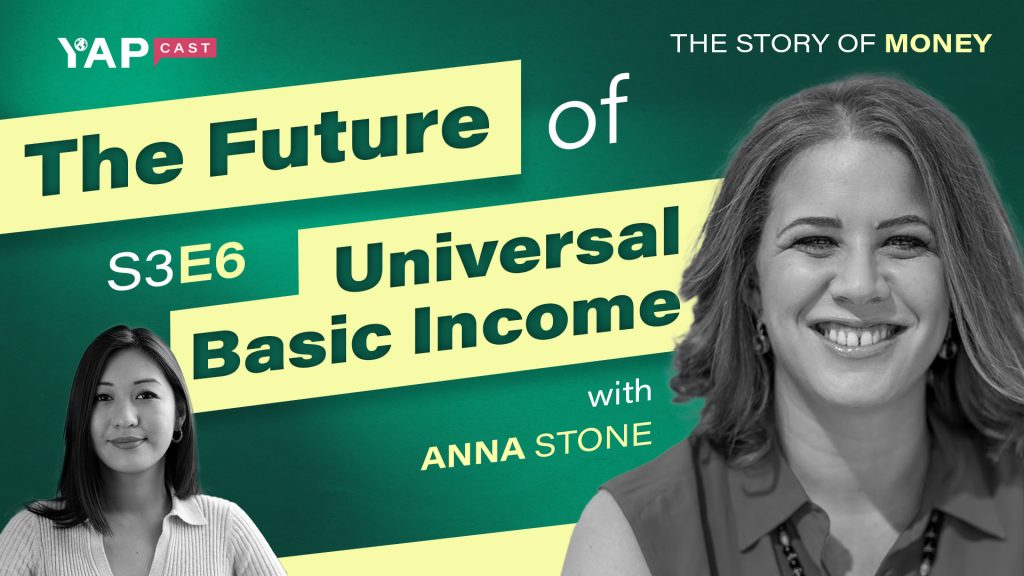
Let’s jump back into my conversation with Anna Stone, Co-Founder of GoodDollar, a crypto-based UBI project, as she delves into its practical implementation and touches on the challenges associated with implementing it at scale.
Anna is an expert in the field of technology and social welfare, with a focus on building a sustainable and effective model for a crypto-based UBI.
Empowering Communities with Use Cases and Value
Samantha Yap 28:36
What does one GoodDollar token mean for someone in Vietnam or in Latin America?
Anna Stone 28:52
Okay. Right. So, I mean, I think it's important for us to like, one GoodDollar are fractions of cents on the dollar. Okay, so one GoodDollar is like, not very much. What I will tell you is that if, let's say you started claiming, when we first launched and you've claimed every day for the past two years, at this point, you would have around $10, 10 US dollars worth of GoodDollars, right? That might not sound like a lot to someone like you or me who's used to operating in an advanced economy, it might not seem worth your time, okay? But for people who otherwise have no access or exposure to any other sort of US dollar-based currency, or any other source of passive income, this actually becomes a big enabler for people. And I think what's important to understand is not just what's the US dollar amount that each individual gets, it's actually what are the ways that people can use their GoodDollars in their communities around them that enable them to do more activity, right? Like what is the goal of those funds?
The goal of the funds is to enable people to actually buy more goods and services and improve their own lives, right? Like that is the goal, the money. And so even though like, you know, okay, if you claim every day for two years, you end up with $10. It might not sound like a lot until you understand how other people around you; your community, whether it's a local community, or a digital community provides the infrastructure where, wherein you can use those GoodDollars to do more economic activity than you could have with just the Dollars or the Naira or the Pesos that are in your bank account, right, or that you have attributed to your name. So, this is where the use cases become really important, right?
Impact on the Brazilian Favela Economy
So, we see really, really interesting applications of people using GoodDollar as I want to, say a global digitally native complementary currency. And I'll give you a few examples.
One is like in a local setting. So, if, we have an amazing community in Brazil that's led by a woman named that Christiane and Christiane is, she's always, she lives in one of the largest Favelas in Brazil and Favelas have really interesting circular economies of their own right? Where people are actually rather than transacting using Reals, in this case, people are like, you know, exchanging goods and services, there's a big barter economy, there's a big time share economy, etc. And one of the things that Christiane has done is she's actually moved a lot of that activity on to GoodDollar. So, she has people now.
First of all, she's hosting workshops that's focused off of getting hundreds if not 1000s of women and girls signed up in GoodDollars. She has opened up a secondhand shop that now buys and sells secondhand goods for GoodDollars. She has opened up a, actually, I want to say it's like a fashion line, she makes bags. She works with women to design these bags, where actually there's a full circular economy in GoodDollar based around that. So, she pays people to collect plastic and trash from the Favela. And she actually then pays them in GoodDollars for separating out the trash, she pays another set of artisans for assembling the bags. And then she sells the bags in her second-hand shop for GoodDollars, right? So, all of those women that she's on boarded over the course of the past few years, they actually have the currency within which they can buy the bags in the shop. Right? So here's an example of like, this is when I said money is a tool, right? At the beginning. GoodDollar is actually a tool that is enabling these women to collaborate with each other and these women to put dollar value that has a liquid price in US dollars for a currency that you can cash out into USDC or in Ethereum or Bitcoin and actually create value, create wealth around these activities that in the past was just like being done without any associated capital formation. Right? So that's one I think, really important example.
Samantha Yap 33:30
That's a great example. Yeah.
Anna Stone 33:32
Yeah, we love it. Like it's like so inspiring to see. I've never met, Christiane is one of the most incredible builders and entrepreneurs I've come across during the course of my career.
Samantha Yap 33:41
Yeah, that's so entrepreneurial.
GoodDollar's Impact in Ghana and Nigeria
Anna Stone 33:44
Ah, no, she is unbelievable. And so, it's like, when we think of who are we trying to empower, right? What's the goal of GoodDollar, it's actually to empower someone who's like Christiane to use this money as a tool to create what's useful for her own community, the goods and services that are useful for her own community, using this decentralized money infrastructure that we've created, right? Or that GoodDollar provides. Another example, I think, is seeing what's happened with, we have a really, really, as I mentioned, we have really strong communities in Ghana, in Nigeria, and there again, just so many entrepreneurial individuals who have, you know, in Africa, mobile money is a really popular use case. People are really used to interacting with, you know, as a store of value, right?
Well, mobile minutes has actually been used as a store of value and both as a medium of exchange in those economies. And so, we've seen many, many, many, I want to say hundreds now, of individuals throughout Nigeria and Ghana who have actually been their own entrepreneurs and again, opened up good dollar for airtime shops, right?
So, where people can actually where their community members, their friends and their families are able to come to them and say, "Here, I've got these 50 GoodGDollars, can I get some MTN minutes", right? And they're facilitating GoodDollar to airtime swaps, basically. So, people are able to use their GoodDollar UBI to get into data and mobile minutes. That's another great example. So, it's like that is because the individuals on the ground have actually been very creative and very ambitious and very entrepreneurial, in terms of creating value around the GoodDollar and creating value around what goods and services are useful for the people around them to use and to be able to buy.
Empowering Community Finance in Cameroon
One last example, which I think is really, really cool, because it relates to DeFi, right? It relates to like, it relates to what is the role of DeFi here, I think. And another amazing community example is actually what we see happening in Cameroon. And so you know, peer to peer finance is actually nothing new when it comes to unbanked populations. Because when you are underserved by a bank, right, like the only people you have around you, or the people around you are your community, right? So, if you or I want to like go to a bank and say like get a loan, we can do that. Right? If you don't have a bank, like then the only place where you can look for credit is your community. And so, this is nothing, this is nothing new, this is something that's been happening for 1000s and 1000s of years, that there are all different sorts of community finance innovations that enable people who don't have access to traditional financial services to essentially pool their capital, use it in a community setting that enables, you know, individuals to actually have money or have access to capital when it's needed.
One of the most popular examples of this is something called Saving Circles, right? So, getting 20 people today, together, getting them saving their money, you contribute a certain amount of money every week to the group pool. And then the group has a pool of capital where if someone has an emergency, and they need to take a loan, they have it in the pool, or if, or you know, there are different rules of engagement for different types of community savings circles. But this is a very well-established practice, right? And what we see in Cameroon is actually a group that is now taking these very well-established principles and habits and human behaviors regarding community finance, community savings, it's called Tontine, Cameroonian French, and they are using it in a digital context.
So, they are now saving together using their GoodDollars. And the way they are pooling and deploying the capital is now instead of keeping it as physical cash under the mattress, right? They actually have this money on chain. And they're able to use it to say, like deploy liquidity and earn fees, and begin to explore using some of these funds, like in other financial products that typically like you have no access to, if you're just operating in a cash based, fiat-based economy. Because it's digitally native, not only is it easier for people to save, and collect as a group, but also you're able to do more and create more wealth off of that, off of what's the money saved, because you're actually connected to a larger ecosystem of finance, right? And so, these are some examples.
Again, this is started by like a community leader in Cameroon who came up with this innovation. And now he's actually, you know, working with a range of different dApp companies that are trying to build community savings apps, and he's using his learnings and his best practices to inform their product development, right? And so, it's just another example of like, how you're lowering the barriers to entry of what it is to participate and how you're lowering the barriers to entry for who can be a builder in web3.
Samantha Yap 39:15
Yeah, wow, this is, those use cases are so powerful. I mean, we started this conversation talking about UBI in the US and the UK and in different states. But you've just launched this crypto based UBI system, and then you've just shared a use case in Brazil and Ghana and Cameroon. How did this all come about? Like how did you get the word out? Or did you just, I mean, yeah, I guess everything in crypto right now. It's like it's kind of like an experiment, but you've done it, so yeah, how did you find all these stories and get the word out about GoodDollar and then understand what, how to use it?
GoodDollar's Approach to Global User Acquisition
Anna Stone 40:03
So first of all, I would say is that like, regarding like, getting started, we were really adamant about the fact that like, there was no way of knowing all the things that we would know, that we would need to know upfront. And that the best thing to do would be to, let's say, try to make smart decisions around how we hope the currency would function and then get started and see how people use it. Right?
So, I think from a builder perspective, we tried really hard to understand like, very responsibly, like, if we're going to be giving out tokens, how do we want those tokens to behave but then also not being, let's say overly academic or overly didactic around, there was no such thing as a perfect UBI model, there still is no such perfect thing as a UBI model, right? So not being fazed by that and trying to get started.
Regarding user acquisition, first of all, like I said, it's there are countless millions and millions and millions of really talented, ambitious, hardworking people who exist all over the world who were just born not necessarily in the right "coordinates" and actually are looking to crypto as the onramp to their greater financial future, because they are paying attention, right? Just like how people in the US are paying attention and see crypto and Decentralized Finance and blockchain as a pathway to creating a new asset class and creating new goods and services. Guess what? People all over the world are paying attention to this and particularly people who have no existing payment rails or no existing savings accounts. Like you don't have to tell them the value of crypto, they understand the value of crypto, can they, do they have money? Do they have access to it? Is it easy for them to begin to access the asset class? That's a different question. Right? But like, do people understand that you underbanked people who are unserved by traditional financial services and who have no assets? Do people understand the value of crypto? You bet they do? Right?
So, like, that is not the problem with the sell, if you will. I'd say, how do we know these people? Like how do we know What their needs are? How are we building for them? Um, we've, like GoodDollar’s not a new project, right? I think this is where having some longevity in the market and having had the time to build out like a pretty robust community and getting to know that robust community and building that trust really comes into play. We've tried really hard to make us, our community as open a place as possible, and to make like the core team, "as accessible as possible" to the community. You know, we host open community calls, it's always fascinating to see you who joins from all over the world, we have, like, you know, we meet people, they show up, they ask us their questions, they want to share what they're doing, like, we've tried really hard to, you know, to do our best to make ourselves easy to find and trusted figures in terms of people approaching us. Having said that, like, you know, there are a lot of challenges, right? Like, we're a really small team, we're serving a ton of different users. The journey and financial empowerment journey is completely and totally different whether you're talking about Brazil, or whether you're talking about Ghana, or whether you're talking about Indonesia, right? Like, across every level, right? The income levels are different. The bank, the existing infrastructure and banking system is different, the currency is different. The levels of inflation are different. What fiat off-ramping means is different, right?
So, there's like, a lot of challenges, both product and communication that come from operating so globally. But I think the flip side of that is that we see people all over the world doing amazing things with GoodDollar in different countries. And so like, we're trying as much as possible to empower the local teams and empower the local ecosystem so that, you know, that can kind of, we can deal with some of the scale challenges we're facing.
Exploring Partnerships for Crypto UBI
Samantha Yap 44:40
Yeah, cool. Has GoodDollar been received by any organizations or governments that are working on poverty reduction or financial inclusion? Have you had any interactions with?
Anna Stone 44:54
So, it's a great, it's actually one of the things that we're working on today. And it's one of the areas that we're the most excited about. So, I'd say that most of our activities today were really focused off of like, standing up the primitive of the system, getting a working protocol up and running, getting the wallet up and running and trying to understand, let's say some of the existing bottom-up community use cases around GoodDollar. It's taken us two, three years to do that, right. And that's been our work, that's been our work to date. Now we're at a really exciting point in time where I think we're starting to feel like we're starting to feel like in a much stronger conf, more confident place where we can really begin to work effectively with partners.
So, whether these are partners, that actually saw it, like accept GoodDollar as a form of payment for goods and services. So, we're, for example, we're working with one company that does solar panels, and we're going to do a pilot focused on Rwanda, where people are going to be able to pay for their solar panels using their GoodDollars. So that'll be a huge milestone for us. So, goods and services is we have a range of different pilots that we hoped to do with other goods and services providers this year. And we also have a range of different, I want to say, we call them segmented UBI deployments, but basically like a, you know, deployments of GoodDollar into specific communities that are being administered and run by different NGOs that are testing different things.
So, we have one NGO that's focused off of understanding what's the impact of a UBI deployment on environmental sustainability activities. We're hoping to pull together another pilot that's focused off of refugees, right? So like, refugees come in, and then they leave. And so how do you know what happens with the money you give them? How do you continue to give money to them over time, right? So that's another pilot, we're pulling together. We've also been working, there's a fascinating experiment being put on by a community member in South Africa. That's actually, she's a former member of parliament, and she's actually running her own GoodDollar UBI experiment in South Africa, where she gives a set number of participants $90 worth of good dollars a month and seeing what ends up happening with their journey. So, this is the type of work that like, now that we have, let's say the fundamentals of the system set up and we have some track record, we're really able to, we're really able to like, you know, think more about how do we add more value to this ecosystem, and enable people to use GoodDollars in more exciting real ways.
Samantha Yap 47:49
Yeah, it sounds like, you know, even just you building the, you know, like you said, the fundamental infrastructure, you've all these use cases, you've made, you know, progress here in terms of, you know, trying to implement, well implementing this crypto based UBI system. I've got two more questions:
Stability and Innovation for a Scalable UBI System
One is more technical. So, we're speaking at a time where, I mean, the crypto market is very volatile. We're speaking at a time where we're in a bear market, and also there's just financial uncertainty. We've just come off like a whole few weeks of bank runs, Silicon Valley Bank collapsing, you know, UBS acquiring Credit Suisse. So very drastic moments in finance. Does the UBI, does the value of the GoodDollar is it impacted by the market? Because with, you know, like you said, you tap into DeFi protocols, so probably there's, you know, there's pools of money in DAOs that, you know, you're able to kind of, yeah, that is difficulty in transactions but how's it going right now?
Anna Stone 49:03
How's it going with the price? Okay, so, it's a great, great question. So, when we knew we were going to create a crypto asset to distribute the UBI in, it was really important for us that the, that GoodDollar token itself didn't perform like a lot of the other tokens that we were seeing in the market. And so, the majority of those like that, we would, I mean, I break those down into basically two categories. It would either be, you know, you have your super volatile tokens, right? Your ICO tokens, the tokens where you know the price is completely correlated to who's buying and who's selling in a retail open market. And then you have your stablecoins, right? Which are designed to be like a refuge from those super volatile assets. And so, we saw what was going on there, and we realized that like, we didn't want to be in either bucket, right? That a UBI token, in order for like a UBI token to work at scale, you would need it to be liquid.
So, you would need people to always be able to convert it into a desirable currency - for the world that's dollars, right? So that would be very important. It would you have to be liquid to US dollars, you would have to be stable enough. Okay, so I said, like, why? Because you need the incentive for people to actually hold GoodDollars and continue to try to enact in GoodDollars. So, you don't want it to be a token that's so volatile that the price is all over the place. But you do want there to be some price incentive or positive price pressure that, you know, creates the incentive for people to hold it and to work around it and to see the value there. And you would also need for it, I said stable enough, and I said liquid, stable enough. And it would have to be designed to circulate. Right? So, we wanted it to be those two principles for us were key to like creating a currency that people actually could build around, we knew that no one wanted to be the guy who spent 10,000 Bitcoin on pizza, right?
So, you need to create some sort of predictable, you need to create some sort of predictable, well, it's actually up into the right is this way, right? Some sort of theory of change around how do you want your currency to work. And so that actually like is key to the tokenomics of GoodDollar was how we built that system. And so, the way we did it was that GoodDollar is a reserve backed currency, and there are stablecoins that sit in the reserve, which means that there was no ICO, there was no big issuance, so nothing, essentially, it's a balancing of demand for the currency, drives the supply of the currency. And so as new money is added into the monetary reserve, you got GoodDollars are issued, and they go primarily to support UBI. But they also go to support the operations and the incentives of the protocol anyway. And so, we used, one of the things in DeFi that I think a lot about is actually, a lot of what we've seen today is smart contract or software enabled versions of existing financial services products, right? Like that's a lot of what DeFi has been, it's been like, oh, let's create a savings and loans product, oh, let's create a derivatives product. Oh, let's tokenize stocks, right? So, like, a lot of DeFi has actually been like a software approach to existing financial assets.
And I think where DeFi actually gets really interesting is like, how can you use those financial primitives of software to create new things that actually aren't possible because of the existing financial system. And so, I think like, you know, one of the best, one of the coolest best inventions ever of DeFi has actually been automated market makers or smart contracts that can trade against themselves. And so, in GoodDollar, as a token is actually an automated market maker. And that's the technology that we use to create that issuance flow, which was, I think, an example of us using this new financial primitive, which is like a smart contract that can mint and execute trades against itself in a really innovative way, which was to, you know, create UBI at scale. I'm gonna give a shout out now to like the Bancor protocol And the Bancor team, because both myself and Tomer, who are authors on the white paper, we actually first worked at Bancor, and they were the first protocol to create automated market maker and decentralized exchange and that origin story.
Samantha Yap 54:02
Wow, yeah. So, you played a part in creating automated market makers. Wow.
Anna Stone 54:10
Yeah. So, but that technology, that financial primitive is a great example of how we can use innovation to tackle old problems in new ways that are only practical or only possible, because we're operating in a pub- in a blockchain network. Right? And I think in DeFi we haven't been creative enough quite frankly. We've like suffered from a lack of creativity, where it's like, oh, everyone's motivated to create like, the next big savings and loans product. Everyone wants to like create like, you know, we're looking at the existing financial services and being like, oh, what's the decentralized version of that? I feel like that's a very western world way of looking at the potential for DeFi which is versus actually, let's say, coming to it from a problem perspective of like, what is the problem that we're trying to solve here, whether it's like offering a decentralized payment solution, or whether it's like, through getting assets to new people, or whether it's like, and if you're coming to things from a problem perspective, I think we can use the tools of DeFi a lot more creatively.
Samantha Yap 55:26
Well, I love the way you think. And you really are innovating. And it really comes back to the response that you had to my first question of what is money because you really do see as technology and I can see that crypto and blockchain technology has really led you on this path to think of really innovative ways to change the world and create money as a public good. So, to kind of wrap up this conversation what's our dream, or your hope for where you want to see GoodDollar in the, you know, next five years?
GoodDollar's Five-Year Mission
Anna Stone 56:02
Wow, in the next five years, so I'll talk about that the next year, which is like, the next year is like we just launched the protocol on the Celo Blockchain, we couldn't be more excited to be there. We are just so excited to like, connect our members who have GoodDollars in their wallets to all of the dApps that are actually designed to like serve, let's say, a mobile first emerging market use case.
So, we're working really hard to make 2023 the year when we get to a million users on a GoodDollar protocol. And so that's like, that's our first goal, we've onboarded around half a million to date, we're really optimistic that we can like, bear market, bull market doesn't matter that we would, we're going to be able to turn it on and achieve that goal. I'd say in the next five years, what I hope for is that one, like GoodDollar has actually contributed- has made a really meaningful contribution to all of crypto and all of like, the all of our industry and improving an example of how Blockchain and crypto can actually be used for positive social impact on the world. Right?
So, I think this is to the good for all of our industry, if you will, is to actually enable people, you know, enable ourselves to dream and to remember, like, what is possible, and like what attracted so many of us to this, in this industry. And it's that, the technology really is transformational and worth fighting for. But we all need to remember, like what that means, right? And who we're helping. And so my hope is that like, is that we don't work, you know, I work in this space, we're all looking for good examples to keep us motivated and to keep us going. I hope that like GoodDollar will be a flagship example for all of crypto and really all of the world of like, why crypto matters, and why DeFi matters and why it actually enables us to make progress. And with that, I hope, you know, we have like, I don't even want to name a number, but like we've already impacted a number of people, right, around the world. But I want to look past that, right? Like, I hope that GoodDollar is like, at the end of the day, this is technology that's meant to help people and it's not just to provide a good example. It's actually to really empower people. And I hope that like, we're not talking about the 100 changemakers that we've helped or that provide great examples. But we're talking about millions of people around the world that have actually been able to use GoodDollar to improve their lives. And it sounds idealistic, but I actually think it's quite achievable, and very, very motivating.
Samantha Yap 58:57
That's very inspiring. And I look forward to seeing, yeah, what you achieve with GoodDollar this year and in the next five years. So, thank you so much, Anna, for joining me on YAP Cast.
Anna Stone 59:10
Thank you so much, Sam, for having us and letting us talk about our work.
Outro
Voiceover:
That was Anna Stone, Co-Founder of GoodDollar sharing the real world use cases and challenges of implementing a crypto-based UBI.
I know I learned a lot about the potential benefits of using blockchain technology to create a decentralised and transparent way of distributing wealth, but it’s clear there are challenges of scaling up such a project and ensuring that it reaches the people who need it the most.
Big kudos to Anna for embarking on this ambitious project, which sounds like it has huge potential if more people can understand it and see value in it.
Outro Spotify
Thanks for listening to this episode of YAP Cast. I’m Samantha Yap. Rate and follow this podcast to join us for another thought-provoking episode of The Story of Money by YAP Cast.
Outro YouTube
Thanks for listening to this episode of YAP Cast. I’m Samantha Yap. Share this episode and subscribe to this channel to join us for another thought-provoking episode of The Story of Money by YAP Cast.