Introduction
Voiceover:
Welcome to The Story of Money by YAP Cast where we explore the past, present, and future of money. I’m Samantha Yap.
Intro CTA - Spotify
Follow The Story of Money by YAP Cast to learn more about where money is heading.
Intro CTA - YouTube
Subscribe to The Story of Money by YAP Cast to learn more about where money is heading.
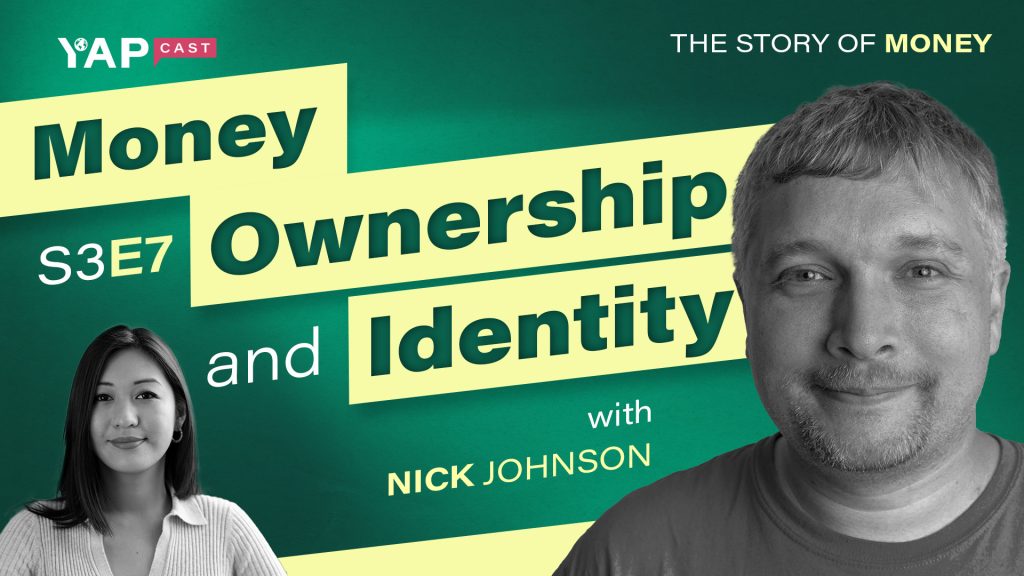
Let’s talk about Money, ownership and Identity.
Most of us may store our money in bank accounts.
But have you ever wondered that while the banks assign us account numbers, and a bank card - the funds deposited in the bank become the property of the bank.
So do we really own our money? Or do the banks?
On the other hand we can fully own and be the only ones to have access to our own crypto if we store it in a ‘self custody’ wallet address which are alphanumeric strings that are unique to each user. It's these mix of numbers and letters that help identify the wallet address we’re sending crypto to and from.
It might seem easy to just plug a wallet address in for a transaction but if you miss just one character your funds could disappear. That’s the risk of being in complete control of your crypto.
But what if there was a better way?
Let’s look at the internet and how we identify addresses online.
Every website has a string of numbers known as an IP address which helps us connect to it but we don’t enter those numbers to visit a website like Google or YouTube. Instead, we use a name that’s easy to remember. Google.com.
So what if we had something similar for our digital wallets? Something that could replace the random string of letters and numbers.
In this episode, we'll be joined by Nick Johnson, founder and lead developer of ENS - the Ethereum Name Service, who will tell us about the great tool he came up with. One that helps turn a long crypto address into a unique, simple username that lives on the blockchain and is not controlled by any single organisation. He'll share his insights on the future of digital identity and the potential of ENS to revolutionise the way we interact with money.
Samantha Yap 00:00
Nick, thank you so much for joining us on YAP Cast. We're really excited to have you today.
Nick Johnson 00:05
I'm really glad to be here.
Programmable Money?
Samantha Yap 00:07
Cool. So Nick, you know, as someone deeply involved in the development of web3 adoption and the Ethereum name service, we believe you have a unique angle and perspective on where money is heading with crypto. So to just begin with, you know, let's start by learning more about your background. As a software engineer, what initially drew you to this world of programmable money from the more traditional tech world?
Nick Johnson 00:34
I guess, for me, it's all about the consensus systems and the idea that you can have this distributed ledger that is maintained entirely independently without any trusted central party and when I first heard about Bitcoin, I sort of looked at it a bit and I went, oh that's cool, but was kind of put off by the fact that it's not actually that programmable. It's pretty much fixed just for payment use cases and so when I learned about Ethereum and, you know, the fact that it's fully programmable, and that you can, you can make it do anything you want and, you know, fulfill that promise of being sort of self-sovereign and no trusted third parties. That seemed really exciting.
Samantha Yap 01:14
Awesome and so this series is about the story of money and just, you know, take a step back, you know, take your software engineer hat back, you know, off, what does, is money to you?
Nick Johnson 01:29
That gets very, very deeply philosophical, very quickly. Doesn't it? I mean, ultimately, it's a way of keeping track of who owes who, what? Or you know, what resources you have access to, ultimately? But I think it also just comes down to where you are pretty much anything scarce that somebody else wants. There's a very fuzzy line between money and collectibles these days.
An Introduction to Ethereum Name Service (ENS)
Samantha Yap 01:53
That's a interesting way you put it. Yes, money and collectibles. So let's talk about ENS. ENS has over 2.7 million registered domains held by more than half a million users in 2023. This is grown out of a side project that you started well, you know, at the Ethereum Foundation. Could you explain what ENS is?
Nick Johnson 02:18
Sure. So ENS is a self sovereign naming system for Web3 and for the Internet in general. Lets you register a name that represents you or your company, or your smart contract or whatnot, and resolve it to something that identifies you or that contract, such as your Ethereum address, or host content on decentralized networks, like IPFS, or even act as sort of the seed of your digital identity and key to all of this is that is decentralized and independent as we can make it.
Samantha Yap 02:53
And why is that important that, you know, there's a decentralized, you know, sovereign identity option for people?
Nick Johnson 03:02
Well, I believe that everybody's entitled to an identity that is theirs and is persistent, and is not reliant on some other person to approve of their having it and continuing to have it and the same goes for being able to name your projects and so on. I- I look at naming as a basic, public good and a basic piece of internet infrastructure that everyone should have access to.
Samantha Yap 03:30
And how did you come up with this idea?
Nick Johnson 03:34
I've always been interested in internet infrastructure and in, you know, things like DNS in particular. You know, I sort of dug into that a fair bit when I was playing around with internet stuff way back in the day and when I came to Ethereum, of course, one of the first things that stood out was the usability around account addresses, and so on. The fact that there wasn't any sort of native built-in naming service or solution and it struck me as like a really obvious omission. So I started working on a solution to that pretty much as soon as I started working in the community.
Samantha Yap 04:09
Yes, I mean, it's pretty good. I mean, it's-- It makes it easier for people to send money to one another. What are some creative ways you know, you've used your ENS name?
Nick Johnson 04:23
So I've- I've set up a, you know, random side projects, like Beer Coin and given them ENS names. I've, you know, I've sort of followed through with all of the various things people put-- Built on top of it like eth.xyz for creating a profile page and NIMI for some other things, as well as hosting IPFS content and so forth. I believe we publish the complete set of all the voters on constitutional IPFS for instance, and then, you know, that's all named with ENS names and so forth as far as snapshot votes and so forth. I think a lot of what I've done has actually just been utilizing projects that people have built on top of ENS like Snapshot.
Significance of ENS
Samantha Yap 05:07
Yes, that's- that's awesome that, you know, you've built something that people are building on top of. You know, the website says that, you know, ENS is building a credibly neutral naming- naming system to address the world's resources. Now, that's quite a broad statement and, you know, coming back to the series about the story of money. You know, money is one of those resources that people use, and it's a big part of our lives. You know, how do you see this, you know, naming system important for money today?
Nick Johnson 05:44
I think that being able to find and connect with people is- is crucial to any system like this and it's why you see, things like PayPal being massively more popular for online payments than direct bank transfers because with one, you could just go send it to this email address, and with the other you have to go in and you know, log into your banking, you have to find the number and enter it manually, and so forth, and so on and, you know, this, despite the fact it actually costs a lot more to use a service like PayPal really demonstrates that people value that usability and the ability to, you know, to- to identify each other like that and on top of that, you've got the whole identity aspect of things, the fact that we really want to be able to build a system where people can identify each other, can have personal profiles that are their own and not beholden to whatever social network they created them on.
Samantha Yap 06:38
Now, that's a really good point here, because yes, the bank account system these days, you still need to have that number, the account number and the sort code and, you know, whatever you need. So this makes it easier. Yes, I mean, I'm sure you've seen the ENS Name be used, especially in the decentralized finance industry, where people are sending lots of money on chain- on the Ehereum chain. Yes, how do you see that? How have you seen that play out? And yes, what do you make of it all because you built this system?
Nick Johnson 07:15
It's-- The adoption, in DeFi and in sort of general, you know, Web3 apps and to the point where it's pretty much the expectation that apps support ENS now at the very least, for entering addresses, preferably for resolving profiles, has been really gratifying. You know, a lot of apps such as Uniswap host decentralized frontends on IPFS, using ENS. So you can access them in your browser without using a traditional web host. I guess it's just been really gratifying people see the value of this and the potential of this and have been picking up on it.
How does it work?
Samantha Yap 07:55
Yes, that's great and just to take it back, you know, for people who may not so-- Some of our listeners, they may not have actually experienced creating a crypto wallet and- and I think they have this 42 character hexadecimal address. You know, can you explain kind of how the ENS you know, Domain Name Service, it makes it easier for people to send money? So, if you just take us through that?
Nick Johnson 08:26
Sure. So as you say, by default, if you get a wallet and you create a new account, it's going to give you this address, which will be 0x and then 40 more, you know, letters and numbers and, you know, especially back in the day, people would manually type this out rather than copy and paste this in many cases that have a photo or something and if you send to the wrong address, even by one character, those funds just become permanently inaccessible. So the usability, the user experience there is really not great and ENS was created to address this. You know, it was pretty much the first use case it- It seriously tackled and the way it does this is that anyone can register a .eth name.
So nick.eth, for instance and you can set it to resolve to your Ethereum address, or any Ethereum address really and from then on, you can give your ENS name nick.eth, which is a lot easier to remember and harder to mistype to anyone you want to be able to send funds to you and this works you know, with Ether, it works with all the tokens and so on and so forth. The address it points to can be your personal wallet, so it can be a paper wallet, so it can be a contract even and, you know, effectively what this does is it makes it easier for people to interact like this and also reduces the chances of mistyped names and addresses and so forth.
Beyond Wallet Names
Samantha Yap 09:47
Thanks for explaining that and when you started ENS, did you only imagine that you're just building convenient wallet names or was there a bigger picture in mind from the beginning?
Nick Johnson 09:59
We-- Right from the start, we had decentralized content in mind as well. So Swarm and IPFS, and so forth and being able to host websites, and we deliberately built in so the extensibility in mind. We didn't want it to be for just one or two applications that we foresaw at the beginning, we wanted people to be able to permissionlessly add their own applications to it and in that we draw a lot of inspiration from DNS which took the same approach that effectively you want the whole thing to be extensible and you want it to be an extent- extensible in a way that doesn't require going and applying for permission or asking for change to the protocol or anything like that. So we certainly saw there'll be a lot of uses for it. Some of them, we definitely didn't foresee right at the start, like, for instance, Umbra, which is anonymous, sending app that allows you to send funds to somebody untraceably. Uses ENS integrally through the whole thing and that wasn't what we had in mind, but it's an example of that permissionless innovation at work.
Transparency Vs. Privacy
Samantha Yap 11:05
Yes and in terms of the transparency side of crypto and- and being able to see money move, now you have nick.eth. Anyone can probably look up your address on Ether Scan, which is the, you know, blockchain explorer that we- we use. What do you think about the transparency of that anyone can kind of see what's on your account, or on your--?
Nick Johnson 11:35
I think transparency in blockchains can be a blessing and a curse, depending on your application. In some cases, allows you to deliberately audit things that can be particularly valuable for organizations. On the other hand, I don't need the person I'm buying the coffee of to know, you know, what brand of toilet paper I buy, you know, it, for a trivial example. And so there's a real challenge there in providing financial privacy, especially given the hostility that many regulators have expressed to any attempts to- to engage in financial privacy. You know, with the Tornado Cash sanctions, the US is effectively saying you must be a criminal to one privacy over your finances which is ridiculous and the other issue is how you actually implement any of this and I think the base layer of systems like Ethereum is transparent and solutions for financial privacy are going to have to be built on top of that, rather than necessarily trying to build them in.
Sovereign Identities and ENS
Samantha Yap 12:39
Yes. Speaking, I mean, moving on from privacy but let's talk about digital identities, and the future of digital identities. So there's often talk about digital identities and you mentioned sovereign identities. Are they the same thing? You know, can you explain the importance of- of digital or sovereign identities?
Nick Johnson 13:04
I think a digital identity isn't necessarily a sovereign one. The idea behind a sovereign identity is that you control it, it's yours to do with as you see fit, and no central agency can say, no, we're removing the salience together, you no longer have that and that's in contrast to many centralized applications like Twitter, for instance, if I have a Twitter account, and Twitter decides to ban it, even if I think that was entirely unjust, my entire Twitter identity just vanishes, it goes away and even worse, if I used Twitter to login to other accounts, those accounts may become inaccessible to me as well and it feels like increasingly, we build our online identities on this towering stack of dependencies on other people and often, it's not even just other people, it's an uncaring large company that won't even notice if their systems automatically ban you and because of the huge volume of spam and- and scam thinking it makes it very difficult to actually correct any of their mistakes.
So in contrast to that a sovereign identity, the idea is that you're not subject to those sorts of things, because everyone has the right to an identity, has the right to be able to use systems that identify them properly and if, you know, that's causing trouble, then the- the platforms can act independently on that but your identity as it is remains invalid.
Samantha Yap 14:27
Yes and so in terms of-- So that-- Yes, that's really well-- Very well explained. In terms of sovereign identities, how can ENS names, you know, help with that storage of- of the data and your information? And yes, ensuring the safety and safeguarding of it, as well as the privacy of it, you know, how do you see this playing out?
Nick Johnson 14:55
So if you have an ens.eth name, the only person who can take that away is you effectively. Your- your account has full control over it. There is an ENS DAO that does governance for the platform but even they don't have the ability to take an existing name and sort of deregister it or assign it to someone else and that's what, you know, provides the possibility for a sovereign identity there and so building on top of that, you can have your- your avatar image, you can have your nickname, you can have your email address, and your Twitter handle and so on all linked from that ENS name so that when you provide that name, or when you prove that you own the account that controls that name, you can demonstrate that, you know, this is you and these are all the important attributes about you. So when you log into, say, Uniswap, it pulls that up and uses that in order to identify you, independent of any single company's systems.
Control and Custody
Samantha Yap 15:53
And how-- And bring it back to money. If you've- you've got your crypto or say all your wealth in- in- in a wallet and in an ENS name, you know, how different is it from having money in a bank?
Nick Johnson 16:14
So in terms of ENS, it doesn't make a difference because anyone- anyone could point any name at any account. In terms of the wider crypto aspects, if you've got money in your- your crypto account, you as the signer are the only one who can spend it or anyone you approve. No external system can- can go and alter that balance without your permission. On the other hand today on ramps and off ramps can be pretty tricky. So you might find it harder to practically spend in some circumstances.
Samantha Yap 16:51
Yes. But then yes, with a bank, then. So the difference is that banks probably can't touch that money. I mean, so if you've got money in a bank, a bank could take that away from you because they would be holding custody of your assets. But if you have your own crypto wallet, only you can access that. So yes. And–
Driving Adoption with ENS
Nick Johnson 17:15
Yes, that's the real distinction as custodial versus non-custodial. Do you actually have control of your funds? Or are you trusting someone else to look after them?
Samantha Yap 17:24
Yes. You have said it before that decentralized identities are key to driving adoption so that operating in the Web3 space becomes commonplace and easier than operating in Web2. You know, can you expand on what you mean, you know, when you say this and why this is important?
Nick Johnson 17:45
I think one of the biggest challenges with Web3 adoption is the usability hurdle because often, you know, Web2 applications are built in the way that maximizes ease of use, even at the cost of- of other factors such as security and safety and self-sovereignty and so when we're building Web3 application, we labor under additional constraints. But in order to get widespread adoption, to see it adopted by the whole world, we need to not just reach with two levels of usability but go beyond that and go even further and I think that's achievable. I see applications that are working in that direction but we have a lot of extra challenges there. Nevertheless, it remains our goal that should be the case, it should be easier to sign up for an ENS name than for a DNS name. It should be easiest to set your ENS account up as an email account.
Samantha Yap 18:46
And we know that blockchain technology and crypto has introduced the possibility of growing better financial inclusion and accessibility. How do you think ENS names and it's link to digital identities or sovereign identities can contribute to this?
Nick Johnson 19:05
I think that improving inclusiveness in the financial system is a- is a crucial goal for- for effectively onboarding the world and also building systems that are less implicitly discriminatory. One of the ways ENS can help with this is that having an ens.eth name is not the only way to have an ENS name, you can have a subdomain. So you could have, you know, my.wallet.eth. You can also have non-dot-eth names that are associated with DNS.
So for instance, Coinbase issues free ENS identities to all of the users and they issue under cb.id. So I could be net.cb.id and all of those are valid ENS names and none of them pay fees to the ENS DAO or require registration or renewal fees. So enabling that and reducing the cost for guests through layer two solutions and so forth, makes this accessible to everyone and ensures that it's not a case where only those who can afford it have an online identity.
Samantha Yap 20:10
Yes. Yes, that's a good point. I mean, yes, remember, I created an ENS, a few ENS names in the height of the bull market and yes, it was a little bit more pricey on the gas fees side but yes, I think over time, it'd be more accessible to- to more people. How long do you think it would take for the world to adopt this notion of having sovereign identity that they can fully own and control?
Nick Johnson 20:43
It's a really good question. In terms of adoption, is, on the one hand, sort of sovereign identity lines up with our expectations around the fact that, you know, if I show up at the- the local cafe five times in a row, they recognize me, and it's difficult for anyone else to come in and pretend to be me and there's no, you know, auditor who says, no- no, you can't pay attention to that, you know, this person's lost their identity unless you're in some Black Mirror scenario.
On the other hand, when it comes to actual formal identification systems, things like driver's license, and passports and so on. We haven't really had anything equivalent to a sovereign identity up until now. So it's really difficult to say. It's an excellent question as to how easy people will find to adapt to that?
I think the most difficult thing is that, ultimately, if you are holding assets, or your identity or anything else, self-custodially, then you are ultimately responsible for safekeeping that and that's not an experience a lot of people are familiar with. You know, they’re used to recovery mechanisms, they’re used to sort of social, you know, recovery, they're used to being able to go into the store and show their passport and assert that, oh, yes, I forgot my password and can I- can you restore access, please and all of those things rely on sort of admin overrides, and the ability to override your ownership of your identity, which can also be abused. So I think, for the most part, the ideas around it aren't alien but the idea of safeguarding it is going to be trickier and a user ability, user experience challenge and we're going to have to build ways around that like social recovery, if we want to see it universally adopted.
Outro
Voiceover:
It was interesting to hear Nick’s perspective on how the advancements in digital identity is reshaping the way we interact with money.
We also talked about financial inclusivity and accessibility, and how sovereign identity and control over our own digital identities are essential for these goals. ENS has emerged as a tool to link identities, bolster privacy, and ensure accessibility for all.
One of the biggest hurdles to adoption in Web3 and Decentralised Finance is the usability problem. For people to embrace these transformative technologies and actively engage in the evolving financial landscape, the user experience needs to become simpler and more intuitive.
Something that ENS is playing a big part of.
In the next half of my conversation with Nick Johnson, we'll continue to uncover what Sovereign Identity will mean for the future of money
Outro Spotify
Thanks for listening to this episode of YAP Cast. I’m Samantha Yap. Rate and follow this podcast to join us for another thought-provoking episode of The Story of Money by YAP Cast.
Outro YouTube
Thanks for listening to this episode of YAP Cast. I’m Samantha Yap. Share this episode and subscribe to this channel to join us for another thought-provoking episode of The Story of Money by YAP Cast.