Introduction [00:00]
Voiceover:
Welcome to The Story of Money by YAP Cast where we explore the past, present, and future of money. I’m Samantha Yap.
Intro CTA - Spotify
Follow The Story of Money by YAP Cast to learn more about where money is heading.
Intro CTA - YouTube
Subscribe to The Story of Money by YAP Cast to learn more about where money is heading.
It’s easy to forget that money is a form of technology that has evolved for thousands of years.
One of the first recorded uses of money dates back to 7,000 BC in Mesopotamia. The people of Mesopotamia used small, clay tokens to represent different goods and services. These tokens served as an early form of currency and were designed to facilitate trade.
Over time, these clay tokens were replaced by coins made of precious metals like gold and silver marking a significant shift in the concept of money, which steadily moved into what we know today as cash.
Now we’re moving towards a cashless society, with most people in the first world using apps like Apple Pay and Google Pay, and doing most of our banking online.
The innovation of money brought by the introduction of Bitcoin and other cryptocurrencies has led us into the next chapter of the story of money.
Cryptocurrencies have the potential to change money for the good of everyone. It can democratize finance, improve global financial inclusion, and offer cheaper ways for instant cross-border transactions.
While the potentials are endless, The Crypto Council for Innovation has a few guiding factors to ensure the innovation of money is developing in a productive way one that is led with a global world view.
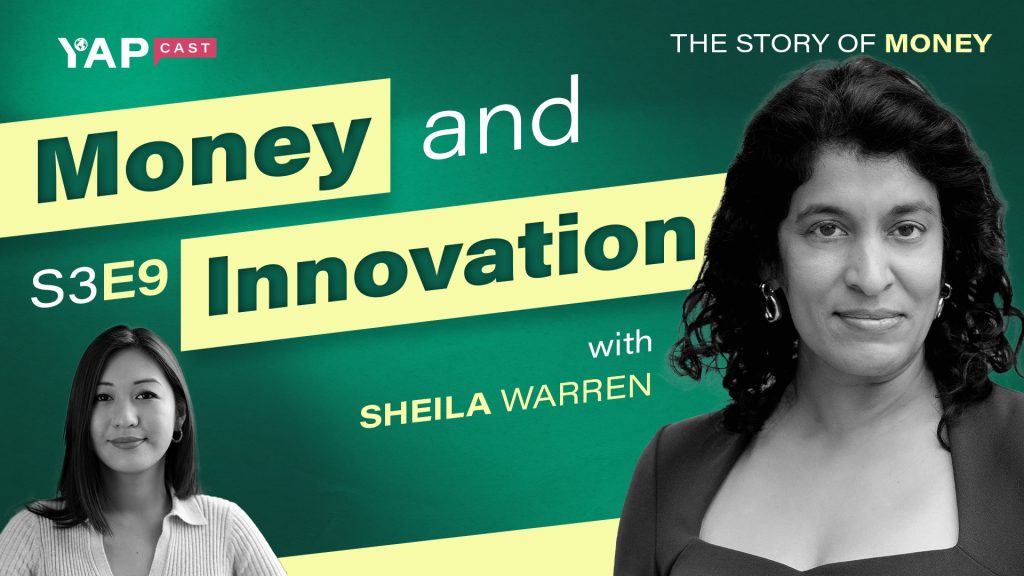
Join me as we hear from Sheila Warren, CEO of The Crypto Council for Innovation share her take on where the future of money is heading with crypto.
Samantha Yap (01:55)
Hey Sheila, welcome to YAP Cast. Very excited to have you here today.
Sheila (02:00)
Oh, thanks so much for having me. I'm glad to be here.
Sheila's Journey into Crypto
Samantha Yap (02:02)
Cool. So, it'd be great to hear about your background and then, you know, what's the thing that sparked your initial interest in getting into the blockchain and crypto space?
Sheila (02:11)
Thanks. Yeah, I'll try to keep it kind of keep it brief. It's been a pretty wild career with twists and turns. I'm a lawyer by training. I started off on Wall Street at a Wall Street law firm. And then I moved out to Silicon Valley to work with tech philanthropists and work in civic tech. I did that for quite a while. I built a tech product, a SaaS product called NGOsource, focused in civic tech and then I got into the blockchain space primarily through a data lens. I was very interested in thinking about new models of not only data storage and data maintenance, but also new models of actually economics around data. And that was sparked by a particular incident that happened to me when I was general counsel at a nonprofit that involved the potential hacking around sensitive information about activists. And I was very concerned about different ways to have not a honeypot of data. This was before Cambridge Analytica, so of course we've seen in recent years, you know, all of the challenges there. And so for me, it really was more of a data story actually than a money story or a fintech story. But I very quickly began to understand as I delved into the technology, a) why Bitcoin was kind of the first sort of use case, if you will, of blockchain technology, but also the differences and the kind of revolution that this technology could spark in financial services and in the money space in general, to the point of your show.
Samantha Yap (03:30)
Yeah, that's very fascinating that you came through it with a data lens because I would say, I would say most people, you know, had come to it because of Bitcoin and the fascination of the fact that it was like this digital gold. So that's very interesting. Thanks for sharing that. So what was the first thing you did when you got involved in crypto? Like, what was the first kind of foray into it?
Sheila (03:50)
Yeah, well, I was really reading white papers, frankly. I read the Satoshi white paper, I read the Ethereum white paper, and I started to think, and this was 2015-ish, and so a lot of people were thinking about all the myriad use cases that were relevant in this space, or potentially relevant - don't forget, 2017 was the year where everything was an ICO, and you just threw blockchain into anything, and you could get massive funding and all this kind of stuff. It was a very hype-y time. A lot of those things have proven to be much more complicated to build than people imagined. So I was one of those people that really had kind of the limits of my imagination. I thought about applications for criminal justice and real estate ownership, the titling, authentication, all these different kinds of things that I think we've seen experiments, some successful and some have failed over the course of time since then. But my first foray was really quite intellectual and nerdy. It was reading the white papers and trying to understand how the technology worked and what it could do.
Samantha Yap (04:45)
Yeah, that's a great starting point. I think yeah starting from the white papers is like how you get that fundamental understanding of crypto. So this series is about the story of money and where it's heading with crypto. So, what is money to you?
Money as a Meme?
Sheila (04:59)
Well, as I say on my podcast, Money Reimagined, I think our very first episode, we talked about how money is kind of the ultimate meme. So money is something that we certainly drive utility from. We use it to create markers so that we can exchange goods and services in society and have a smoothly functioning society and a functioning economy that to some degree is predicated on the idea that, you know, what a dollar is a dollar is a dollar, right? Just like we say, a Bitcoin is a Bitcoin is a Bitcoin.
But money itself, it has value at this point in time because of faith to some extent, right? Because of whether it's the backing of the US government or the backing of the Indian government for the rupee or whatever it might be, that's a critical part of it because of course the paper and the money that money is printed on is not inherently worth the value of what we assign to it. So to me, I think it's really interesting to think about currency, to think about money in that way. To say there's a metic component to it. And when we start to unpack that, it's actually quite fascinating that we have such a complicated system of finance and the economy that runs on what fundamentally comes down to an act of faith.
Evolving Money and Adoption
Samantha Yap (06:06)
That is very fascinating. So money is an act of faith and yeah, I think there's a lot of opacity in just financial system that yeah, we really are operating on faith a lot of the time. That's fascinating. So I mean, yeah, since the introduction of Bitcoin, you know, when the white paper was written and Bitcoin was created in 2009, how have you seen money evolve with crypto and the introduction of these other cryptocurrencies?
Sheila (06:28)
Yeah, well, I think there's been a lot of, I think you have to think about fintech more broadly, right? So it's not just crypto. We've kind of seen an explosion of fintech over the last even five years. And exploring everything from more efficient payments and the payments action around this, of course, has been very, very strong in certain cases. But also thinking about different ways of providing financial services, whether that is credit, even insurance, whether it's a store of value, all these different kinds of things, and of course the investment side of this as well, an opportunity to create potentially generation-changing wealth. I think all those things have been relevant in the crypto ecosystem. Again, I think that when we think about crypto, we think about money, I have to say, again, that is but one use of blockchain technology. It's the one that gets the most attention and it's the one that's perhaps the most complicated because of course our financial system is highly regulated as one would think it ought to be. But the question of kind of how this new opportunity, this new form of money, you know, this new form of currency in some cases fits into our existing economy is one I think is quite unsettled. What I think has been very interesting to me personally, with my background in civic tech, you know, spent almost 15 years in civic tech, working with communities to see how and whether, technology could actually be empowering, a tool of empowerment, and the ways in which technology was actually the opposite, right, it was a tool of oppression, is something I spend a lot of time thinking about. So to me, seeing the different kinds of communities that have embraced this opportunity is quite fascinating. So in my previous role, I was the head of, I founded the blockchain team at the World Economic Forum, and when I left there, I ran all of tech policy. And I had said as far back as 2017, when I took that position, that I always believed we were going to see more adoption in the global south and in other parts of the world before we saw that kind of adoption in the United States. And that was largely true, but what we have seen here in the United States is that certain communities have actually adopted this technology opportunity much more than others. And those are largely immigrant communities, black and brown communities, communities of colour, of folks in rural areas. We've actually seen disproportionate adoption there.
And I think that we can't have an honest conversation about money in society unless we're talking about who has historically been embraced and excluded by the financial system, the legacy financial system. Now, I'm not going to go through a whole history lesson, although we certainly could. But if you look in this country, United States, where I currently am, when you look back on the history of who has been allowed to get a loan, for generations, women were not allowed to own property, to get loans, to hold title to anything, to have bank accounts, right? For many, many generations, people of colour did not have this kind of access. And even when it was granted, there were such strict limitations and parameters around it. It was certainly not equitable in any way. It was only very, very recently you've actually seen some of that behaviour, redlining, de-risking, be acknowledged and try to be corrected.
But the reality is that the legacy of that financial exclusion and that intergenerational trauma still persists. So when you ask folks now, and particularly ask black folks now, you know, why are you drawn to crypto? Why don't you just go get a checking account, for example? If you were to phrase that so crassly. They would often say because those systems have not treated people like me in my family well in the past, right? My own personal example, which I do think is relevant, is I've been a 20-year-old person with very little money trying to cling to a bank account and always worrying about overdraft, minimum balance, things like that. And a lot of those things don't exist anymore. Minimum balances have largely gone out the window, right? But I remember that. And then I look out there and a person of more age than that who people are kind of like, please come bank with us. Come bank with us, right? It's a very different experience in the same system. So who you are, where you are, how you experience that is going to affect how attractive an alternative might be. In the United States, most people, certainly not all, but most people do have access to basic financial services, right? Checking and basic savings, things like that. Some line of credit, you know. So these aren't acute problems for most of the population in the US. Other parts of the world, that is not true. And there are entire countries that are largely excluded from the ease of a seamless financial system because of correspondent banks that have left their countries, because of the cost and expense and just because of access. And so that's where you see, I think, some more of the adoption that's happened in an earlier stage than what we're seeing kind of continue.
Financial Inclusion with Crypto
Samantha Yap (10:43)
That's fascinating. So you're basically saying that crypto has made money more accessible to different groups of people and especially perhaps minority groups that were maybe left out of the system. Can you give me an example just to expand on that? You said you've seen more adoption from black or other minority groups, but how have they been using crypto?
Sheila (11:06)
Yeah, well, the classic example, I think, that's gotten tons of press and there's lots of data on this is remittances. And so remittance is a very low value payment that is made across a border, generally speaking. And so the classic case of remittance is somebody who leaves their country of origin. They go to a different country to make a bunch of money to send home to their family. And so in the US, there are all kinds of communities that do this from all over the world, like Korea and the Philippines. There's all kinds of places, parts of Africa, where people migrate across the border and they send money home, okay? Sending money home can be very expensive, depending on where you're sending money to. So you can go with remittances, you can go from 6% to 2%, which is a significantly huge savings if you use crypto. And in some cases, you can't even send a remittance, to be clear, there's not even access to that at all. So in some cases, you've got people who are still flying money on a plane, right? Like with a guy that runs this for the community, giving the money to some person who takes it to the community and then distributes it, right? Because it's so expensive to get the money sent through multiple wires or through whatever services do exist. So crypto makes it faster, first of all, and cheaper to send these small dollar payments abroad. Now, this is a pretty well-known and well-documented use case. And in fact, Moneygram, which is kind of an ATM for people all over the world, if you think about it that way, it also sends money. It's actually using crypto to basically get money more quickly from one person to the recipient, from the donor to the recipient, the sender to the recipient in another country. And that I think has proven to be quite valuable.
So I think what's interesting to me is that use case, which I think that use case alone not only justifies the existence of this opportunity, but also I think articulates how compelling the opportunity is, because it's largely helping people who don't have means. But it's not the sexy, multi-trillion dollar kind of business line that I think people think about when they think about high finance. And what has been challenging to me as I've spent the past almost six years in this space, largely full-time, around thinking about tech, at least in tech policy, is observing that those kinds of stories and that kind of, even at scale, remittances are now are operating at scale, that kind of thing is not necessarily compelling to everybody because it doesn't have the giant dollar signs behind it. And for something to be taken seriously, apparently it has to have engagement at the orders of scale and magnitude that are deemed like pertinent and relevant to the entire global economy. Whereas I would say, to some extent, this is a gap-filling opportunity. And if it only creates and closes gaps that have existed and allows more people to access financial opportunity, to me, that is one of the best uses of my time, first of all, also something we should be celebrating as a society. So I personally find a lot of the kind of backlash, if you will, against crypto very surprising and misguided because the people that are actually being helped, there are people who are being hurt very clearly, and sometimes they're the same communities, but there are so much potential for more people to be served, and to be served in ways that are actually relevant and meaningful to them and their communities, and I would hate to see that vanish. I don't think it will, but it would be very tragic, I think, if it did.
Mariginalized Narratives Overlooked
Samantha Yap (14:14)
Yeah, you raise a good point because, like you said, the remittance is the biggest and very important use case of crypto. But yet the media and, you know, we work in PR, so the awareness of crypto people are drawn to more of the, yeah, the sexy kind of new financial tools and what crypto can enable and DeFi and all that, and we'll talk on that later. But yeah, what do you see is the biggest challenge with this awareness of the benefits of what crypto can be in the remittance world as well.
Sheila (14:43)
Yeah, I actually think, yeah, I think these stories are actually extremely powerful, because they are kind of the heartstring stories that tend to get PR folks like you kind of excited. Because you're like, oh, you can tell that story, and it's got an emotional pull, and it's also true. you know, So it's wild to me that what people want to see for credibility is these giant, big, like high finance. That's hard to understand, right? Like if you're talking about swaps and derivatives, and it's like, the average person doesn't know what that is, or what it means, or care, because they're not going to ever use that kind of a financial tool, right? They're going to use something that's very simple. It's like, I'm sending money to somebody in a different country across the board. I mean, like, that's a very understandable and grokable use case. So I find it mystifying, and I try not to be very cynical, but all I can say is I think that people just don't really care about marginalized people, right? So to have these stories, there might be an emotional tug of it, but unless you actually are committed and care about these communities, I think you just dismiss the stories. And again, I try not to be cynical about it, but it's hard not to be, right? Because the stories are persistent. There are so many of them, and they just don't get the kind of airtime as like, crypto criminals, scams people, which of course happens. That is a horrible thing, right? Criminals who do crime should go to jail. You know, I'm like, yes, terrible. But that's really not, I think, why so many of us are in this space for sure. And it's also just not in any way a full picture of what's actually going on, especially when you take a global frame on this. So I think part of this is myopia. Part of it is people looking only in their own backyard and they want something that's relevant to them personally. And it's a lack of kind of empathy and compassion for other folks, I think, is part of this, which is, I think, a societal problem, if I may. But I think that's the reason why these stories don't get the same traction, the same attention, the same excitement, you know, as some of the other stories get.
Crypto Council for Innovation
Samantha Yap (16:29)
Moving on to advancing crypto innovation for the future of money, you're the CEO of the Crypto Council for Innovation. So how did the Crypto Council for Innovation come to be and what inspired its creation?
Sheila (16:40)
Yeah, so the Crypto Council of Innovation, CCI, actually started before I got here. It was pulled together by a number of folks who I think were troubled by what they saw as just a general kind of lack of nuance in the dialogue around crypto, you know, and some of these stories, for example, being brought to light. And they were looking, I think, for, well, I wasn't there at the time, but they were looking for, I think, just a different kind of message around the value of crypto, the use of crypto, particularly in places like Washington D.C. And so I'm the inaugural CEO. I was brought in by the group that started CCI. I've hired everybody on the team. I took the job in February of 22 and I've been here ever since, and I left the Forum to come and do this. And I took the job because I felt and feel that over the next, from when I started, that over the next three to five years, the most important issue in crypto is going to be policy, number one. Because you can only build what you are kind of like allowed to build in a way, right? And what you have confidence in building. And there's so much innovation space here that we've yet to explore. It's such untapped potential. And if we don't get the regulation, the policy right, you know, that's not going to happen. Now, the good news is that most parts of the world, I think, are really kind of embracing the technology, or at least embracing the potential, and are putting into place rules that I think are quite open to innovation while being mindful of the fact that you have to protect consumers from scams and from fraudsters and from criminals, frankly, which is, I think, also we can all agree, extremely important. In the US, in Washington, I think there are some voices that seem pretty eager to kind of crush this industry and offshore it, recognizing the industry is not going anywhere, but it's either going to be in a country or not in a country, right? And that I find disappointing. But our hope is that our work will open minds, and through some of the stories that we try to tell, people will understand there's a lot more to this than just speculation and investment. And there's a lot more to this that can come, particularly if the guidelines around how to safely and responsibly build in this space are articulated beyond just what the imagination of a builder might come up with. I think that's an important time that we're in. So that's why I took this job. I think at some point the policy will be relatively well settled. And at that point in time, we'll have to kind of see where we are and take stock. And it may well be that there are other jurisdictions besides the US that are the places where builders have located and become the locus for where this thrives. We'll just have to see. My hope is certainly it will remain fully global as an innovation opportunity. And that is what we are striving towards every single day.
Navigating Regulations
Samantha Yap (19:04)
Well, we are speaking in a week where the SEC has just sued Coinbase and Binance and classified a number of cryptocurrency tokens as securities, where people in the industry would argue that they're more like utilities. So how does the Crypto Council for Innovation engage with policymakers and regulators on something like this and you know, yeah, what's your perception with everything unfolding this week?
Sheila (19:30)
Yeah, well, I do think that these SEC cases are not surprising. I mean, we knew that Coinbase had a Wells notice, and they've been talking for some time about their response to that and what they were going to be saying and all of that. So I don't think any of this is surprising. If anything, I mean, these are very dramatic things. I think for the industry, these are not like earth shattering. I think this is kind of like what we knew was going to happen. What I think is actually quite complicated here is that yet again, I would say, we are seeing an example of Chair Gensler and the SEC in this case really trying to articulate what is and isn't a security, kind of like obliquely, without actually going directly at it. And I find that very troubling. I think to assert that it is incredibly obvious that all of these tokens are securities presupposes that very, very brilliant members of the bar. And in fact, most securities lawyers or most firms here at the securities law practice think this is an ambiguous area. And so it asserts that all of them are wrong or they're committing malpractice or they don't know what they're doing or they're incompetent, which is, I just think, crazy. This is an area that's complicated. You've got members of Congress who have different views. You have the CFTC chair’s different view. So someone has to decide like who has authority? What are these assets? How do you classify them? How do you regulate the exchange and the trading of them? All of that has to be decided. And I think it's unfortunate that's playing out in the courts, but those are the choices that the SEC chair has made. And so that is sort of the parameters around this. Now, the other thing that happened recently that I think people are missing in all of this is that we had drafted the Market Structure Legislation Bill. That bill language came down. So this is, of course, a bill that Chair McHenry and Chair Thompson of the Financial Services Committee and the Ag Committee in the House have put forth and collaborated on very closely, which is unusual for those two committees to come together and say, we're both on board with a bill, because they have authority over two different agencies, the CFTC and the SEC. So it's quite profound to have that out there. And I think you can't ignore the interplay of the SEC coming out with these, what really are kind of statements about what their authority is, that they're just asserting kind of like the gorilla, you're kind of like, we're gonna sit on this space, and you've got Congress, I mean, at least these two committees and the Republicans on the committees coming out and saying, we don't agree with that. We think there's more nuance to it than that. It's more complicated at the same time. So that is wild, right? Whether that bill is going to pass or not is a separate question. That's more of a political question. But the reality is you certainly have different points of view being expressed in real time from different branches of government. That is just bananas. I mean, that is just like what, you know, there's a joke in the crypto industry, digital assets more broadly, I would say, even in banking. If you don't like what an agency says about crypto on one day, wait a couple days, and some other agency will say a different thing, right? And that actually proves to be the case. So you're in this environment where it's like a hot potato, and some people wanna grab it, and some don't, and you're like, what is going on? So I think the context is much more than just the SEC sued Binance and Coinbase. I think it's like, look at all these other things that are coming into play, and how are they all gonna intersect. And the last thing I'll throw in there into the mix is that just, I think yesterday actually it was, and we're recording, MCCA, which is the Markets and Crypto Assets Act in Europe, actually went into the official journal, which means that now it's signed, it's done, that's the last step. Now it goes into implementation. So we have Europe implementing a comprehensive digital assets regulatory scheme. At the same time you have the US, it's just like, you know, so it is, there will be like case studies about policymaking that come out of this period of time, just as a general matter. And like, what do you do in an environment that is so chaotic? You know, it's a very tough question for builders.
Diverse Research and Perspectives through Education
Samantha Yap (23:07)
And you guys are in the middle of this I mean you are working with your you're trying to inform them.
Sheila (23:10)
Oh yes, all over the world.
Samantha Yap (23:13)
Wow, and so I mean what would you say is like was one of like a highlight project or initiative you've worked on with CCI?
Sheila (24:19)
Oh, there's so many. I mean, I think that, you know, so much of what we do, right, is education. So it's really pulling together different kinds of research and different kinds of evidence. It's weighing in and doing a lot of, you know, a lot of point of view, but also like, why does this matter? Why is it interesting? Who's using it? Who's not using it? Where are developers going? And there's an infinite number of, I think, of projects and things we work on. But a lot of this is just trying to, at this point, I think it's just trying to get people to understand in the United States, why it's important because I think there's a dismissal of it that you don't see in other, and really in any other jurisdiction in the world. It's really a very unique American dismissal of the space, which I find fascinating. And so I would say, you know, off the top of my head, I mean, we just, when I was at the Forum, I commissioned some research, ethnographic research on the use by minority communities of crypto and of digital assets.
And because I had said to my team at the time, look, if it turns out that people of colour are really only using this stuff because they were, they're idiots who were scammed, I mean, then like, let's just pack up and go home, right? It's exactly the opposite. And that's what I was talking about earlier, is this idea of like intergenerational trauma, the fact they feel left out of systems, all of that is very relevant to the reasons why folks actually find this opportunity compelling. And so we can actually document that now. We have qualitative analysis of that using ethnographic methods. That's been a really rewarding project. We did actually really interesting research deep dive on energy, energy use and Bitcoin mining to see, okay, people are claiming that there's more complicated nuance because there's stories like Bitcoin mining is terrible for the environment. We're like, well, is that true or not? We went in and did this kind of actually quite objective study of like, what are the different cases where that might be true or might not be true? And we actually found several examples of models that if incentivized through policy, would actually be productive or net positive in terms of creating more carbon neutral or carbon negative environments. And so that was pretty, I was very surprised frankly, but I didn't know anything about that space. It was very interesting to watch that research emerge. And now you're seeing in parallel states like Texas and other places that are like, yeah, there's something here. We got to figure out the policy around incentivizing the behaviour that's going to actually be helpful here, which I find really interesting. So every time you kind of it's like anything, right? When you start and you have a surf scene, all just something it's maybe like interesting or compelling because it seems sexy, but as you get more and more familiar and learn more and more, you realize how nuanced everything is. And sure enough, in crypto as well, you know, everything's there's pros and cons, there's trade-offs and reasonable minds, I think can differ on what the right set of trade-offs is. But I don't think anybody reasonable could say credibly that this entire space is like ridiculous and should be, you know, killed. I mean, that is just like flat out wrong and there's tons of evidence to document why that is wrong.
Outro [25:56]
Voiceover:
Sheila highlighted well the importance of understanding the nuances of blockchain technology and the potential benefits it has, especially for those who have been marginalised by traditional financial systems in the past.
This technology offers an opportunity for financial inclusion.
Currently, there are many people around the world that don’t have access to traditional banking services due to barriers of entry, limiting their ability to save and transfer money or engage in financial transactions.
Crypto enables people to participate in the global economy, regardless of where they live, their documentation or their financial situation.
it is important that we continue to have open and honest conversations surrounding the intersection of crypto and money, to ensure that it is used for good.
Outro Spotify
Thanks for listening to this episode of YAP Cast. I’m Samantha Yap. Rate and follow this podcast to join us for another thought-provoking episode of The Story of Money by YAP Cast.
Outro YouTube
Thanks for listening to this episode of YAP Cast. I’m Samantha Yap. Share this episode and subscribe to this channel to join us for another thought-provoking episode of The Story of Money by YAP Cast.