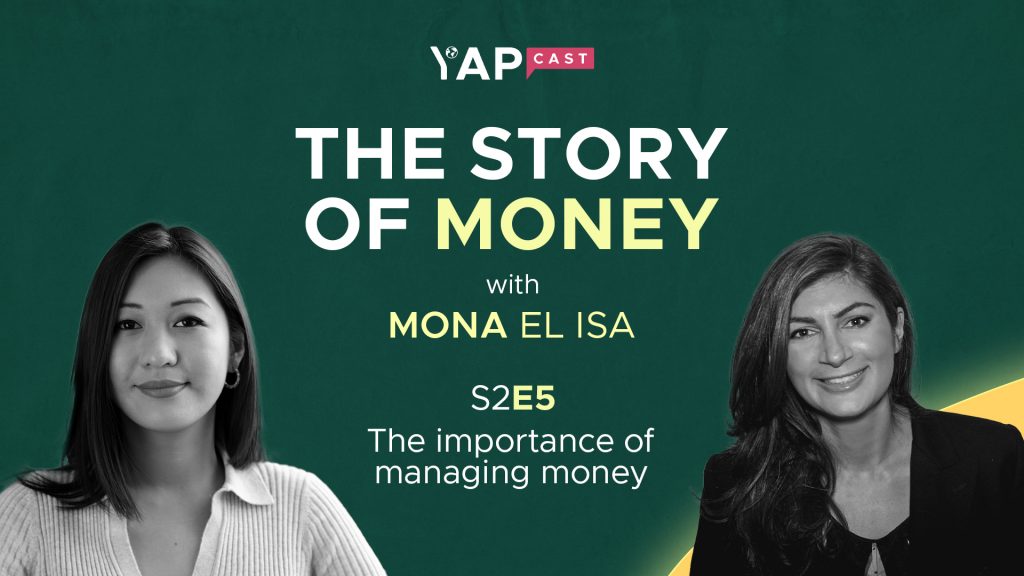
Episode 5: The Importance Of Managing Money
Samantha Yap [00:03]: Hi! I’m Samantha Yap. Welcome to The Story of Money by YAP Cast where we talk about where money is heading. Join me and Mona El Isa on this episode of the Story of Money by YAP Cast.
In DeFi we hear a lot of talk about financial inclusion — the idea that there are millions, possibly billions, of people who don’t have access to the kinds of financial services we take for granted like putting our money somewhere safe, having access to credit, being able to send money to someone else far away. But there’s one aspect of money that even those who can take these financial services for granted don’t do, or are scared to do, and that’s managing their money.
Many of us are just not confident about doing it. In fact, 24 million adults in the UK don’t feel confident managing their money. That's nearly half the country, according to the Money and Pensions Service, a body set up by the government, to try to do something about this. This is extraordinary, in that during the past 20 years or so we've seen an explosion in online investment apps and services.
So, I wanted to explore this, to see whether it’s true that even those of us who have access to all these savy tools, don’t actually feel comfortable managing our own money. And if it’s true, why is that? Is it important that we manage our money? Money is money, right? And are there alternatives? Is this a case for DeFi as well?
The obvious person to talk to is Mona El Isa, who entered the Goldman Sachs trading floor straight out of university, but has, for the last six years or so, delved into DeFi, most recently with a company she founded called Avantgarde Finance, an asset management services tool built on decentralised finance.
Why is it important to manage money? How hard is it?
We want to learn more about what led you to start Avantgarde Finance. But before we get into that, I would like to start by asking you why it's important to manage money?
Mona El Isa [02:13]: Yeah, so I think people don't appreciate how hard it is to manage money. You know, it's not something you learn how to do at school. It's not something that we're taught to do as most people have…to learn how to drive, and they have to get a driving license to, to drive a car. I'm actually kind of surprised, it's not a more formal requirement at an early age to learn the basics about managing money, but the reason that I think it's important for people to understand the options with giving someone else your money to manage is because it does require expertise. It does matter if you want to preserve your capital. Some people might simply just want to preserve their capital against inflation, and other people might wanna 10x their money because they have a higher risk profile, maybe more savings, or maybe some combination of both. Either way, whatever you want to do, it takes skill and time, and most people don't have that combination of things, so I think it is important to think about the options you have to delegate money management to third parties.
What does managing money mean to ordinary folk?
Samantha Yap [03:13]: I think not many people realise there's so much you can do with money, and it does take skill. So, what does managing money really mean to everyday people who don't necessarily have full control of their finances?
Mona El Isa [03:27]: Yeah, so I think when you're handing money over to someone else to manage some things that you should be aware of is that first and foremost you are giving control of your assets to some third party and you're trusting that they will be managed in the way that you have been promised. Hopefully, it's in a written contract or in some terms and conditions, and if it's not, then you probably shouldn't do it. But managing money successfully is, like I said, a very highly skilled and focused job, and the first thing you should be looking out for is somebody who has a multi-year track record at doing that. If it's a regulated fund, you will want to know that there are some nominated third party financial intermediaries such as fund administrators, custodians, and their job is to ensure that the funds you are giving this third party are being managed as promised to you via the offering docs, or via the legal contract that you have. So, for example, if you think you're investing in a fund that focuses on S&P stocks, you know their job is to prevent the manager from investing in something totally off piece like Nigerian real estate and reminding the manager at all times, maybe even forbidding the manager from touching anything outside of the S&P universe. So, you do lose a level of transparency in traditional finance when you give control of your funds to someone else, you also lose custody of those assets and you will not be able to see, in real time, transparently what is happening to those funds. At best, you might get weekly or monthly reports, and you do run a small risk, but a real risk; and we have seen this happen before, losing your funds due to counterparty risks such as fraud. If you think back to Madoff or counterparty risks that occurred due to systemic risks like the Lehman demise and these can lead to a partial or complete loss of funds, and so you really need to be aware that on the one hand you're getting somebody to provide their skill set, but you are putting a lot of trust in them and a bunch of other financial intermediaries to enforce certain behaviors, and you also have to trust that the system is safe and secure in terms of counterparty risks. And yeah, those are the sort of trade-offs you need to think about.
Mona’s discovery of crypto
Samantha Yap [05:36]: Yeah, I think yeah, we should expand a little bit more on the severity or the seriousness of handing over control of assets to a third party, and could you maybe share a little bit more about your background as an investment banker, and later on hedge fund manager? Yeah, tell us about your experience and the roles you did.
Mona El Isa [05:56]: Yeah, sure, so it sounds like forever now, but I started my career in 2003 straight out of university at Goldman. I was a market maker and prop trader there for nearly ten years. So, I was market making European equities and prop trading really across the entire asset spectrum. By the time I left everything from CDS to bonds to commodities to derivatives, swaps etc. and also kind of got to see 2008-2009 unravel in real-time from a trader’s perspective. So had a great time, learned a lot there and then in 2000…I forget the year now. I think it was 2012 I left to go and work for one of our clients, one of Goldman's clients. It was a large European hedge fund and I ran a long, short equity strategy for them for nearly four years. And at that point, I decided to leave there because I was offered an opportunity which was at the time my dream opportunity. It was an opportunity to launch my own hedge fund, so somebody wanted to seed me twenty million dollars to launch a longshore equity fund. I thought that was an awesome opportunity; took it; raised another 10 million, launched a fund, and actually, had one of the worst years of my life professionally. I really hadn't been prepared for how tough it was for small to medium-sized managers to make it. The barriers to entry were very high. The tooling is just like completely non-existent or comes at a very high price, and the assumption is that you're able to afford four or five operational staff per investment professional, and so by the end of the year I just realized I was spending my time doing everything except investing and decided to wind down the fund and take some time out, which is also when I discovered crypto and blockchain; and soon after that, decided to found Melon which was what our protocol used to be called before we rebranded to Enzyme. We did one of the first token sales and the vision was to build a decentralized asset management protocol. We've been doing that ever since, except that after we decentralized the protocol in 2019, we later founded a private company called Avantgarde Finance, which is on the Council, which is on the Enzyme DAO, and we continue to do a lot of the core development, but I think we'll talk more about Avangard later
High barriers to entry
Samantha Yap [08:07]: Thanks for sharing that and it sounds like you know you've learned a lot of lessons from starting that initial fund that you did and it and you talked about the like small to medium size fund and the size of it. I guess my next question is when do people or organizations start to engage in asset management services? Is there like a threshold where it's like...OK, we have at least this million we're ready for some asset management services?
Mona El Isa [08:32]: Yeah, I think, again, the barriers to entry are not just high on the fund management on the like setting up a fund side, but they're also quite high on the, you know investing in the asset management side as well, because regulations have become so strict in the last couple of decades that a lot of products that you might want access to are restricted to accredited investors or investment professionals and you know different countries have different definitions of that. But assuming that access is easy, I think you want to start thinking about it when you have excess idle savings, which you likely don't need or don't want to touch for a while. And keeping that money in cash is inefficient, first of all, because it can lose value in real-time. But furthermore, it can be a tool to earn a nice return for you. So, I think at any point when you have you know savings and excess of what you need, and savings that you don't need or want to touch or be tempted to touch, I would definitely recommend engaging in some kind of asset management services to the extent that you can get access.
Samantha Yap [09:32]: Is there a minimum amount depending on the size of the funds?
Mona El Isa [09:37]: Yeah. It varies from fund to fund, and that's actually the problem, and it also tends to be that some of the really better funds have higher thresholds; so it is something that you need to think about carefully and educate yourself on. You don't need to educate yourself on how to allocate a portfolio, or which positions to buy yourself. But in terms of navigating the asset management universe and the different options available to you, I think that is something that requires some education.
Samantha Yap [10:02]: Let’s expand on that: when an individual or organization engages an asset manager, they are trusting this third party to manage what happens to that money. Is there more of a say, or is it just a passive viewing pain and you're just maybe moving things from one service to another? Or is there a more hands-on approach to making decisions on what they want to invest in?
Mona El Isa [10:25]: I mean, yes, it should be. If you've engaged a good asset manager, it should be a very hands-on process. Like I said, you do have to trust in several third parties to execute what they've said that they will do as part of their strategy. I think that the system generally works, although in traditional finance you have this problem of trades not being reconciled, and instantaneously there's always this T+2 or T+3 settlement time. So, you can never really tell in real-time whether someone is following, not that the end investor would be able to see anyway, but even as a financial intermediary, whose job is to enforce certain behaviours, you would never really be able to see in real-time anyway and check whether you know someone is doing their job properly. So, that's probably I think a disadvantage of traditional finance. It's one of the things that got me so excited about blockchains, and the potential to build financial applications on the blockchain, this immediate settlement and what that means for transparency in real-time reporting across the entire financial spectrum.
The complexity of handling money
Samantha Yap [11:23]: Yeah, I'd love to expand on that in a bit, but before that, I just wanted to touch on the complexity of managing money; and you did say that there's just a lot more the average person does not recognize...like needs to get involved, so could you expand a little bit on that? Do you know how complex is it? And that's why there are so many firms that offer this service.
Mona El Isa [11:44]: So there, I mean, as a starting point, there are so many different asset classes; and within each asset class, there are so many different assets. So, if you just think about a very small sub-universe within a very big universe - equities and let's just focus, I mean, every single country has its own equities. Let's just focus on a sub-universe, like the S&P 500, that's five hundred companies. And if you really wanna, you know, have an edge in terms of outperforming the S&P, assuming that's your mandate or that's your desire, you know that's what you want to achieve out of your own personal allocation. You know you're going to need the resources and expertise to analyze data around five hundred different companies with new evolving information coming out all the time on these companies. And so, it's not something that a single person can do. It's something that an entire team needs to do. They need access to really high quality, frankly, quite expensive data and research and they need some methodology or some investment framework to narrow down that universe and keep tabs on it so that they're making sure that they always are making the right investments. That's the first part of analytics and the resources required.
The second part is having as expertise in portfolio allocation and sizing. So, every time you want to take a position, you have to think about the risk-reward associated with that position and make sure that the position side is worth the risk. This is extremely important and often poor sizing and portfolios are what blow up a lot of money managers. So, knowing when to be large because the risk-reward is worth it and knowing you know when to be small because it's not worth it is almost as important as analyzing the fundamentals themselves. And lastly, I think it entails some degree of discipline, because you know, in theory, it's quite easy to come up with like a methodology and a practice, a sizing practice, etc. But in my experience, and from what I've seen in my career, it's harder to keep disciplined around your own investment process. Having people around you that can challenge you and bring you sort of back to reality, reminds you of what you're supposed to be doing. And they sometimes are a good and healthy thing because you do get the tendency to get emotional or carried away emotionally by certain.
Samantha Yap [13:58]: Thanks for shedding light on that I didn't recognize what and how much goes into this process. Is there an anecdote or a story that you can share from the past?
Mona El Isa [14:10]: I think you know a lot of hedge funds and banks, you know, when we worked on the trading floor, they have risk managers who all they do full time is risk management. And what they do is they look at the individual risk each individual is taking and the aggregate risk if you aggregate risk across the firm and they run stress tests and scenarios based on you know one standard deviation moving the market 2 standard 3 standard deviation. They make sure that you're well prepared, well sized, and that we or the firm can take, can take can handle and withstand those kinds of moves. I think that's great when it works. I would just caveat that there is, in my mind, I've always kind of felt that there are some conflicts of interest in terms of having a risk manager that is paid by and reports to the fund manager usually or the CEO of the fund or the bank, or you know. Because ultimately you know if the culture is not one of open discussion and you know mutual respect and you know, etc. You can quickly get into a situation where a risk manager is flagging, you know, maybe you shouldn't be 6 times leveraged because we've promised investors, we only get to maximum leverage of three times. And the investment manager or the head of the firm is just saying, well, yeah, I know but this is a one-off, it doesn't matter. And what's the risk manager going to go and do then? So, is he gonna really battle the guy that pays his check at the end of the month etc? So, I think I've always felt that having that role is an important role but I think sometimes in my career I have seen basically, the risk manager has been ignored or, you know, kind of treated badly.
What happens when the returns aren’t as expected?
Samantha Yap [15:41]: Interesting. So, I guess these asset management firms, I guess they do well because they help make more money for their clients. What happens when they don't? Or yeah, what happens when the returns aren't as expected? Is that just it's just part and parcel of the relationship, like sometimes the returns are good, and sometimes they're not. What happens then?
Mona El Isa [16:01]: I mean really, a good manager should be able to, and again, this goes back to what you're looking for when you originally invest. You know, are you looking for something positive regardless of low volatility and positive in up markets and down markets? That's hard, you know if not many people have cracked that. But if you're just looking for something that can outperform the S&P in an upmarket, and can outperform the S&P in a down market by X% or over time.
Samantha Yap [16:29]: What happens when, yeah, the returns aren't as good? Or yeah, perhaps yeah has been cases where asset managers do lose their clients' money.
Mona El Isa [16:38]: Yeah, they do. I mean there have been cases where asset managers don't keep their promise. They don't stick to their investment mandate. There have been cases where they're not disciplined and they go rogue, frankly, or they, you know, they get so emotionally torn up that they do things they shouldn't really be doing. There's been a lot of cases where financial intermediaries have not stepped in when they should have, maybe because of the opaqueness of traditional finance, you know. Or maybe because, you know, the financial intermediaries weren't there in the 1st place. So, these are the kinds of things if you're investing your money, you should be looking at track records. You should be monitoring performance. You should be making sure that everything is consistent with what you have been told, you know, is to be expected and to be reading the reports to make sure that yeah, this is what you expect. If you're seeing money being made in a way that is different to what you were promised as part of the investment strategy, I would personally be concerned about that. Even if it's making money as a strategy because it's not really, you know, it's kind of a sign. It's an early sign that they're deviating from what they themselves said that they do.
Hard to get real-time transparency
Samantha Yap [17:42]: On that like talking about financial transparency here, or rather having visibility because you know when you know with traditional asset managers, clients hand over their funds and like you said, sometimes they might not stick to the way they're making the money or their strategies. Yeah, for a client, is there a way for them to even know if they're deploying the money the funds in the right way?
Mona El Isa [18:07]: There is no way to track this in real-time in traditional finance. We are also, as I said, like exposed the conflicts of interest when our managed, you know, when our assets are managed by a bank for example. You know, if you're asking a bank, a investment banker or a private banker for advice on where to invest your assets, you have to be careful that they're not just recommending a product to you because they are going to get referral fees on that product. Or that they are, you know, somehow pressured internally to sell you a certain product because the bank, for them, benefits disproportionately. You need to find a way to make sure that you're being shown all the options and that you're being given all the information and the transparency so that you can make decisions. But once you've invested in a fund or in a product, it's very hard to get real-time transparency. I think at best you might get like a monthly newsletter and an app with some key stats.
Samantha Yap [18:57]: We’ll leave it there for this episode and return to my interview with Mona next time, where we’ll explore how she has tried to solve some of these problems in DeFi. What jumped out at me listening to Mona were two things: firstly, traditional finance is clearly a highly manual, connections and back-office-driven world, and yet Mona only realised that when she cut loose and tried to run her own fund. Suddenly all her skills and experience in managing money counted for little as she found herself having to build all the connections, physical, social and legal, to get her fund going. No wonder few outsiders have ever successfully challenged the big players on Wall Street or in the City.
But another thing struck me too: we think of TradFi as very buttoned down, logical and by-the-book, with strong legal and ethical constraints, but at the end of the day handling money is just as, possibly even more, emotional a pursuit as any other. Investment choices may be presented very coldly and logically, but there are clearly decisions made, sometimes very expensive decisions, based on emotion, on gut instinct or passion, or internal conflicts of interest.
In short, the handling of money under present conditions is opaque, both in terms of who is actually allowed to be involved, and in the sense that no one can be 100% sure whether their assets, the money they've entrusted to the system, are being managed in a transparent way, free of factors like the manager's mood or emotional state.
Next time we’ll look at how Mona has taken her hard-earned wisdom and applied it to crypto and decentralised finance. And crucially, whether this will solve some of the problems we’ve heard in this episode — and not add too many new ones.
Thanks for tuning in to another episode of YAP Cast. I’m Samantha Yap. For new episodes follow The Story of Money by YAP Cast.