Challenges with money often give rise to a desire to reinvent money.
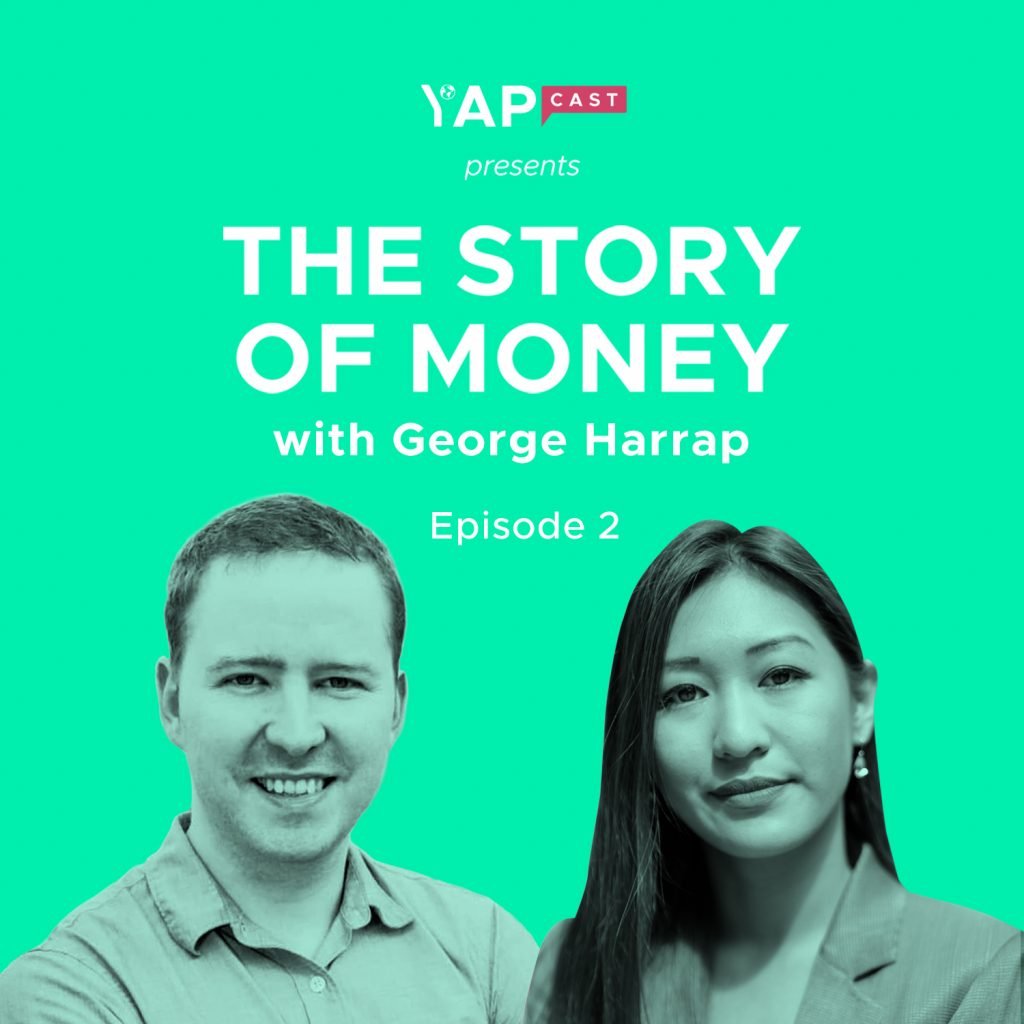
In this episode, Samantha Yap is joined once again by George Harrap, Co-Founder and Head of DeFi at YAP Global. They talk about ‘Reinventing Money’ with Bitcoin, and George takes us through a quick history of Bitcoin and an explanation of how it works with mining, the decentralisation of control of it and how Bitcoin may solve the problem of the debasement of money.
Join Samantha Yap on a quest to discover the history of money, to better understand why Bitcoin, cryptocurrencies and decentralised finance may play an important role in our future. She’ll take you on a 5-minute audio journey that touches on the history behind today’s topic, followed by the best parts of her conversation with our returning guest, George Harrap.
George is a veteran crypto entrepreneur. Having started in the crypto world almost a decade ago as an early miner, George brings a wealth of experience. He has built the first crypto remittance startup in the world, built 6 cryptocurrency exchanges both centralised and decentralised, and launched 12 stablecoins. George now focuses exclusively on the DeFi space – which he believes is the next giant leap for crypto assets and blockchain technology.
Episode Transcript
Reinventing Money (S1E2) Transcript
Listen on:
Spotify
YouTube
In our second YAP Cast podcast, we continue our What is Money? discussion with George Harrap, the Co-founder of Step Finance, and Head of decentralised finance at YAP Global.
Here are the key takeaways:
[0:28] Where Money Originated and the Meaning of ‘Pay’
[5:31] Reinventing Money with Bitcoin
[7:53] What is Bitcoin Mining?
[10:52] You’re the Custodian
[13:07] Finding More Value in Crypto
[15:27] Paying for Things in Bitcoin
Samantha [0:03]: Hi, I’m Samantha Yap, and I help blockchain and cryptocurrency companies tell their stories. I’m really passionate about demystifying emerging technologies and making it easy to understand for everyone.
I’m embarking on this journey to discover the history of money, in order to better understand where money is heading today. In this series we’ll explore why Bitcoin, digital currencies and decentralised finance may play an important role in our future.
Come join me on The Story of Money, by YAP Cast.
Where Money Originated and the Meaning of ‘Pay’
Samantha [0:28]: In the last episode, we talked about trust and accountability with our money, differences in the perceived value of money, and the difficulties that can arise from trying to get your hands on money when you need it. These challenges have given rise to a desire to improve the systems of money as we know it - to reinvent money, so to speak.
Before we get into that, let's go back to the Yapese. As I mentioned before, we don't really know how this system works, and it has become an illustration of more or less any interpretation of money over the years. The truth is, as with the Yapese, we don't really know how early civilizations developed a system of money.
Here's our best guess: money didn't arise from the marketplace, but from the quarrels, tensions, and hardships of life. The first institutions were tribal ones, and their main purpose, then and now, was to solve disputes either within the tribe or between tribes. These could be over rights, obligations, sexual misconduct, or boundary disputes.
The word ‘pay’ itself is derived from the Latin word Pācāre, which came to mean ‘pacify a piece’ or ‘make peace with’. To keep the peace, tribal society demanded a means of compensation and an end to the matter. Money, therefore, came in different forms, and that form was associated with intrinsic value. It could be as an ornament, as with the Rai stone or shell, or it could be useful, like a tool, food, or cigarettes. Out of this arose the functions that serve to define money as a medium of exchange, a currency, a unit of account, a way to value something, a store of value, or a standard for future payments.
This is an area where students of Yap disagree, some don't believe the stones themselves contained any value other than as a store of value, which means that some people don't see them as money at all. A house is a store of value, but you can't perform any of the other supposed functions of money with it. For example, you can't buy a loaf of bread with a house.
Samantha [2:36]: That just sounds strange. But not everyone sees it that way. For one thing, we know that the items don't need to move physically to change possessions. An unwritten ledger of who owns what, whether it be livestock or land, is stored in the minds of villagers instead.
In fact, this is how most of our transactions take place. These days, no physical money actually changes hands when we buy something online via a credit card or an app, the transaction merely exists because of the communication. In this way, a stone is a memory of contribution.
In the words of Michael Bryan, then-vice president and economist at the Federal Reserve Bank of Cleveland, "This is a halfway point between our idea of barter, my eggs for your iPhone, or my necklace for your TV, the difficulty of barter has always been finding a perfect match the double coincidence of wants, and that's where money has come in, and why maybe there has never been a clear cut case of a barter economy".
But what if there was a midpoint, something we can use as a marker to postpone the need for the coincidence to happen simultaneously. This is where money is seen more as a communication device. In this definition, money is just a rather crude technology that allows us to keep track of the balance of our gifts to society, relative to others, as Brian, writing in 2004, put it: "In fact, from this perspective, we might foresee a future in which all transactions are costlessly and instantaneously recorded for all to see making the idea of money, at least as a physical construct obsolete".
Whether this interpretation of early money is right or not, we still end up in the same place today, where money plays two important functions, first as a medium of exchange, and second as a unit of account. So that all works pretty well, right? Nothing to fix or change here, or is there?
Well, the process of reinventing money has a long history, and the cryptocurrency revolution, which started with Bitcoin in 2009, should be seen as just the next chapter in the story of money. Bitcoin was created to be a peer-to-peer electronic cash system and is a cryptocurrency that is not owned by a central authority.
Samantha [4:53]: But before we delve in, there are some important questions that need to be answered. What exactly are cryptocurrencies and how did they come about? Do cryptocurrencies like Bitcoin actually solve the issues that exist with traditional money? And is this really money that we can truly trust if no one owns it?
To answer these questions, we have George Harrap back with us. George is the co-founder of Step Finance and head of decentralised finance at YAP Global. George is a crypto entrepreneur and one of the earliest Bitcoin pioneers. He actually began mining Bitcoin in 2011.
Reinventing Money with Bitcoin
Samantha [5:31]: George, thanks so much for coming back onto YAP Cast. So we've touched on how trust is dependent on where you are in the world. And value isn't always agreed upon. And it's not always possible to get cash in hand when you need it. Is that why there seems to be a movement of people right now trying to reinvent money, and it seems to start with Bitcoin?
George [5:50]: I think that's a lot of where Bitcoin came from, surely there's a better system to solve some of these problems that you mentioned. I've been in Bitcoin for almost 10 years now, actually, over 10 years and it's sort of been part of my life every single day. I started as somebody not knowing anything about finance, and how the financial world works. To be honest, I wasn't too interested in that. But I've sort of educated myself over the years. And in Bitcoin, there's this concept called mining, and that's the creation of these Bitcoins, it's how transactions get verified and you need computers to do that.
My hobby was to go and build computers. I would buy parts off eBay, I would put them in my room, they would go and make some Bitcoins, and they would also be a heater at the same time. So it was a heater, which made money, which is the best kind of heater. That's how I got started, and then from there, I continued to do the mining thing. I started to learn about trading and what all of that is about, and why Bitcoin exists in the first place. What are the sort of philosophies behind it? You can get that from the white paper as well - the Bitcoin white paper by Satoshi Nakamoto.
George [7:01]: But, in 2014 I decided to leave my job in Australia, and go and co-found a company in Hong Kong that was focused on the use of Bitcoin for sending money around the world. And back then that was kind of a novel concept, using this digital currency to exchange value across these different borders, there wasn't anyone doing that. We were actually the first in the world to do it. Through my learnings with Bitcoin from there, it's evolved into various other forms, whether it's stable coins or DeFi or these other new concepts, but everything starts with Bitcoin, and that's where a lot of people came into it.
Samantha [7:38]: And you still have some of that Bitcoin today?
George [7:40]: No, I don't. Obviously, everyone says they wish they did. My first Bitcoin, I bought it at $1.72. It's now whatever it is 40 something $1,000 or something. So, yeah.
What is Bitcoin Mining?
Samantha [7:53]: Okay, George. So you're talking about mining. What is Bitcoin mining? Talk us through it.
George [7:59]: It is how Bitcoin transactions get verified. Well, how do we know that I had that one Bitcoin to send you? In order for me to say that I have that one Bitcoin, you can't just trust that I'm a good guy, and I'm not going to defraud someone. Whenever a Bitcoin transaction happens, that transaction essentially goes out to the rest of the world on the internet, and all of these different mining computers, and they do some complicated maths in order to determine that I actually did have that one Bitcoin, it was in my account. Bitcoin mining is just verifying these transactions. The question is: why would anyone do that? Well, you would if you're going to get paid for it, right? When people verify these transactions, they are rewarded in new Bitcoins. And that's how Bitcoin comes into circulation. It's not thought up by some bank.
Samantha [8:45]: Right. Do we know the creator? Who created it?
George [8:48]: We don't. All we know is that their name was Satoshi Nakamoto. And that was maybe a pseudonym. It's an online username. Who knows? But this entity called Satoshi Nakamoto, was the one who first started Bitcoin. And they disappeared, I think it was 2012. I could be wrong on that, but they disappeared at some time around then, maybe a bit earlier. Satoshi basically said things are running well and I'm going to leave it for now.
Samantha [9:13]: But can anyone turn it off? Does anyone control it and can they shut it down?
George [9:18]: Here we're talking about centralisation versus decentralisation, so, maybe take a step back. When I do that bank transfer to you, the person who can approve or deny that transaction is the bank, right? They can, quote, “turn it off”, or they can do whatever essentially. They are the ones who verify their transactions; it's up to them.
In the case of Bitcoin, there isn't one entity which is able to turn it off or to stop people verifying. In the case of these miners, there's no one miner who has a majority share of things who can just make decisions unilaterally and just go, “Yes, everything is the way that I see it”, and I'm going to turn off this transaction, and I'm going to stop this one. Nobody can do that. It's impossible to do that because anybody can start mining Bitcoin. That means that anyone can start verifying these transactions. What it comes down to is in the Bitcoin world, there is no central entity which can exercise control over the whole system like a bank can; there's nobody that can turn off the taps or turn off the transactions.
George [10:20]: One of the key values is that this system is not censorable. It works 24/7, and it doesn't require the input of one individual entity, whatever they call themselves. It's just a bunch of people on the internet, who are incentivised to verify these transactions because they're going to make some Bitcoin. And, because there's a lot of them who are doing this, even if one person says, "Hey, I don't want to do it anymore", or "I don't want to mine anymore", there's still a lot more people that can verify it in their place. So that's what we call a decentralised system that doesn't rely on this one entity.
You’re the Custodian
Samantha [10:52]: That's interesting, because this goes back to trust as well. I'm so used to if something happens with my bank account, I can call up a number and I might have to wait a little while, but I will be able to speak to someone over the other end of line, and they'll be able to solve the problem for me. What if something goes wrong with Bitcoin? Who do you call?
George [11:15]: Well, A: there's no one to call. But also think of it like if you lose your wallet on a park bench. Well, who do you call? There's nobody to call, you just lost your wallet. If you lose some cash out of your pocket, who do you call? Well, there's no one to call. Once it's gone, it's gone. Essentially, you have custody of your money, and you are the one in control of it. And that's the same as Bitcoin, there's nobody to call, you are in complete control of your money at all times. And you've got to be careful about it. That's why security is a big area of concern. There's various ways in which you can back it up and make sure that you don't lose your wallet, let's say just like your wallet on a park bench. But ultimately, you're the custodian, it's all on you.
Samantha [11:58]: But that's, I think, scary for a lot of people, even for myself, I can't trust myself to keep 1,000s of dollars. And I like that I can go and say to my bank that I forgot my PIN, because I can't even remember my own passwords to half the things I signed up for. I think that's scary for a lot of people.
George [12:17]: Yeah, it might be and people, I guess, have to make the decision if they want to take custody of the money or do they want to abdicate that to someone else? There are services available, like Blockfolio, where you can have your Bitcoin that's managed by somebody else. People that are experts and they're the ones who keep it safe. And then, if you have a problem or something, they have a support line, you can call them up.
There are options out there, but it comes down to, you have the choice now. With the Bitcoin world, you have the choice of ‘custodying’ your own money, or giving that custody to somebody else. In the traditional world, you don't have that choice. I guess you have cash, but if you're wanting to hold a lot of money, you probably don't want to store a lot of cash in your house. So you have to use banks. There's not really the same level of options there in the traditional world.
Finding Value in Crypto
Samantha [13:07]: Okay, so we've touched on what Bitcoin is and how no one person controls it. And right now, the Bitcoin price is quite volatile. So George, how can we trust Bitcoin as a means of payment? If it's worth something today, will it be worth something different tomorrow?
George [13:26]: Well, I guess to answer that question, it really depends on what your references are. If your references are your local currency, let's say pounds, then something that is not in pounds is always going to have a different price in pounds, because there's no pounds. That's what we say when it's all relative to what you're valuing things in. I would say that there's always going to be volatility because your reference is not Bitcoin; there's always going to be some other currency involved. And that means that it's always going to be different.
I guess, where we're going, though, is there a world where we don't use the British pound as a reference? And we use some other currency, perhaps Bitcoin? And people might go, "Well, I don't think that that will happen". Well, it already happens in many countries of the world. Many countries, say Venezuela, for example. They don't want their local currency, they want some other currency. It's quite reasonable to say that another currency might become more useful for people who might want to value what they have in that local currency. They don't care what the exchange rate is. They don't care what the local Bolivar currency in Venezuela is. They just want one thing and one Bitcoin is one Bitcoin.
George [14:37]: I guess the answer to your question, is it going to be volatile? Yes, it will. But you might reach a point in society where you don't actually care about that because you're not using your local currency anymore, because maybe something provides you more value. Maybe it's going to be worth more over time rather than less. That's what we see with fiat currencies, historically, they're always worth less. You know why? You could buy a house in London for £20,000 50 years ago, but now, forget about it. What? Do you pay a million pounds to buy a new house? It's often the same house, it hasn't become 50 times better. It's literally deteriorated, the brickwork is older, all of these kinds of things. The value of these currencies is what’s going to push people to use a different mechanism and value things in Bitcoin one day. We'll see, the question is still out.
Paying for Things in Bitcoin
Samantha [15:27]: So [we] touched on the history of money, where it comes from, and what it is, and we fast forward into the future of what money could look like. But let's go back to today because I still can't pay for my mortgage in Bitcoin. But George, you seem to be able to pay for things in Bitcoin. How do you do it?
George [15:44]: Yeah, well, last year, I paid for most of my rent via cryptocurrencies. Not Bitcoin, particularly, but some of the other ones. I got a loan for that, in the DeFi world, the decentralised finance world. There's lots of mechanisms out there today of which people can use to make Bitcoin or these cryptocurrencies more relevant for your everyday transactions. Whether it's paying your rent or buying your groceries or paying for a hotel room, like I'm doing, or flights or whatever it might be, there are options out there. And what you're seeing over time is that the usage of these services are increasing. We started where there were only a couple of people on the internet who knew this thing. And now, hundreds of millions of people around the world are using this system.
The question is, where do we go from hundreds of millions of people around the world to billions of people around the world? And once you reach that kind of level of utility and people using this new payment mechanism, there will be groceries, which you'll be able to buy in these cryptocurrencies. I think when we talk about the future, it's not really this lofty ideal, which is sometimes when we're all in flying cars and spaceships. It's more "Look, this is the reality right now, there are options". There are people using this system to pay for their everyday lives. And I think that's only going to increase.
Samantha [17:04]: Well, why don't you just have some money in your bank account and just pay in fiat? Why do you have to pay in crypto?
George [17:10]: Well, the money in my bank goes down in value where the money in crypto goes up in value. I'd much rather have my crypto money than then my money in my bank.
Samantha [17:18]: So you store all your wealth in crypto?
George [17:21]: 100%. Yeah.
Samantha [17:22]: Wow, that is bold, because I still like to have a number to call. But I think that we're going to have to agree to disagree on this point about money and see where we go from here. I think it's been a great discussion, learning about where money came from, how things are changing, and also where we're heading today with it as well. Well, George, thank you so much for being on the show today. And I'd love to have you back to talk more.
George [17:50]: Thanks so much for having me.
Samantha [17:51]: If you’d like to watch my full-length conversation with George Harrap, head to the YAP Cast Youtube channel. I’m Samantha Yap, and you’ve been listening to The Story Of Money by YAP Cast.