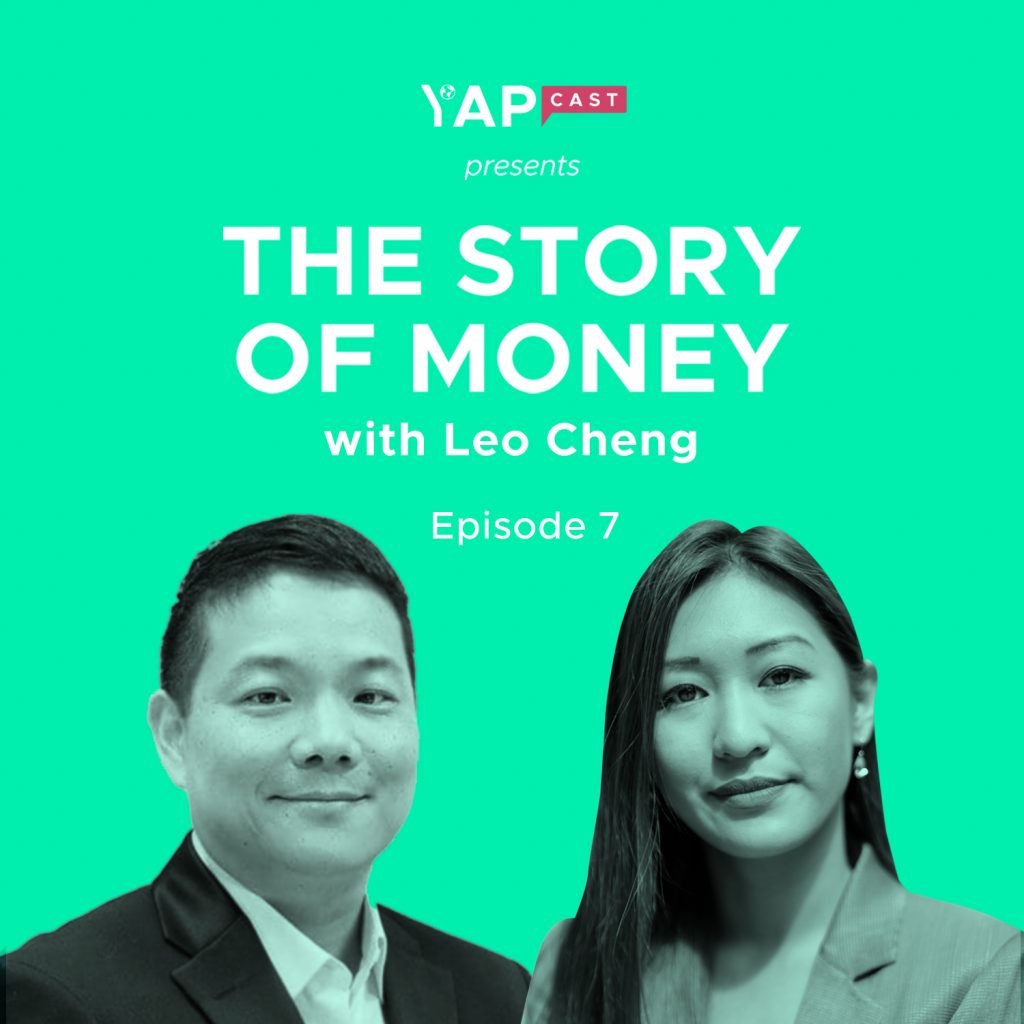
The Art of Borrowing and Lending Money (S1E7) Transcript
Samantha [00:06]: Hi, I’m Samantha Yap, and I help blockchain and cryptocurrency companies tell their stories. I’m really passionate about demystifying emerging technologies and making it easy to understand for everyone.
I’m embarking on this journey to discover the history of money, in order to better understand where money is heading today. In this series we’ll explore why Bitcoin, digital currencies and decentralised finance may play an important role in our future.
Come join me on The Story of Money, by YAP Cast.
Samantha [00:42]: So today we're going to talk about borrowing and lending. It's an uncomfortable topic. When we talk about not talking about money, it's usually because of this. We're told never to borrow stuff and not lend stuff. And yet we do it all the time, usually with strangers - a bank, for example. Our language shows just how uncomfortable we are with it. A lot of cultures make no distinction between the act of borrowing and lending. In languages both ancient and modern, there is often no distinction between borrow and lend. Chinese, German, Danish, Norwegian, Dutch, Estonian, Bulgarian, Serbian, Japanese, and many others each have but a single term for borrowing and lending. Even in vernacular English, borrow is sometimes used instead of lend. Can you borrow me a fiver, for example. There are lots of reasons why this might be the case but it's probably down to the way we can't really place a value on the act of lending. Is it okay to borrow a book? Yes, if it's already been read, but maybe we really liked the book, and like to have it around. And how do we ask for it back if the person forgets to return it? So should the person not just give the book back but pay something for its absence? And what about the risk of never seeing it again? Here we enter the world of interest, which is interesting, including why we use the same word for something so pleasant, and something so risky that it has added to the financial burdens of many. Charging interest is the oldest financial practice. But why would you charge someone interest - more money - when the only reason they're borrowing from you is that they have none to start with? Well, a loan can enable someone the opportunity to own a car, get on the property ladder, or grow a business, and that should come at a cost. The tricky part is to borrow from the right lenders and to stay away from the unauthorised lenders known as loan sharks, or engage in usury, those who lend money at unreasonably high interest rates. Wisdom literature is aware of the dangers of overreliance on debt. Proverbs 22:7 of the Bible says 'the borrower is slave to the lender'... That is, until debts are repaid. So should banks lend to people knowing they might have trouble repaying it? Should you even charge interest to those who need it? And who is morally and legally responsible for that? What about the subprime loans that led to the financial crisis of 2007? And what about lending to whole countries knowing that the next generation will have to pay it off? We hear a lot of talk about financial inclusion, of giving access to credit and other services to those denied them because of location, class or lack of financial infrastructure. But is that not just another way of building up more indebtedness? What I really want to find out here is how can technology help make borrowing and lending fairer, and, well, less fraught? To help answer this question, I'm excited to welcome Leo Cheng, Project Lead of CREAM Finance, a decentralised lending protocol.
Samantha [04:08]: So Leo, thank you so much for joining us on YAP Cast.
Leo [04:10]: Thanks for having me.
Samantha [04:12]: Really excited to have you on today to talk about borrowing and lending. Now, I've been raised with a very frugal and Asian mindset where my dad taught us to hoard money, you know, to have a bunch of cash is security and safety in a sense, and he always taught us not to be in debt, only maybe with student or housing debt. But he always said not to owe anyone money, even to the government. He was like, 'just pay off your loans as soon as you can'. So in essence, I was brought up with trying not to borrow so much money. So could you share a little bit about your take on borrowing and lending money? Is it good or bad to borrow money?
Leo [04:49]: I think it depends on how you're using it. But generally, if you're borrowing money in a responsible way, it can be good. And I think for the most part, if you aren't sure, then you probably would be better off not doing it. I think a good example of that would be when I think about back in college, some of my friends for the first time had a credit card and they were just saying, Yeah, I'll buy rounds for everybody, I'll go buy this expensive stereo system because it's there. And then you forget that your payments accrue and then the cost of the borrowing is super expensive. So I do think that people should be very much educated before they make these decisions. I think generally more acceptable scenarios of borrowing would include something like school loans where you're improving yourself or house debt or house loans, that you're responsibly leveraging your existing amount of money to finally get that dream house or the actually the first house, whatever the house or property may be.
Samantha [05:33]: Right. So, school loans and housing. Some people say getting a loan to buy a car is also not that good because once you get a car that depreciates, right?
Leo [05:42]: Yeah, I think that's true too. And also the cost of capital for borrowing against a car for that very reason that it's a depreciating asset, and tends to be worth less, I think back to some of the social media humblebrag of like, “Oh, I worked all my life”, and, “Over the last 10 years, I've been saving all my pennies. So I bought this really nice, beautiful Mercedes!”. It's like congratulations, but that's really not how you should be investing. And what would be worse is that you finally spent all that time in life working and eating ramen or whatever, just so that you can put the downpayment and borrow against a depreciating asset. So I think in terms of being smart, money managing for yourself, it would be super useful to think about what it is you're borrowing to leverage on. And you should be, from a smart financial standpoint, leveraging on something that is going to end up giving you more assets and more value later than something that's going down.
Samantha [06:26]: My dad taught us to save for a house first, then go on to maybe buy your fancy car later, right? We were always taught as well to live within our means. But living within our means is also kind of living with what we have. But right now, these days, a lot of people can't even put up a bunch of cash to buy a house. So they must borrow. So yeah, it's interesting when you think about that way, borrowing enables people to get that house or study, for example, because you need to study to qualify for certain jobs.
Leo [06:54]: Or start a business, right? So if you have a really good idea and you just need some startup capital, that might be an okay place to borrow. That, of course, would be a higher risk activity for something like a bank, because then we get into something that is collateralized or not collateralized. And that's why you hear these stories of entrepreneurs that may say, “Well, I put my house on the line and took out a loan to build my business”. But I think that's another place where if you believe in it, you have a good plan, I think borrowing might be okay. But of course, there are risks involved.
Samantha [07:21]: Right. So we've spoken a little bit about borrowing. Now, what's the benefit for people to lend their money? Usually, you might lend money to a friend if you trust them, you trust that they're gonna pay you back for a meal or for a night out, for example. But why do people lend money?
Leo [07:37]: I think it's a very basic idea of savings. So you can get for every $100 you put in, maybe hopefully get some money back in the future. In the lending scenario, I think it’s just to get yield. The more you can get back in that yield, the more money you have in the future. If you just stick your money into the regular bank savings account, you know, you might get very low rates, less than 0.1% or something like that. And then if you lock it up on a CD (certificate of deposits) for a certain amount of time, but maybe the trade off is if you have certain amount of money, and you lock it up for six months, for a year, or for five years, you might be getting these rates, like 1% or 1.2%, etc. But that's generally retail to banks. There's also peer-to-peer, lending trees, etc. services, where you can then get in these higher-risk activities, they tend not to be bank insured, etc, but you end up with more yield because you're taking on higher risk.
Samantha [08:25]: So yeah, so like a certificate of deposit, I think that's what they call it in the States, is like a fixed-term default posit in certain parts of the world. So my bank gives me that option where I can kind of lock it away, I might get a little bit more yield. Is interest kind of a similar thing?
Leo [08:38]: Yeah, yield sounds more complicated. Yeah. If you put money in a savings account, you earn some interest. It's the same thing.
Samantha [08:43]: Okay. So there is a benefit to lending money because you could earn more because that money could be used by someone else to pay for the student loan or buy a house, right? So we've talked a little bit about good and bad debt, why people borrow and lend money. Could you just talk through an experience where you've had to borrow money in the past, for example, and this is more real-world experience, like buying a house?
Leo [09:05]: Yeah, I've done the home loan. When I was in Los Angeles, I bought a small condo. it was quite painful actually, as a first time home buyer, you're trying to understand all the laws and say, you know, in California, you can do these things. And you can get these benefits. But then you have to read all these pages of disclosures and things and you have to go into the office, you have to show a bunch of ID, there are so many people involved. And because there are so many people involved, you gotta pay for so many different parties. Then there's also all kinds of hidden fees. And it's really hard to do and just took a long time on the home buying experience.
Samantha [09:34]: You were saying, yeah, you have to apply to get approval for a loan. That's not often easy, right? Because not everyone's loans get approved. When I bought my home, I had to put up 10%, which is actually quite generous. So I have to have that amount of cash, then I was able to borrow 90% of the home value. So this is what we call 'collateralized lending'. And the collateral is 10% that I put up and the home essentially, because if I can't pay back my loan, the bank will basically take ownership of the home. Could you explain what under collateralized lending is?
Leo [10:10]: Yeah, under collateralized lending or not collateralized at all would be something like your credit card, right? So you have this credit card, you have a credit limit, the bank looks at whatever reasons that they do and they say you have X amount you can spend a month. And then once you’ve spent that much then you can't spend any more, but you're allowed to carry balances from one month to the next one period to the next. But that's why the rates you're seeing for credit cards (if you get a good deal), you're looking at maybe 12%. If you get a normal average deal it’s like 16% or so. If your credit’s bad (in the U.S. anyway) it looks like 25% per annum in terms of your costs, which is very high compared to home loans - I think recently, probably depending on where we are in the world, 4% to 6%. If you're anything like Japan, where my brother lives, it's like 0.5%, which is generally a lot lower than the uncollateralized, unsecured loans on the credit card.
Samantha [10:56]: And let's talk about that a little bit. My dad also told me credit cards are not good, you know, because you don't want to be buying drinks for friends and then figuring out a month later that you can't pay that back. So what's your take on under-collateralization? Like, who is that for?
Leo [11:10]: I think that it's for the financial services that make money, that's what it's for. If you think of it from the standpoint where the best customer for a credit card company is actually one that carries a large debt load, doesn't ever default, but uses a large part of that credit limit in order to finance things they need or they don't need (that's not for us to decide) - but if they make good on that loan and they're paying back that 16%, then they're the best customers. Which is why I think if we're looking at current day credit score services, it's interesting to see that (at least in the U.S. anyway, with the FICO scores) you should have a good number of credit cards, and you should actually ideally, never close them so you have a longer credit history with more credit cards. It actually helps your credit if you have a larger borrow amount, but you always pay back and that establishes your profile as a good candidate for borrowing money. I don't think it's actually super intuitive though. I feel like that's kind of in the interest of measuring credit worthiness for the bank, but not actually showing how good you are at managing your finances. So the incentives are a bit skewed here.
Samantha [12:06]: You raise a good point. But then at the same time with credit cards, again, I've been taught to make sure you pay it off before the due date, because why pay interest? Or why pay additional fees when you should just live within your means, right? What happens to people who don't have a good job or salary and even just the cash to buy a home? I guess that's a situation for a lot of people where they can't borrow money, that there are people who are kind of locked out of borrowing money because they don't have this track record or this-
Leo [12:33]: Yeah, the system is definitely broken in some ways like that. As well as sometimes you hear about people who have money in a bank, but because they don't have a steady day job and they don't have steady income, they can't qualify for loans because they don't have a steady paycheck right? So that means that they're not credit worthy from the standpoint of, these folks don't have, by average normal definition, 'what a standard paycheck and a standard job looks like'. But when in fact they have very good credit worthiness but it’s just not being used here and it actually creates an inefficiency as well, where you have these people who have the assets to pay things but just don't fit exactly into that mould. I think if you expand that out more some people may say societally, there's problems where certain groups of people or certain behaviours they may be discriminated against based on who they are, what they do, or those kinds of things which are inherent in our system and not ideal.
Samantha [13:19]: Let's talk about Bitcoin and cryptocurrencies and programmable money. Now Bitcoin was established as a peer to peer cash system that's decentralised, and global. So Leo, in an easy to understand way, could you explain what programmable money is?
Leo [13:36]: Sure. So programmable money is pioneered by the invention of smart contracts, which was popularised by Vitalik Buterin's Ethereum. And Ethereum is currently the second largest cryptocurrency by market cap behind Bitcoin. So this notion of programmable money simply means that you can have behaviour like if you go into a bank, and you say that some amount of money put in equals some amount of money that we're gonna get as interest, you can guarantee that if this behaviour is programmed into the smart contract, that it’s going to happen in that way. So there's no humans involved, you can imagine a bunch of robots running this thing. And so the benefit here then, is transparency and automation, which means that you don't have to say, “Hey, you know, did this thing that not paid out?”, you got to call your bank, and you can see exactly when something happened, if it's happening, as opposed to the current system which is somewhat opaque.
Samantha [14:24]: So it's essentially like trusting the code like you and I, if we didn't know each other, we can essentially programme a contract, a deal, where if I offer you a service, and then once I complete it, that money will get released to me. Is that a better way of looking at it?
Leo [14:39]: Yeah. So basically, it's an If-Then Statement - if this happens, and then this other thing happens. So in your example, you would probably need some sort of data feed into the system to say, “Oh, did Sam complete this job? And if so, then this money gets sent”. So in that example, yeah, there's no middle person in there to complete the transaction because the smart contract is simply waiting - “I was told to do this one thing. And once that second condition is met, then the result is released”. So it's faster, it's cheaper, and it's more transparent.
Samantha [15:05]: So you're saying there's no one to also check your credit score? I mean, is there that system? Do they need to check whether you've got a good salary and credit score history? Does that apply in this world of programmable money?
Leo [15:18]: Yeah, so far, not quite yet. It doesn't really know or care who you are, how much you make on a monthly basis, or where you live or what language you speak. It just treats you and everybody else the same. So the benefit here largely is that it doesn't quite matter if you're lending out or borrowing $100 and that's all you have. That's all you own to your name, or if you have a bazillion dollars, the treatments are the same. You get the same payment terms, you get the same treatment, the same efficiency.
Samantha [15:43]: Right. As we speak right now, Leo is the Project Lead of CREAM Finance, which is a decentralised lending protocol. Now Leo, in a really easy to understand way, what is a decentralised lending protocol?
Leo [15:58]: Right. So, decentralised lending protocol in that there's no real central party. It's software that runs, so no bank, you don't need any bank approvals, no nation state really has the exact claim to come in and say, “Okay, we're doing this thing” - the whole thing runs autonomously. So I think about them as robots - they take your money. If you give them the money, and then they tell you “Okay, well, this is what you're gonna get”. The robot very smartly within the system then calculates the interest that you would receive. On the other side, if you're borrowing the robot says, “Okay, here's how much you can borrow based on how much you deposited”. And then when you do come back and return it, then everything gets squared off. But this is also where robot automation comes in. So the collateralization, I think, is important. In this case, much like a home loan, it's over collateralized. So it may be that for every $150 you deposited, you might get $100 of a credit line. And that's somewhat counterintuitive to a lot of people, like well, “Why would you put $150 in to borrow $100?”. But really, it's $150 worth of value to borrow $100 worth of something else. So you could think of this as - if we stick to the default world of currencies, you can say, “Well, if I put in $150, I might be able to borrow $100 worth of Japanese yen”, or something like that. And in which case, there are different types of currencies, but for us in the cryptocurrency world this is more applicable to Bitcoin and Ethereum and other variants of crypto assets.
Samantha [17:14]: Earlier we were talking about interest and yield, and how banks right now give us like 0.01%. Maybe if I locked my funds up for like 6 to 12 months, I might get 1% or 2%. We are talking right now in 2021, and the yields and the interest with this decentralised finance world, they're quite high, right? I mean, could you talk us through what the benefits are with putting your savings in this ‘machine’ you talk about?
Leo [17:45]: Right, I think that there are a few things going on here that's causing the interest rate to be higher. Certainly some of this is automation and other parts of it is fairly advanced usage. So the opportunity costs are different. So I think that people borrowing money have other things that they could do to make more money, therefore they can pay the supplier more money. But in terms of actual numbers this morning, when I took a look at our site, we're looking at roughly 5% - 8% annualised rate on the U.S. dollar basis. So comparing that to something like 0.1% or 0.05%, on an interest bearing account that you can move money out of any time versus like a savings account, or like a CD that may lock you up for a month or so at 0.1% or 0.2%, maybe if you're lucky. And that's a very, very big difference. And in this world of decentralised finance, not only can you access these interest rates that are higher, you could also enter and exit as you wish. So there are some transaction costs involved here with gas fees, etc. but if you have a large enough chunk of money, where you do want to pick up 5% or 6% for a week or so, you could put it in there for a week, you could take it out. You could put it in there for an hour, you could take it out. It's gonna do the math correctly. There is zero scenario of human error. There's no clerical error in the back end - somebody hits a button and then all sudden, it's gone. All of it is automated.
Samantha [18:53]: But that's pretty revolutionary. And I think to a lot of people it's a bit scary putting their money into a system where there's no number to call. So, Leo, with programmable money and with this decentralised lending protocol, can people lose their money? Because I know that with the bank, or fixed deposit, I guess I trust that, you know, HSBC is going to still have my money. But can I trust that my money in CREAM Finance will still be there?
Leo [19:18]: Yeah, I think it's a very good question for most people coming into the space to learn about. I think there are a few elements of risks that we should cover: One is just the self custody risk. If you’re really coming in from decentralised finance, using something like MetaMask to log in, people often don't understand exactly how it works. It's not exactly intuitive in today's setup. It is possible for people to end up making mistakes, but I think that's a general knowledge gap for anybody who's new to the space. So that's something to look after is how you manage your money, are you sending it to the right places, etc. And secondly would be the smart contracts potentially having an error or an exploit - so if an exploitation happens, and money can leave those bank accounts, at that point, that is a risk potentially. But to combat these risks, though, the industry does have insurance. Probably worth pointing out the fact that to date, no supplier that put money into decentralised finance lending protocols have ever experienced a situation where they couldn't get their money out. So there's never been a run on banks, there’s never been bank insolvency to this date. And I think with insurance coverage with good security practices, with a good understanding how you operate your wallet, these risks can be managed. I tell my friends sometimes, like, think about my mother, she's gonna want to call someone to reset her password, she's gonna want to call someone to ask questions. So she's probably not the best candidate to use decentralised finance directly. But I do think that there are other services that are more centralised versions of the crypto lending space that have these - BlockFi. Nexo, Celsius, etc, you can actually go to those services and you can have customer service calls.
Samantha [20:43]: So what Leo's mentioned there is the centralised crypto lending platforms, Nexo, Celsius, etc. So if you could give any advice for anyone who is not in the crypto space, just some practical steps, what should they do if they want to lend or earn some of that maybe 5% - 6% yield?
Leo [21:02]: Yeah, if you're adventurous enough to figure this out yourself, I think it's actually getting easier and easier to onboard into crypto globally. So I would say whatever amount of money you have in your savings account that you put into a locked deposit type of setting, you take some of that budget, and maybe just start off with 1% or 5% of that money. You take that out, you experiment with it. And the reason I say 1% - 5% is so that if you mess something up, it's not your life savings, it's not gonna hurt you tremendously. But if you do it successfully, the yield you're gonna get from that 5% of your money could potentially be equivalent to the other 95% of your money, depending on what vehicle you put it into. So at that point, it is what some people would like to say, an asymmetric bet, right - the amount of gains you're gonna get is potentially a lot greater than the losses you could potentially experience. But I think it's always good to read up on it, put the work into it, and not any more than you can lose, because this is a highly experimental realm. There are a lot less guardrails in place for this space so it's very important to make sure that you know what you're doing before you put any kind of significant investment in. But certainly, it's worth exploring, and I don't see how this is not the way of the future. So it would actually behoove you to jump in, learn about it and participate, not just for financial gains.
Samantha [22:11]: That is some really great advice. I think it really starts with learning. And for those who are willing to learn, I think it'll be an exciting journey. And as Leo says, we're still in an experimental phase with this. So we've talked about the current system of borrowing and lending today. And we've also talked about decentralised financial lending. Now how does decentralised financial lending solve the problems that the current systems have today? Where some people are actually shut out from borrowing money because they just don't qualify for a loan.
Leo [22:40]: I think the benefit of decentralised finance and what we're working on with CREAM Finance as a lending protocol is that we're very much blind to the people are coming in from the standpoint of who they are. Because I know, around the world, folks are being in some ways, unfortunately, discriminated. Whether it is because they don't have money, or they belong and they affiliate to groups that some circles don't like. And that causes a problem for them and impacts their ability to borrow, quite frankly. By decentralised finance being just permissionless by nature, anybody can come and interact with our smart contracts and get the exact same terms. It doesn't quite matter who they are, or how much assets or what school they went to, etc. None of that stuff matters. Whether it's a really really wealthy person with a small amount of money in or a poorer person with all their assets in, both parties would get the exact same terms, the exact same service and not be required to physically show up, present a bunch of documentation, etc. And it's a very drastic departure from how it's done today in the lending market. So I think in that sense, it levels the playing field, and in a little bit, allows for more opportunities for everybody.
Samantha [23:37]: Levelling the playing field, that's a really great point to end on. Leo, we've been on an awesome journey today, talking about borrowing and lending money, the systems today, to where it's heading in the future with this experimental programmable money. Thank you so much for joining us on YAP Cast.
Leo [23:51]: Thanks for having me.
Samantha [23:52]: Leo offers a glimpse of what borrowing and lending may look like in the future. In some ways, it seems logical that it becomes more decentralised and even more impersonal than our present system as a way to solve the problems of inequity. Why should the lending and borrowing of money be this fraught after all? If you can program money to do these things, not only does it become more efficient, but it also removes the discrimination inherent in our present systems. But decentralised finance is still daunting to use, and we're some ways off from making it easy and secure enough for even my grandma to do. But stay tuned and we'll be exploring how some of those gaps might be filled, bringing money back to the people.
If you'd like to watch my full length conversation with Leo Chang, head to the YAP Cast YouTube channel. I'm Samantha Yap, and you've been listening to the story of money by YAP Cast.