Does debt really deserve the negative connotations often associated with it?
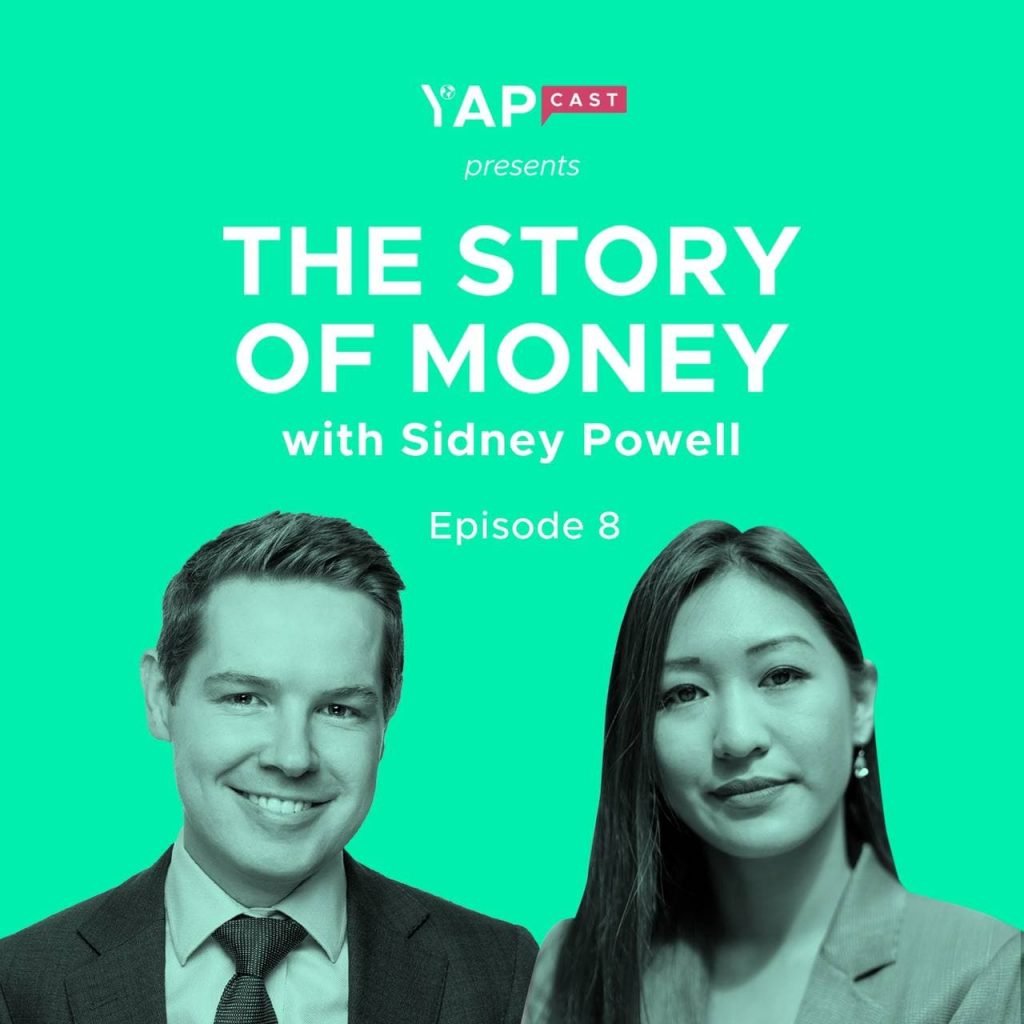
To answer this question, Samantha talks to Sidney Powell Co-Founder and CEO of Maple Finance, a decentralised institutional marketplace for borrowing and lending. They explore how the negative perceptions around debt came to be, and the ways those sentiments gradually began to change. Sid breaks down some powerful factors that help to differentiate between good and bad debt, and makes it easy to understand how debt can be harnessed as a tool for our benefit.
Join Samantha Yap on a quest to discover the history of money, to better understand why Bitcoin, cryptocurrencies and decentralised finance may play an important role in our future. She’ll take you on a 5-minute audio journey that touches on the history behind today’s topic, followed by the best parts of her conversation with this week’s guest, Sid Powell.
Sidney Powell is the CEO & Co-Founder of Maple Finance. Sid comes from a background in debt capital markets and institutional banking. During his career in traditional finance, he participated in $3b+ of corporate bond issuance, established and ran a $200m+ bond funding program, and managed Treasury at a commercial lending fintech company.
Episode Transcript
The Need For Debt (S1E8) Transcript
Samantha [00:06]: Hi, I’m Samantha Yap, and I help blockchain and cryptocurrency companies tell their stories. I’m really passionate about demystifying emerging technologies and making it easy to understand for everyone.
I’m embarking on this journey to discover the history of money, in order to better understand where money is heading today. In this series we’ll explore why Bitcoin, digital currencies and decentralised finance may play an important role in our future.
Come join me on The Story of Money, by YAP Cast.
Samantha [00:43]: Debt often has negative connotations associated with it. It’s not ideal to owe someone money, and paying off debts is a freeing act - this is generally understood, right? Well after this episode, your perspective on debt might change. Let’s first look to the people of Trobriand Islands, an archipelago off the east coast of Papua New Guinea. Not too far from our friends on Yap island. We can learn a thing or two about debt from their ocean-based exchange system called Kula in which island chiefs circulate possessions in the form of precious shell necklaces called (soulava) and shell bracelets called (mwali) from island to island. The shell necklaces travel clockwise around the geographic ring of islands while the bracelets travel anti-clockwise continuously stopping only when they meet a real, present need. The Kula exchange binds the tightly knit community together through debts of obligation because objects are always on the move. So what does this tell us about 'debt'? Well, in the case of the Trobriand Islanders, there's no such thing because all items, both practical and ceremonial, are in a permanent state of circulation. Like a step ladder or drill in a village which might constantly 'be borrowed.' This creates a bond between a community -- It may not be in the form of a gift, but it does assume we now have a [non-financial] relationship with one another. This is quite unlike most financial transactions, which are 'settled' on the spot -- because we assume some reciprocity. Borrowing and lending within the world of finance is, most times, a quite different transaction to the ones we make as related individuals, or within a community. Transactions that involve debt, similarly puts the borrower in a relationship with the lender - in the financial markets those relationships are often between unrelated individuals or parties who are not in the same community. And that might explain some of the discomfort we have with debt. But how does debt fit into the broader financial markets? What is debt and why would someone want to get into it? To answer these questions, I speak with Sidney Powell Co-Founder of Maple Finance, a decentralised institutional marketplace which enables trusted institutions to borrow and lend money.
Samantha [03:16]: Hey Sid, thank you so much for joining us on YAP Cast. Really excited to have you here.
Sid [03:20]: Thanks for having me, Sam. Really excited to be here.
Samantha [03:23]: You seem to be an expert on debt, you know, being the co-founder of Maple Finance, a decentralised institutional marketplace. Let's just touch on the basics of debt. What is debt to you?
Sid [03:36]: So to begin with, debt is, at its core, when you receive something now, which you have an obligation to repay later. So it's neither good nor bad. Debt in and of itself is just a tool, it can be used well, or it can be used poorly. So that's what debt is to me. A tool.
Samantha [03:49]: Right. And what do you know of the history of debt? Has it always been there? What do you know of that?
Sid [03:55]: So, the story of debt is as old as the Bible. If you look, one of the original sins was usury, which was money lending. So historically, debt was always viewed quite poorly. And this was because there was a fixed mindset that you have, if you will, the economy is a pie, and the pie was neither growing or shrinking. So if you had debt, which usually carried the obligation to pay interest, then that meant interest was in effect, the loss of the borrower and the gain of the lender. This all changed around the time of the Renaissance, when people for the first time started to have a positive view of the future. So in their minds, you could now have a bigger pie in the future, and therefore debt could be a good thing, because it could allow the baker to invest in expanding their business, and then they would be able to afford to pay the interest and repay the debt at a later point. So it's this shift in mindset towards a growth mindset, and away from a fixed mindset, which really catalysed a different view of debt as something which could enable opportunity and development and growth.
Samantha [04:58]: It’s interesting that you draw it back to how debt was in the Bible, because debt to some people is kind of regarded as a sin when you live above your means, and you can't pay back what you owe. So, it's really interesting that you view it that way. How do people kind of shift that perspective on it?
Sid [05:15]: Well, I think it all depends. So whether debt is good or bad, ultimately depends on what it's used for. And when I say useful, I mean what it's spent on. So, for example, if you have a person who has difficulty with impulse buying, then debt is not going to be a great tool for them, because it's going to be used for consumptive purposes. So you know, buying a new sweater, or let's say you want to spend it on gambling at the horse races, these would all be poor uses of debt, because they're going to unproductive purposes. But if you want to use debt to, say, purchase a new house, or buy tuition for a university degree, or to expand in a new shop front for your business, these would all be productive purposes, because they're going towards an investment in something in which you expect a greater return in the future. So, it ultimately comes down to the choice of what you spend that debt on as to whether it's good or bad.
Samantha [06:05]: Cool, that's really helpful that you've given us examples of good and bad debt in personal finances. Are there any other examples of good and bad debt when it comes to our personal spending?
Sid [06:16]: Yeah, so I think when it comes to personal spending, let's say that if you want to purchase a car, for example, because you want to buy a really expensive top of the line car. Well, that's probably a poor use of debt. But if you're somebody who needs to travel for work, and you're purchasing that car so that you can serve more customers, let's say you were a delivery driver, and you can now double the number of customers you can serve by getting a better car. That would be a positive use of debt in a personal sense.
Samantha [06:45]: Yeah, that's a good point. Maybe we'll go into paying the debt off.
Sid [06:48]: Yeah, that is a good point to draw. So where you use the debt to buy something which would generate cash flows that can pay that debt off over time, Well, that's actually quite a positive use of debt, provided you don't take out too much. So, let's say somebody uses the debt to purchase, you know, for their business, it's a baker and they purchase a new oven, well, the oven is revenue generating revenue for them, which they can use to pay off that debt over time. So you can see that it's actually a very productive use of debt, because at the end of the loan, they will have an oven that can produce more loaves of bread to expand their business, and they will have paid off that debt. Whereas if they used it to simply purchase a brand new Ferrari, in five years time, they still have the debt because the Ferrari is not paying it off. And the Ferrari is now worth less than when they purchased it, they've never effectively got nothing out of it.
Samantha [07:33]: Actually back to the baker example or businesses, I think it's about the balance of not borrowing too much. So making sure that you're borrowing enough to know that the revenue that you might be making can pay off that loan. How does one strike that balance? I mean, similar to a home loan, you need to have enough income to make sure you pay that off, how do we all strike the right balance?
Sid [07:57]: So, generally finding the right balance, there's a few rules of thumb. So if you're using debt for your business, you might look to cap the amount of debt that you take on at most, maybe three to five times what you would call operating income of your business. So in the case of a baker, they would limit the amount of debt to three to five times what they sell the loaves of bread for, less the cost of the flour that goes into making that bread. And therefore they know that it wouldn't take them too long to pay off that debt. So three to five times, they would expect they might be able to pay it off in three to five years then, versus, something that's going to be a debt that they're going to be saddled with for 10 to 20 years. Similarly, when people are taking on debt to buy a mortgage or a house. That's a longer term loan that is typically 20 to 30 years long. And so what they would look for is, they're taking on debt, that they can still make their regular household expenditures, and have a little bit left to save, and still pay the interest on that home loan. So that would be a reasonable amount of debt, if they find that they've taken out so much, they can no longer meet the interest payments of the debt, that would be a pretty good indicator that they've extended themselves beyond their means. And that's really what it's about, taking on only so much that you can improve either the quality of your business or the quality of your lifestyle through having a home. But not so much that you can no longer actually afford to service that debt.
Samantha [09:17]: I think that there's a principle coming from the Bible as well, where you've got to pay off your debts, and to be free, you got to be debt free. However, today there are millennials, even Gen Z today, they're going to graduate with student debt. And then they're going to spend a few years working in their first jobs, and then they're going to save enough to put a deposit down for their home loan. So it seems like they're going to be in this perpetual debt. Is this a part of life? Are we always going to be in debt? Should we strive to pay off all our debts but is that even possible? Could you explain a little bit about that?
Sid [09:52]: Yeah, so there's this binary idea that you're either saddled with a lot of debt or you need to get to the point where you have no debt. Having no debt is certainly having less obligations and it means that you're in a state of lower risk. But let's be clear, having debt does not mean you're insolvent. For example, Elon Musk famously took out several margin loans, which were backed by his equity holdings in Tesla and SpaceX to purchase houses. Now he had debt, but he was far from trouble financially. And this was because he made the decision that his equity in Tesla and SpaceX was going to be worth more in future or growing at a faster rate than the interest cost of his debt. Therefore, it made a lot of sense to take out debt now, rather than selling his productive assets, you know, the equity in Tesla and SpaceX. So what I would say to someone is that you don't need to necessarily be debt free, because having some debt does not mean you're insolvent provided that you still have an income that allows you to service that debt, and you have assets which are going to be worth more in the future. So I would say you don't need to completely eradicate debt. Now, that said, the problems facing a lot of Gen Z's and Millennials are that the cost of education has expanded precipitously. This means that, arguably, we're not actually getting value for money anymore when we pay for a degree. And we're needing to finance that degree with student loans. So this is the problem where we're now taking out debt to pay for something that's actually perhaps not necessarily increasing our human capital and our earning potential that much. The other thing is that because of zoning laws in a lot of areas, the single biggest purchase in most people's lives is the family home, right? And so, now, house prices have appreciated because zoning laws have been managed poorly, such that house prices have skyrocketed, and the supply of new housing has not kept up with the increase in demand. So, arguably now, two of the biggest expenditures that Gen Z and millennials will pay for in their lifetime, their degree, and their house are now costing more and delivering less value, and are increasingly needing to be financed with larger amounts of debt. So I would say that is a problem to be aware of.
Samantha [12:01]: That is a problem. So you said that they're in debt, and that debt is not generating enough human capital for them to grow from there. So would you say that's bad debt?
Syd [12:11]: I would say it's bad debt, I would say, on average, the average person who goes and gets a college degree and then enters the workforce, and then tries to purchase a house is probably getting a raw deal. They're probably over leveraging themselves. And the increasing human capital from the degree is not commensurate with the additional cost of paying for it, and how much it's gone up over the last 10 years. And a lot of them are paying a very large price for a house on the expectation that that is going to appreciate in value. So a house is viewed as both a really important lifestyle purchase, but also an investment to a lot of people. And I would say the fact that house prices have appreciated so much now means they're not likely to appreciate that much in the future. And so what people are doing in our generation, Sam, is that they are choosing to exit on both fronts. So they're choosing alternatives, like more entrepreneurialism, or alternatives to a university degree, like say, Lambda School, which teaches you how to code, and then you don't get saddled with upfront debt. Instead, you have a revenue share agreement, which only kicks in once you receive, you know, a job that pays over X dollars. The other thing is that people are choosing not to purchase a house. Increasingly, people of our generation are choosing to purchase Bitcoin or Ethereum or some other cryptocurrency, because in their perspective, it's likely to appreciate and deliver a better return than a house and it's liquid. So it's probably a better use of that capital.
Samantha [13:34]: Wow. So you just basically outlined the problem today. But again, what is the solution and the way out? Not everyone is entrepreneurial, I mean, sure, people can do a course and learn how to code but it's kind of also a chicken and egg thing, right? Because you need to get an education to be qualified to get a job to have that income to pay for your home. But yet, at the same time, I think something to add here is obviously the income hasn't increased. I mean, the salaries of graduates, for example, hasn't increased parallel to the increase in housing prices, for example.
Sid [14:08]: So the answer is what is the solution. So I would say, what happens is that pressure builds up within a system, and then it hits a release point. And so, an example would have been, as I mentioned, you have Lambda school, an alternative to a more formal education. And this is something that Peter Thiel famously tries to encourage with the Thiel Fellowship, where he gives people, Vitalik Buterin was a great example, a grant to instead of going to university, try and found something. Now, appreciating not everyone has that entrepreneurial streak. But there are increasingly accepted alternatives to the kind of credentialism of going to an Ivy League college and getting a degree. So for a lot of employers, an Ivy League education is a signalling effect, it shows that somebody has a moderate amount of intelligence, that they can motivate themselves to complete tasks. Now, if we are able to find alternative ways of signalling that or certifying that, then people will have access to lower cost alternatives, in terms of getting a job in the workforce, and not being saddled with monumental amounts of debt. Necessity is the mother of invention when it comes to other significant costs. People from your and my generation are likely to incur in our lifetimes like a house. You know, we are seeing other inventive solutions. I don't think anyone is there yet, but you're seeing alternatives like 3D printed houses and communal living options. So, I would say none of these solutions happens quickly. They're all things that evolve over time in response to pressures and needs.
Samantha [15:32]: I’m really enjoying this discussion, because I think it's really shifting perspectives. And also just like you were mentioning, the binary view of debt and how it is bad, we must pay it off. I mean, for example, I come from an Asian upbringing. And my father is always saying 'clear your debts!'. But then you can also see it work for good. Thanks for explaining that Sid, that was a really good explanation. Actually, It would be really great to actually learn about your background and how you are so informed about this, because maybe you want to also talk about your experience. You said that you had to update Excel spreadsheets and deal with debt in the actual system right now. If you want to expand on your background, please do.
Sid [16:10]: Yeah. So, prior to being in crypto, I came from a background in banking and finance. So I used to work in institutional banking in a very specialised area, which is called securitization. So, this is something that fuels home loan lending, car loan lending in the wider economy. And what it involved was effectively, we would help lending companies to raise debt through issuing bonds. And they would use that debt to give out home loans to mums and dads or car loans to mums and dads. The part that is called securitization, just refers to the fact that the loans would be used as collateral for those bonds, which meant that mums and dads would repay their home loans, that money would then go to repay the investors who had purchased those bonds. And those investors would be pension funds, superannuation funds, which is something very common in Australia, and other banks and asset managers. So, these were funds and asset managers who are investing retirement savings, for example, or parts of banks balance sheets, so when you deposit at a bank, part of that could have been used to fund the purchase of these bonds, which in turn funded home loans, so that's a sort of more simple explanation of what I was doing in banking. And then following that, I went to work at a commercial lending FinTech and I needed to set up a programme so that it could raise money through debt, to provide commercial equipment and finance to customers. So in my time in both companies, I observed that you have a lot of bottlenecks in financial markets, and that a lot of processes were being done in very manual ways mostly as you alluded to in spreadsheets, traded around in email inboxes. And then you would have third parties who collect fees for largely trading PDFs around. And so the cost ultimately gets passed on to the people who take out the home loan or the car loan. And it's a system in which it felt like time was moving a little bit slowly. So it hasn't changed a lot probably in 20 years, and it really hasn't evolved towards a kind of a global system. So you say global capital markets, but the idea of a global capital market was somebody calling up a colleague in another country and offering to sell them bonds or debt over the phone and confirming via emails. So it's not really 21st century technology when you think about it. And I think what this meant was that capital was really getting bottlenecked between countries, and also in these large institutions that moved very slowly. And the debt basically wasn't going to promote innovation in new industries and new areas. So as I started to learn more about the blockchain, I got to thinking, we have this global layer of infrastructure where we can programme financial contracts to shift and transfer money. Why couldn't we build a capital market on top of this brand new layer of infrastructure, and why couldn't that be global first? Why couldn't it promote economic opportunity in new cutting edge industries? So in my mind, really, blockchain is kind of the first proper FinTech. All FinTech prior to this was really just a fancy front end on systems that were built in the 80s and hasn't improved since then. Blockchain is really the first time that we've actually said “let's build a new system”.
Samantha [19:24]: Thanks for that whole overview. It seems like there's different forms of debt, you're just saying there's loans, there's bonds. But in the real world sense, with your experience at a bank and at a FinTech is literally PDFs and spreadsheets being shared around, and people bringing up the phone and talking to each other and trading them, which is not what people think when they think capital markets, they think money in a physical sense is moving around the world. But really, it's just spreadsheets. Sid, thank you so much for joining us on YAP Cast and giving us an overview on debt. I really hope that for those listening, that we've shifted your perspective on debt today. So, thank you Sid again for joining us on YAP Cast.
Sid [20:03]: You're very welcome, Sam. Thanks for having me on. It was great.
Samantha [20:06]: This new system built on blockchain technology that Sid talks about certainly seems to be the way the future of debt is heading. My perspective on debt has certainly changed after speaking with him. I like the reminder Sid makes that having debt doesn’t mean we’re insolvent. The debt we have just determines what level of risk we’re taking with our finances and what value we are really getting out of it. What I particularly look forward to delving into next with Sid is whether blockchain technology and decentralised finance really can fix the problem we have with debt today.
If you’d like to watch my full length conversation with Sidney Powell, head to the YAP Cast youtube channel. I’m Samantha Yap, and you’ve been listening to The Story Of Money, by YAP Cast.