Can DeFi Be The Better Financial System? (S1E12) Transcript
Listen on:
Apple
YouTube
Spotify
Samantha [00:06]: Hi, I’m Samantha Yap, and I help blockchain and cryptocurrency companies tell their stories. I’m really passionate about demystifying emerging technologies and making it easy to understand for everyone.
I’m embarking on this journey to discover the history of money, in order to better understand where money is heading today. In this series we’ll explore why Bitcoin, digital currencies, and decentralised finance may play an important role in our future.
Come join me on The Story of Money, by YAP Cast.
Who’s in Charge of the Money?
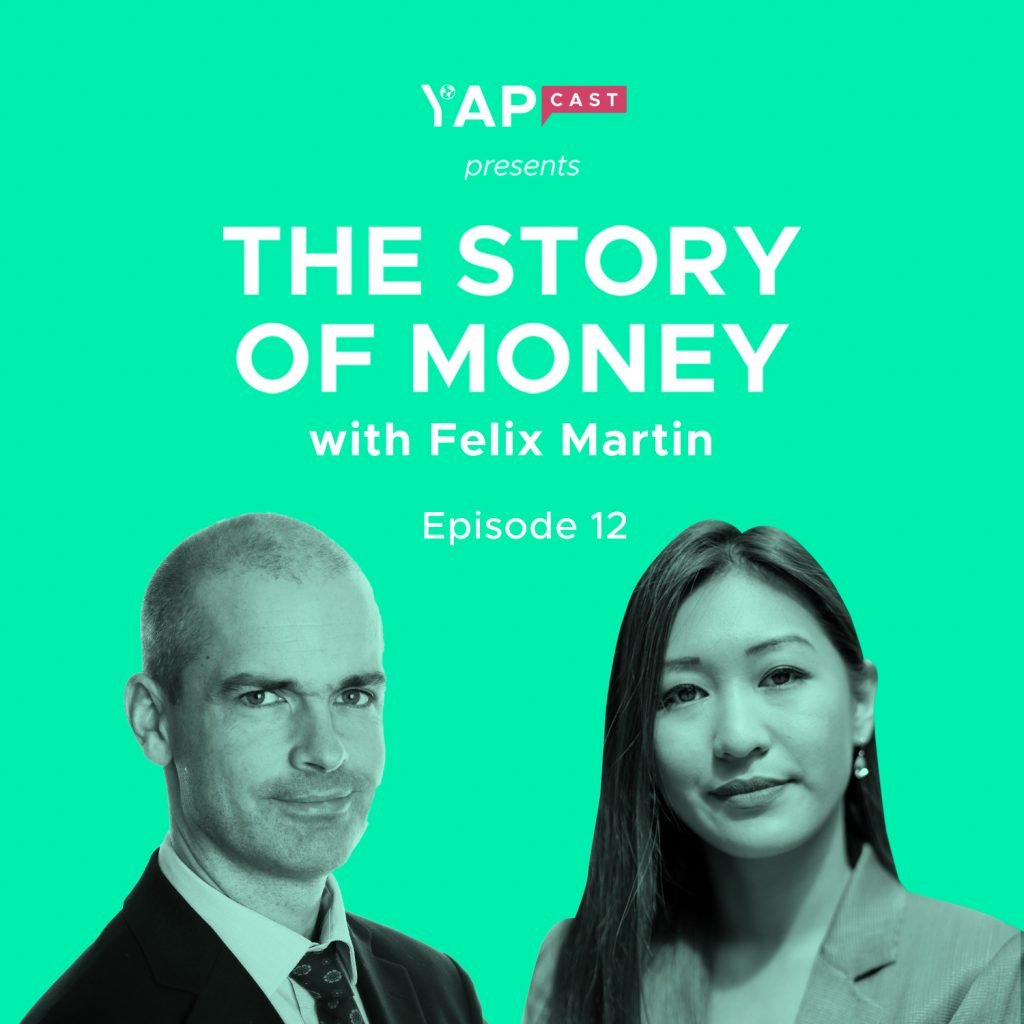
Samantha [00:42]: Felix Martin’s book, ‘Money: The Unauthorised Biography’, is a brilliantly written overview of the economic, historical, cultural, social, and anthropological aspects of money. In this book, Felix Martin challenges whether economists really know what money is, our philosophical views on money and the notion that thinking about money as a thing is not quite the way to think about it. The way it’s written is original, easy to read, and incredible just how he’s been able to cover so much of the origins and journey of money in sixteen chapters.
In his last chapter of the version of his book published in 2013, he recounts a conversation with his entrepreneur friend who sums up the ‘moral’ of the story of money. To fix problems in a system, naturally you write to the person in charge. But Felix arrives at the point where he says ‘the state is not society, so the state’s control over a monetary standard is never complete.’ So his friend asks, “Are you trying to tell me that there’s no point in my writing to the new governor of the Bank of England after all because he doesn’t actually control inflation and he’s not actually in charge of our money?” Felix responds by saying, “If he agrees that money is a social technology, then the conventional way of thinking about money as a thing is wrong. So, it’s no use writing to the experts.” So who should we write to? Well, Felix concludes that you are in charge of money. Yes, you and me. It will all come down to ourselves. So what does that really mean?
Samantha [2:21]: Well, while Felix ended his book on that note, I’m thrilled to invite him back on the show to see what he thinks about cryptocurrencies and Decentralised Finance - and perhaps to even prompt a sequel to his book. I also figured this is an excellent way to end this season about the story of money on YAP Cast. Felix began his career as an economist at the World Bank in Washington DC in 1998 working mostly on sovereign lending programmes and debt restructuring in eastern Europe. He holds degrees in classics, international relations, and economics including a Doctor of Philosophy in Economics from Oxford University.
Samantha [3:01]: Hi Felix, really excited to have you on YAP Cast today. Thanks so much for joining us.
Felix [3:06]: Thank you very much indeed for having me.
The Burden is on People Disrupting the System
Samantha [3:07]: You published your book in 2013. So maybe this is when it was all more unfolding. And, we're talking at a time where Bitcoin adoption has really grown. And crypto adoption has grown as well to more mainstream users. And you've got PayPal and other mainstream payments platforms really adopting it. You end your book by saying that ‘if anyone wants to reform the way money is working, we need to do it ourselves’, or, everyday people need to kind of play a part in it. What is your perception of where it's heading now with this technology?
Felix [3:38]: So what I mean by that is, that was just a sort of exhortation at a very general level, which is all I could do at the time - I can't do much better now. But it all comes back to that conflict we were describing earlier, which is a very, very ancient conflict between the sovereign and independent people, and wanting both to have control of this crucial technology. It's so germane to our societies and how they work. That's the very reason why on the one hand you can't have it captured by one group, and it's also the reason why everyone wants to have a say in it.
And when I said, ‘it's up to us, and you've got to get involved’, it's been really thrown into sharp relief by these technological developments in the wave of cryptocurrency and DeFi taking off. That really shows why people must get involved, because it's possible that 90% of these developments are complete flops and turned out to be nonsense. But it's also possible that the other 10% turn out to be genuinely very revolutionary and very disruptive of the current financial sector, and therefore the whole monetary system. And if that's the case, you must no more allow that to happen without the involvement of the people who are going to use it, than you should have allowed the financial system before 2008, just to be run by bankers for their own purposes.
Felix [4:55]: So it's really important. The technologists will remake the monetary system simply as they see fit. And unless there is participation of the people who are going to use this monetary system, in setting these rules for how much money is issued, and what technologies you use, and how accessible they are for different people, and so on, it will end in tears - of that I'm certain. Of course, that's a very general statement. The question is how to do it.
Now again, I'm going to be the boring old conservative now and stand up for the current monetary system and say, ‘look, it may have many flaws and failings, but in a country like Britain, at least in principle, it is subject to democratic governance, right?’ We have a parliament, and the parliament appoints the Chancellor of the Exchequer, and Chancellor of the Exchequer sets the high level rules, which the Bank of England is responsible for implementing when it comes to the monetary standard - how much money is issued, which banks get licences, and so on, so forth. So, it may be very very roundabout. It certainly has not worked perfectly, that's pretty obvious over the last 10-20 years, but you can trace the way whereby people get to set the monetary standard, get to set the rules of the game in the monetary system.
Felix [6:05]: I’m always advocating that they should be more active, and that it should be done better, but it does exist, you can see how it's meant to work. So the burden is on people who are trying to disrupt this system to show how that same thing would work. Of course, there are answers to that question. You, yourself mentioned earlier on, one of the main philosophical premises of the cryptocurrency movement is precisely that has to do with this. It basically says, ‘look, what you were just describing, Felix, is all so corrupt, that it's useless. Therefore, we've come up with another way of doing things, whereby it's all essentially hardcoded in Bitcoin.’ Now unfortunately, on further examination, that begs the question, what have you hardcoded? Why did you hardcode this thing and not something else? How do you know that what you've hardcoded will suit the majority of people?
There's another school of thought, which we haven't talked about yet, which essentially has to do with a sort of utopian idea that you could replace the people on the monetary policy committee, who after all are sitting there, reading the incoming data on what's going on in the economy, churning it through their minds and chatting it through all the theories they learned or didn't learn in their economics courses at university and coming out with a decision on monetary policy on interest rates on how much money should be issued. There's another utopian school of thought which says, ‘well, that's all very old fashioned and silly, we can replace this strange committee with an algorithm. We can programme this. We can automate it. So that all the information is fed in much more efficiently using some sort of neural network machine learning process.
Felix [7:35]: We have an artificial intelligence, which absorbs all the same kind of data and more, and it comes out with rules for the creation of money in the setting of interest rates and so on, which of course, will be much more accurate and sensible than the ones which the monetary policy committee came out with.’ This is the idea of not having a set rule. It's the idea of having an automated algorithmic monetary policy. Again, it sounds good, but let me tell you, there are many questions that are begged by this picture as to whether it would work. The idea of a self regulating market mechanism, again, is something very, very old in monetary theory. Throughout monetary history, there have been people who have thought you don't need to apply any kind of control or authority from above to a monetary system, you can simply allow it to run itself. And these hopes have always been disappointed in the past.
Samantha [8:20]: That's a good way of looking at it. I think something that we've seen over the last year is that the decentralised finance industry has grown quite rapidly. Before crypto was like a pool of people, and it's still very well is. It’s a community of people, but it's decentralised. There's a global community that is now seeing more value in crypto. Is it as big as the banking system yet? No. However, the decentralised finance industry has grown from a market size of 500 million dollars in January 2020. And now with the Ethereum price and Bitcoin price going up, the total value locked is now at 170 billion dollars the last I checked, and so the space has grown quite rapidly. You're seeing a move of traditional financial leaders going to DeFi like a movement. They call it ‘TradFi to DeFi’. Do you see another war happening or the same battle you just described, but in a different form?
Felix [9:12]: I think that, ultimately, the battle, which I was describing, is drawing a distinction earlier between new technologies for recording monetary balances, for recording value, for transferring value between people, and so on. That's the new technologies aspect if we want to summarise it. That's distributed ledgers, that's blockchain - that's that kind of thing. Which by the way in principle, does nothing to stop those technologies being used with national sovereign monies. There's nothing to prevent a world coming into being in which blockchains and distributed ledgers are widely used, but just with national currencies. So, there's a distinction between that, the technology part of it which facilitates DeFi, crypto, and so on, and private monetary units which is what most people really think of when they think about crypto. They're thinking about Bitcoin, Dogecoin and Litecoin, and so on, so forth. Now, those are all private monetary units. Private in the sense, I stress, that they are not state monies.
The history, the great conflict, and the great compromise is really to do with that second aspect. It's to do with the difference between nationally determined monetary units and privately determined monetary units and how they get managed. The reason why that's such a contentious question throughout monetary history, and will remain so until the end of time, is that in a system which operates with credit and debt, the changing value of those units has enormous distributional consequences. If I run up an enormous debt of three million pounds to you, but in a year's time, the unit, the pound, is worth nothing, that's great for me and it's terrible for you. That is the root of it, what that is all about. And so, you go back through history, and it was always in the interest of sovereigns to inflate away the value of the currency because they'd run up huge debts buying luxuries or waging wars or whatever. And that's why private merchants got sick of it and fed up with it, because they were the creditors at the end of that.
Felix [11:04]: So that's where all the contentious part of it lies. And it will continue to be contentious. I noticed Ray Dalio only yesterday was saying, ‘You know, crypto’s great, I love Bitcoin. But on the other hand, when it gets big, it's going to get squashed by the regulators.’ It's become a commonplace thing to say but of course it's true, because that contention is not going to go away. There is a further issue about how easy it will be for regulation to be applied in these cases. That's of course one of the crucial arguments and in true innovations because it's tied to cryptography. The advocates of these new private monies would say that it will be very difficult to regulate them and that's different from previous incarnations of private money, but that part of it is not going to go away and the overall dimensions of what's going to happen. I don't think it will come as a great surprise to you, you know the regulators will try and squash these things.
Samantha [11:54]: Yeah, and you touched on a good point though, because Uniswap is one of the largest decentralised exchanges. And there is the SEC, they've got a case against Uniswap Labs, the central entity that's running the interface. But they say they can probably shut that down, maybe deal with them, but it wouldn't shut the whole system down, which right now has at least $5 billion total value locked in. No government or regulator can shut down that exchange.
Felix [12:18]: Exactly. And this is going to be an interesting experiment because, like I said, this is the first time we've lived in this era where this can all be completely international. It's the republic of the internet, it's not the republic of any particular country. But when you think about the denouement of this conflict, typically throughout history, let's take the most recent example, in 2008, these banks went mad and created all this shadow money in the shadow banking system outside the regulated banking system. And then there was this gigantic moral hazard. That's what actually caused the crisis. It was that governments could not allow this thing to collapse on its own because they were so worried that it would blow back into the real economy. So, the question one should be asking is - how is that going to play out? Let's imagine that the cryptocurrency space becomes not a couple of 100 billion, but a couple of trillion. Is that kind of blowback possible? That's one thing. I think you'd have a hard time making the case at present, that the connections between crypto transactions and the real economy are all that significant. They may be significant in some small sectors, but difficult to say there. And in fact, many of the advocates of cryptocurrency correctly say at the moment, this is a good aspect of it. They say, ‘Look, Bitcoin collapsed. It was $60,000 down to $40,000. And you see, there wasn't a crisis, and that's great. That shows you there's no moral hazard here.’
But, one question is, what kind of blowback could there be? At the moment, probably not very much, but who knows if it gets to 2 trillion. But for moral hazard to operate, there has to be an incentive for the government to step in. And the reason why in a traditional banking crisis that happens is that you're dealing with your own jurisdiction. You're dealing with the creation of a lot of ‘funny money’, and then its collapse, within your own jurisdiction. You're dealing with the economic consequences. Therefore you, the government, will suffer the political consequences of this happening. Now, those distinctions one assumes will be somewhat erased given the international nature of cryptocurrencies. So, the moral hazard may not be there to convince governments to step in and bail their people out.
Should DeFi Embrace Regulation?
Samantha [14:10]: So, my question to you is, should the world of DeFi, an alternative finance with this new technology, embrace regulation, reject it, or preempt it? What should they do? These are run on decentralised, autonomous organisations and that's what these decentralised finance protocols are - they are DAOs.
Felix [14:29]: That's right. Well, I don't know the answer, so this is all just supposition on my part. I wouldn't dare to try and tell the very innovative technologists who are actually going about creating this new system. One should not do any of this down, it is quite incredible what's going on. These people are actually doing this stuff and creating. It's not my place to tell them what's going to happen, but what I would say is that I would be surprised if you didn't see the same kinds of disagreements or the same kinds of parties emerge amongst those people, exist in the conventional financial system. That is to say, there will be people who are the real ideologues who believe in what I was describing earlier, this utopian idea that markets are self-regulating. Indeed, they would say political systems perhaps are self-regulating. These people are genuine anarchists or libertarians, however you want to call it. ‘You do not need any government to run a political system. You do not need any regulation to run a financial system. Markets operate very well, they are the ultimate sort of algorithm which will produce an efficient and equitable result and so on.’
There will be people like that, they exist, and they believe that if you can, if you have the technology which can set up the rules in a way which cannot be tampered with, this will result in a satisfactory equilibrium outcome. But I predict that there will also be people who don't agree. And this disagreement, I hasten to add, is not about technology, it's about political philosophy. That's the crucial thing. And they will say, ‘No, you do have to have some sort of authority in place, whether it's despotic authority, or democratic or whatever it is, but you have to have some authority in place to govern politics. You have to have some authority in place to govern markets, otherwise you don't end up with good results.’ And then there will be a great debate amongst these people. Well, how do you implement such an authority? Do you mean a discretionary authority and how's it going to work? So this is what I would expect to happen, but I can't really be much more precise than that.
Samantha [16:17]: Yeah, it's still very early days as you said. Even the price of a Bitcoin is very volatile. And even in DeFi, for example, I'm sure you've noticed there's this 640 million theft of Poly Network that happened not long ago, and that led to a manhunt by proponents of investors or participants of the system, which in turn led to the return of most of the assets. I guess because the community right now is still small, they all kind of know one another. So this also suggests that there are some shared values that help bind the stakeholders together and almost deter or reverse fraud. But that might just be either a strength of a system, or it might just be the people or a rare occasion. What do you make of that?
Payment Risks: Credit Risk and Settlement Risk
Felix [17:00]: That's an important point because, again, traditionally the way that private money used to work. Like I said, private money is as old as money itself. It's not that sovereign money has already always been dominant, private money is as old as money itself but traditionally, the way the private monies have operated is precisely amongst groups of like-minded people. Those groups have tended to be fairly small throughout history, simply because the technologies which enabled all of this were not conducive to very large networks of people like they are today. Today, they are conducive to large, certainly geographically spaced networks of people. There's a question of how large they can get in terms of numbers without losing cohesiveness, but where are these limits being tested? Well, they're being tested on discord. That's where such limits are being tested these days because those are the technologies which are allowing large groups of people to gather around some kind of ideal. So that's always been a crucial feature of them.
Again, this comes to the question of whether these new technologies represent some sort of qualitative change in the ability of very large groups of people to come together. And it all comes back to what you mentioned at the beginning - trust. I'm a little bit skeptical about that because I think often there's a big confusion between these various different kinds of trusts, which are needed in running a financial system. And remember that although we've been talking about DeFi, all this kind of stuff started from payments. Now payments come with various risks, and the main risk in payments is what's called settlement risk. Now, this is not about me lending you lots of money, and then you going off and doing something with it and me trusting you that your project is going to work and you'll be able to pay me back. That's what we call proper credit risk.
Felix [18:35]: The risk inherent in payments is much, much shorter term. And it's really just I'm going to pay you, but the money is in transit for one day, and during that day, it's going to be sitting with JP Morgan, and there is a very tiny risk that JP Morgan might go bust on that day and then you won't receive your money. It's not even about whether I'm going to be good for my promise to send you the money. It's that something might go wrong in the plumbing between me and you. The first example I gave you is about credit risk. That's about you having to trust some entrepreneur who's going off to do a project. That's the fundamentals of a capitalist economy. I do not believe that, as far as I'm aware, DeFi, distributed ledgers, blockchain, and everything else mitigate that risk. That is a fundamental risk in capitalism which you cannot defray by any kind of clever cryptography. And now the second kind of risk, which is settlement risk, that's really what has been attacked and addressed through these new technologies. And the jury is out perhaps on how effective it is. But it looks reasonably effective.
Lender of Last Resort in DeFi
Samantha [19:34]: And on the credit question because you're saying, yes, that's something that maybe DeFi and cryptocurrency can’t mitigate. But what if there are pools of money that can be the lender of last resort as you said? Because there's 170 billion now, could be a trillion. And that's just a pool of decentralised money. That's like the money in the world can be that lender of last resort whenever anyone needs it.
Felix [19:55]: One would have to go into the details of exactly what you're getting at there. But in finance, all the things which are really good are also the things which are really bad. So the thing that's really bad about central banks, according to the advocates of crypto, is that they can print as much money as they like whenever they like. That's obviously bad because they’ll just go crazy and start printing for their own purposes. Of course, that's also what's good about the system because what it means is you don't have to run the system with tremendous redundancy. You don't have to somehow accumulate hundreds of billions of dollars of savings to serve as a buffer in case things go wrong and you need a lender of last resort. This is not required. I can assure you in the Bank of England, there is not a huge store of money sitting there waiting to be used by the lender of last resort. That's not how it works. The fact is when we get into a crisis, because people trust those institutions, they can conjure it up out of thin air.
That's all it is - being a lender of last resort, injecting liquidity into the system is simply putting a lot of numbers in a digital ledger on the authority and legitimacy of these institutions. That's what it is, it's a metric. It's a barometer for the legitimacy of the state in those circumstances. So it’s both what's great about the system if you believe that the state is legitimate and deserves to be trusted, and it's what's awful about the system if you think that the state is just a bunch of carpetbaggers and so on. And you can say that all the way down through the system, it's the same with the banking system itself. ‘Isn't it awful? Can you believe that we live in a system where these executives, at JPMorgan in Manhattan can just invent money. I mean, they can literally just make loans out of thin air to whoever they like, isn't that outrageous?’
Felix [21:34]: Well, yes, maybe. But on the other hand, that's exactly why the system is so flexible and can licence entrepreneurs to go and do whatever they like without having to accumulate lots of savings. We don’t live in a sort of primitive pre-financial economy before we rediscovered banking, first discovered by the Romans. It doesn't work like that anymore, that's the miracle of banking. So it's both what's great about it, and what's disastrous about it. And the disagreements between people, draw it in primary colours - crypto enthusiasts on the one hand and conventional bankers on the other- they all come down to differences of essentially political philosophy or certainly philosophical differences about whether these things are really good or bad and which of these things dominate.
Where is DeFi Heading?
Samantha [22:14]: Cool, and just one final question just to wrap up. What's your view? Yes, there's the conventional bankers and there's the crypto enthusiasts. Where do you see this heading? Where do you see decentralised finance heading? It seems like you want to learn more and there are people who do see the promise of it. Right now, the market’s not really reflecting the maturity of it yet.
Felix [22:30]: Don't get me wrong. I think these technological developments are extremely exciting. I have a great deal of sympathy, just by personality and philosophically with the people who are behind these developments. But what I would say is that, and I say this, as someone who is obsessed with money and finance, that I'm grateful that the place where these technologies are first being applied, where they have come to fruition initially is in money and finance, because I understand a bit about that. But I don't believe that that's actually going to be the ultimate place where they have their real impact, I think the impact will be much broader. And the impact is much more broadly political in particular.
I'll say this in closing - To me, it's no accident that these technologies came along at a time when first of all, people were thoroughly fed up with the financial system after 2008. This was a way out of it, but that's just one part of it because they've also come along at a time when people believe that their political systems, at least in the West, are very sick. And they've lost a lot of trust in conventional political institutions, not just financial institutions. And the potential for some of these technologies to contribute to the solutions to that problem, I think are in the end going to be much larger than just contributing to the problems in the financial sector. So that's why I think it's really very, very exciting. All of these developments in cryptography and decentralised ways of doing things.
Samantha [23:49]: And that is a really great way to end this podcast. Thank you so much, Felix Martin, for your time. Really looking forward to continuing this conversation with you over time. Thanks, Felix.
Felix [24:00]: Thank you.
Samantha [24:01]: And there you have it from Felix Martin, an expert on money and finance who has spent years studying the history of it saying that it’s no accident that these technologies have come along when people were fed up with the current financial system. As we wrap up this season of The Story of Money, I am left with more questions about where we are heading with money. Will the so-called trustless nature of decentralised finance really work because we need to trust code which we don’t understand. And it’s not like we understand the current banking system either right? - But we still trust it. How likely is Felix’s idea that the disagreements that will emerge in the DeFi landscape might undermine or damage the process or make it stronger? And then there’s the question of regulation - how much of DeFi can be regulated without destroying the promise of DeFi itself, or should it be regulated at all?
This journey of the Story of Money will continue, but for now, I hope your perspective on money has shifted thanks to the wide range of experts I spoke to on YAP Cast. Mine certainly has, I started this season with little idea about money itself and where it came from, and now see money as a concept and a social construct. I have come to the realisation that we really need to look at and learn about the way society thinks about money, to understand where it’s heading.
If you’d like to watch my full-length conversation with Felix Martin, head to the YAP Cast YouTube channel. I’m Samantha Yap, and you’ve been listening to The Story Of Money, by YAP Cast.